The Gentlemen ransomware operation has put Nvidia on its leak site with a countdown to 28 November, but has so far published nothing to back up the claim. Nvidia says it is looking into a possible incident at one of its third-party partners and has found no sign that its own systems or networks were touched.
What happened
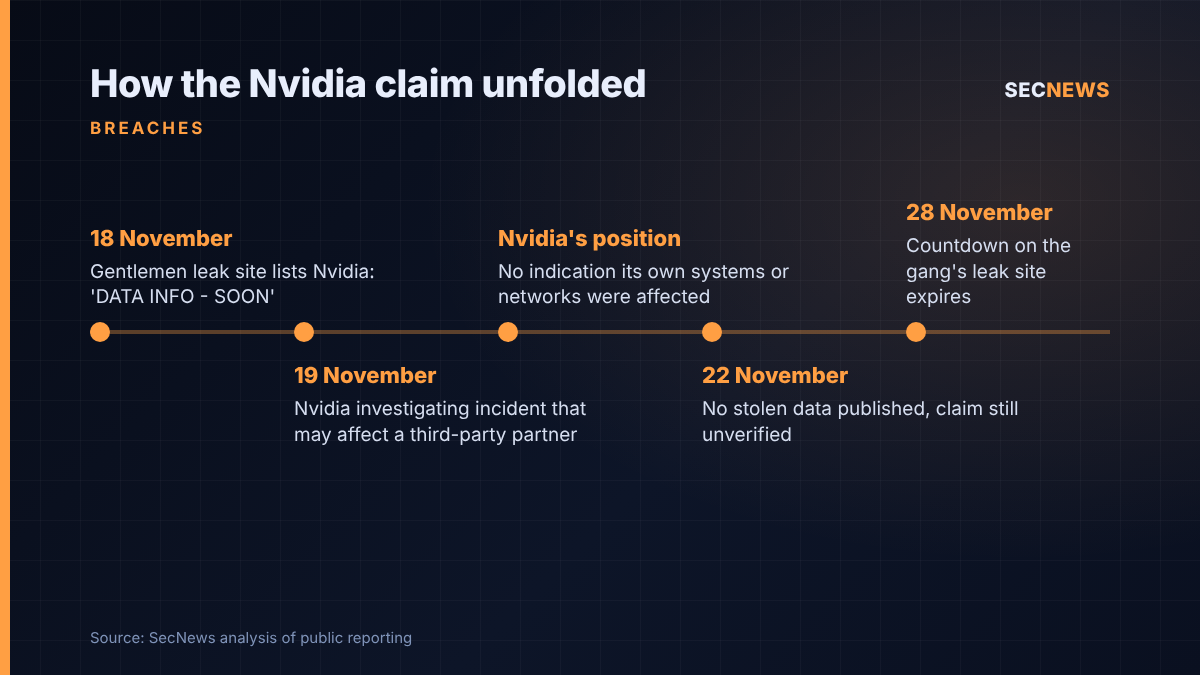
On Wednesday 18 November 2026 Nvidia appeared on the data leak blog run by affiliates of The Gentlemen, one of the busiest ransomware-as-a-service operations of the past eighteen months. According to The Register, the entry carried little more than the company’s name, its logo and the words “DATA INFO – SOON”, alongside a timer counting down to 28 November. BleepingComputer, SecurityWeek and Cybernews all report the same picture: no file listing, no sample documents, no description of which part of the business was supposedly hit and no indication of how much data was taken.
Nvidia responded on 19 November with a short statement given to several outlets. The company said its inquiry centres on a possible incident at an outside partner, and added: “We have found no indication that Nvidia systems or networks were affected.” It said it would keep monitoring the situation. It has not named the partner, described what that partner does for it, or said whether any Nvidia information could be in the partner’s environment.
At the time of writing, on the morning of 22 November, I have found no confirmed update from Nvidia and no reliable report that the gang has published any data. None of the outlets covering the story has been able to verify the claim. One Cybernews researcher, Aras Nazarovas, suggested caution, saying the listing would probably turn out to be “misattributed data, or a small, relatively inconsequential breach”.
The detail
The Gentlemen surfaced in mid-2025 as a closed group and later opened an affiliate programme. SecurityWeek reports that Microsoft tracks the operation as Storm-2697. BleepingComputer reports that affiliates are offered up to 90% of ransom proceeds. The model is classic double extortion: steal data, encrypt systems where possible, then threaten publication to force payment.
The group’s scale is hard to pin down, and the figures vary by source. SecurityWeek and BleepingComputer put the leak site tally at more than 1,100 alleged victims. The Register cites Check Point researchers who, during an incident response case, got into a live command-and-control server used by one affiliate and found telemetry referring to more than 1,570 victims, mostly corporate environments in the United States. Trellix’s operational technology report, published on 18 November, found that industrial ransomware claims rose by almost 51% on the previous quarter to roughly 1,500 posts, and that Gentlemen affiliates were responsible for about 16% of them.
Sophos, quoted by SecurityWeek, has seen affiliates rely on compromised credentials and legitimate administration tools, and in one case push ransomware out less than 24 hours after the first post-compromise activity it could identify.
The Register also notes that the group claimed more than 320 victims as of April 2026. Listing a household name with a timer but no proof is a recognised pressure tactic, and sometimes simply bluster.
Nvidia’s wording is worth reading closely. Saying that its own systems and networks show no sign of compromise does not rule out Nvidia data sitting with a supplier, integrator or service provider. The company has been here before: BleepingComputer notes that in May 2026 it confirmed that some GeForce NOW users in Armenia were exposed after a regional partner was hacked, while stating that its own network was unaffected.
Why it matters for UK organisations
Few UK organisations will be directly affected by whatever happened here, but the shape of the incident is one that UK security teams deal with constantly. The attacker names the brand. The breach, if real, sits with a supplier. The named company can truthfully say its own estate is clean while its data may still be in criminal hands.
For UK users of Nvidia hardware, drivers or cloud services, the practical exposure is limited for now: there is no advisory, no tampered software and no sign of stolen customer credentials.
The Trellix figures are also relevant to the UK. The UK has a substantial manufacturing and engineering base, and Trellix found The Gentlemen’s affiliates were the most prolific posters of industrial claims last quarter. A UK manufacturer does not need to be Nvidia-sized to attract this group’s attention.
Under UK GDPR, the duty to assess and, where needed, report a personal data breach to the ICO within 72 hours still applies when the data was lost through a processor. If an affected supplier holds personal data on your behalf, its incident is your problem as well.
Expert view
In my experience the first 48 hours after a leak site listing are when organisations make their worst decisions. Some rush out a flat denial; others say nothing at all. Nvidia’s statement is a reasonable middle course: it confirms an investigation, scopes the denial tightly to its own infrastructure and leaves room for whatever the partner investigation finds.
When we test supply chain resilience, the weakest point is rarely the contract. It is the inventory. Many organisations cannot quickly say which third parties hold copies of their source code, design files, customer exports or staff records, so they cannot work out what a supplier breach means for them. A countdown timer is a poor moment to start building that list.
Leak sites are marketing tools: some listings reflect serious intrusions, some recycle old data and some are pure intimidation. The right response is disciplined verification, not panic or dismissal.
What to do now
- Map who holds your data. Keep a current register of suppliers, integrators and managed service providers holding sensitive data or remote access, and what each holds.
- Prepare a leak site playbook. Agree in advance who verifies a claim, who speaks publicly, how legal and the ICO decision are handled, and how you engage suppliers. Rehearse it.
- Harden supplier access. Enforce multi-factor authentication on every third-party account, limit standing privileges and remove dormant accounts. This maps directly to the Cyber Essentials user access control requirement.
- Watch for credential abuse and admin tooling. Given affiliates’ reliance on stolen credentials and legitimate tools, alert on unusual remote management software, new administrative accounts and bulk data transfers to unfamiliar destinations.
- Keep secure configuration and patching tight. Exposed remote access services remain a common way in; Cyber Essentials secure configuration and security update management controls cover the basics.
- Test offline recovery. Assume encryption is possible even when the story starts as data theft, and prove you can restore critical systems from isolated backups.
Bottom line
Right now there is a leak site entry with no evidence behind it and a vendor statement that rules out compromise of Nvidia’s own systems but not a partner’s. That could change when the 28 November deadline passes, and it is worth watching. For UK organisations the useful takeaway is not about Nvidia at all. It is about knowing which suppliers hold your data, and having a tested plan for the day a gang puts your name on its blog because of one of them.