Attackers sat inside three AI inference providers, one of them since mid-July, and copied customer prompts, including requests marked Zero Data Retention. OpenRouter has now removed three providers and stripped 125 endpoints of their privacy status, so secrets sent in prompts routed through affected hosts should be treated as exposed.
What happened
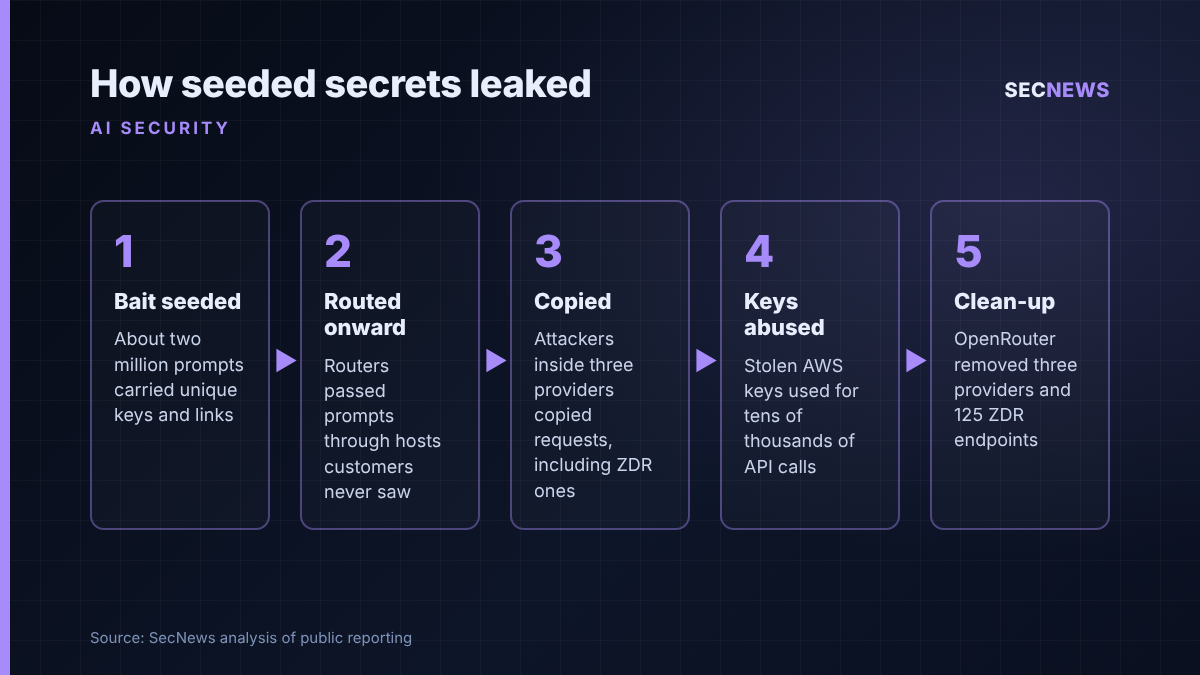
Between July and November 2026, HD Moore, chief research officer at Dragos, sent roughly two million prompts to popular AI services, each carrying unique bait: AWS keys tied to empty, fully logged accounts, DNS names, web links and logins for servers that existed only to be watched. Any use of a secret meant someone had read the prompt carrying it.
Dragos says data from at least three AI hosting providers was stolen by attackers. None of the three knew until Dragos told them, and the earliest intrusion goes back to mid-July. Separately, sellers on an inference marketplace were logging and reading customer prompts, and a Chinese AI lab, which Dragos does not name, fetched secret links from over half the prompts Dragos sent to its models, including about two-thirds of those flagged “no data collection” or Zero Data Retention (ZDR).
The new development this weekend is the response. OpenRouter, a gateway that routes customers’ API calls to a pool of third-party model hosts, said in an incident announcement, reported by The Hacker News, that it had removed three providers from its platform, taken 125 endpoints off its ZDR-eligible list and notified every customer who may have been affected. It says its own systems were not breached. According to a customer email quoted in a Hacker News forum thread and reported by StartupFortune, OpenRouter told some users that prompts sent to MiniMax models, including via forwarding providers AtlasCloud, Novita and StreamLake, could have been seen by an outside party, and advised them to rotate any secrets those prompts contained.
Three providers have published their own notices. Phala says an attacker controlled one of its inference servers and could see request data until it was contained on 8 November. Together AI says a credential committed to its public GitHub repository by an AI coding agent let someone download stored prompt samples from June and July. Novita says a routing configuration error sent some MiniMax requests on to MiniMax’s official API.
The technical picture
The research shows that “the AI provider” is often a chain of companies. A router passes each request to whichever upstream host is cheapest, which may itself be another router, and every hop sees the full prompt. Dragos built a form of traceroute for inference, and across about 2,000 traced routes, several hundred included a system it could not identify; a handful sent data to a company not on the advertised path at all.
The largest breach involved a couple of hundred seeded AWS keys sent to one provider during short windows in late October. Every request in those windows was taken, even some the provider rejected before a model ran, which tells you the copying happened at the front door. The attacker then ran a familiar cloud playbook across tens of thousands of API calls: validate keys, enumerate S3, search Secrets Manager and Parameter Store, then try to mint Bedrock API keys and add IAM users for persistence. From 1 November the same actor also used ARTEX, the AI-driven penetration testing framework, to confirm stolen keys were still live; Dragos has published two of the tool’s user agent strings, artex-agent and artex-judge-r121, for defenders to hunt.
The marketplace thefts needed no exploit at all. A seller lists a popular model at the lowest price, switches on request logging and waits. Dragos watched individuals on home broadband open secret links and try stolen passwords by hand. Oddest of all, a link from a ZDR prompt sent to a US provider surfaced 24 days later in a Feishu (Lark) chat, opened from devices in Beijing and Shanghai. Moore’s verdict is blunt: “A privacy flag doesn’t help when the attacker is already inside.”
Why it matters for UK organisations
Many UK development teams and start-ups use AI routers for cost and flexibility. This research shows the privacy setting you tick often binds only the first hop. If prompts containing personal data went through a breached host, or on to a lab in China, you have a UK GDPR problem as well as a security one: an unknown sub-processor, a possible restricted transfer to a country without UK adequacy and, potentially, a personal data breach that needs assessing against the ICO’s 72-hour reporting clock.
The credential angle is just as serious. Developers paste stack traces and connection strings into AI tools daily, and coding agents send whatever they can read. Together AI’s own incident started with an agent committing a credential to a public repository. Any cloud key, database password or API token that may have passed through an affected third-party model host should now be treated as compromised.
Expert view
In my experience, the most damaging data leaks rarely involve clever exploits. They come from data going somewhere nobody mapped. That is exactly what this is. Firms spent years on SaaS supplier assurance, then let developers route source code and secrets through marketplaces where the cheapest anonymous seller wins. ZDR is a contractual promise, not a technical control.
When we test cloud estates, the first thing we look for is long-lived access keys lying around in code, tickets and chat. AI prompts are now another place they collect, and one far harder to audit. The canary technique is the part I would adopt immediately: it is cheap, has almost no false positives and answers what no contract can, namely who is really reading your data.
Note too that ARTEX appeared here only as a key checker: AI bolted onto ordinary cloud tradecraft, not replacing it.
What to do now
- Find out where your prompts go. Inventory every AI API, router and agent in use, identify the real upstream hosts and record routers as data processors.
- Rotate exposed secrets. If you received an OpenRouter notice, or used Phala’s DeepSeek V4 Flash 0731 endpoint between 21 October and 8 November, rotate every key, token and password those requests carried. This sits squarely under Cyber Essentials user access control.
- Hunt in CloudTrail. Look for the artex-agent and artex-judge-r121 user agents, Kali-flavoured AWS CLI strings, unexpected Bedrock enablement, new Bedrock API keys and new IAM users.
- Pin your providers. Choose upstream hosts explicitly rather than accepting a default pool, avoid reseller marketplaces, and for sensitive work go direct to a first-tier provider or self-host.
- Seed your own canaries. Put fake credentials into the context your agents and pipelines send, and treat any use as an incident.
- Stop secrets reaching prompts. Enable provider-side secret filtering, use short-lived credentials, keep secrets in a vault rather than in files agents can read, and assess any personal data exposure against UK GDPR breach reporting duties.
Bottom line
Zero Data Retention turned out to mean very little once an attacker, a reseller or an upstream lab had the prompt. OpenRouter’s clean-up is welcome, but where prompts travel is a security decision UK organisations must make themselves. Map the chain, rotate what has leaked and plant your own tripwires.
Sources
- Dragos: Three breaches, endless leaks: Your AI supply chain needs canaries
- The Hacker News: OpenRouter Drops 3 Providers After Researchers Catch Months of Prompt Theft at AI Hosting Firms
- StartupFortune: OpenRouter warns MiniMax prompts may have been read by a third party
- AI Weekly: HD Moore seeds 2M AI canaries, exposes prompt leaks to China