Coles Group, one of Australia’s two dominant supermarket chains, has disclosed a cyber security incident and says it is working with national authorities and outside specialists to contain it. The retailer reports no evidence so far that customer, staff or supplier data has left its systems, but it has said little about what actually happened.
What happened
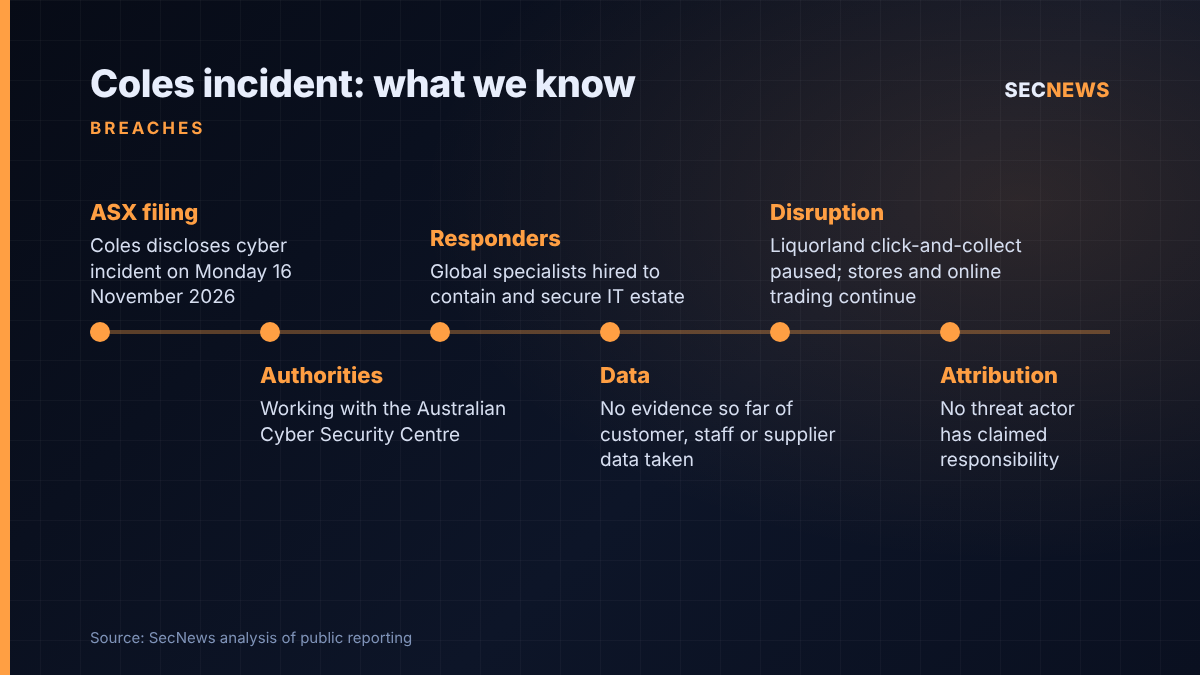
On the morning of Monday 16 November 2026, Coles Group Limited lodged a short statement with the Australian Securities Exchange confirming that it was investigating a cyber security incident. The release, authorised by the board, said Coles is engaging the Australian Cyber Security Centre (ACSC) and that outside specialists from around the world have been hired to “contain and secure” its IT estate.
The central claim in the filing is a negative one. According to Coles, nothing found by its investigation so far indicates that data belonging to customers, staff or suppliers was compromised or taken out of its systems. Stores and online shopping are running as normal, and the company apologised to customers and stakeholders, pointing to a rising tide of cyber incidents in Australia and further afield.
The one visible operational effect so far is at Liquorland, the group’s liquor chain. Coles told customers it was aware of a small number of people having trouble with Liquorland click-and-collect, and The Shout reported that Liquorland had emailed customers to say the service was temporarily suspended while stores and home delivery carried on. ABC News reported that Coles’ customer page listed gift cards as working normally, with no sign of impact on Flybuys loyalty accounts or on the Coles Plus and QuiteLike subscriptions.
Cyber Daily reported that, at the time of its report, no threat actor had claimed responsibility. Neither Coles nor Liquorland has said what kind of incident this is, how it was detected or when it began.
The detail
There is very little technical information in the public domain, and it would be wrong to fill the gaps with guesswork. What can be said is what the disclosure pattern tells us. Involving the ACSC, retaining external incident responders and using the language of containment all suggest that something serious enough to affect part of the estate was found, and that the response is still in its early stages.
Pausing one service, Liquorland click-and-collect, while the main grocery websites and apps stay open is also consistent with containment, though Coles has not said why the service was suspended. Responders often isolate the systems nearest to suspected activity rather than shutting everything down. That protects trading, but if the boundary is drawn too tightly, an attacker with a foothold elsewhere stays in place.
The “no evidence of data removal” wording deserves a careful reading too. It is a statement about what investigators have found so far, not a guarantee. Early in an intrusion, logging gaps mean exfiltration is often confirmed days or weeks later, if at all. Coles’ customer advice reflects that uncertainty: no action is needed for now, but customers should watch for unexpected emails and text messages, never give out passwords to unsolicited contacts, and use a strong password unique to their Coles account.
The disclosure also lands in a busy week for Australian retail. ABC News noted weekend reports of unauthorised transactions emptying digital gift cards at rival Woolworths, which is investigating. No source has linked the two events, and they should be treated as separate until evidence says otherwise.
Why it matters for UK organisations
British retailers do not need reminding that grocers are attractive targets. The 2025 attacks on Marks & Spencer and the Co-op showed how quickly an intrusion at a large retailer can spread into stock, payments and online ordering, and how expensive the recovery can be. More recently, as ABC reported, European supermarkets have suffered IT incidents affecting fridge and freezer temperatures that were believed to be cyber attacks. Large food retailers combine busy e-commerce, sprawling supplier networks, data-rich loyalty schemes and operational technology, giving attackers several ways to cause harm.
Coles also offers a useful comparison for UK boards on disclosure. Its first statement was quick and cautious: it confirmed the incident, named the authorities involved and avoided early promises. UK listed companies face similar pressure under market disclosure rules, while personal data breaches must be reported to the ICO within 72 hours when they meet the threshold. The Cyber Security and Resilience Bill would add incident reporting duties for many digital service providers and suppliers. Having pre-agreed holding statements, and a clear view of who signs them off, is far easier before the incident than during it.
Expert view
In my experience, the first 48 hours after an incident at a large retailer are dominated by one question: how far did the attacker get? Statements like Coles’ are honest snapshots, nothing more. When we test retail environments, the weak points are rarely the shop tills themselves. They tend to be the connective tissue: identity systems, third-party integrations, click-and-collect and fulfilment platforms, and the service accounts that tie them together. A problem surfacing in a single fulfilment service is exactly where I would expect to see either the attacker’s activity or the effects of containment work.
Curtin University’s Alireza Jolfaei told AAP that this was “just the beginning of seeing such problems”, warning that thinner staffing makes incidents harder to fix. I would add that the organisations that come through these events best are those that can quickly answer basic questions: which accounts are privileged, where logs are kept and for how long, and which suppliers can reach which systems. If those answers take a week, the attacker has had a week’s head start.
What to do now
- Review privileged and service accounts. Remove dormant administrator and integration accounts, enforce phishing-resistant MFA for admin access and rotate long-lived credentials (Cyber Essentials: user access control).
- Map your e-commerce and fulfilment integrations. Know which third parties and APIs connect to ordering, click-and-collect and loyalty platforms, and be able to isolate each one without taking the whole business offline.
- Check that logging will support an investigation. Make sure identity, VPN, cloud and endpoint logs are centralised and kept long enough to show whether data was taken, not just whether systems were touched.
- Harden internet-facing systems. Patch exposed services promptly and remove unnecessary ones (Cyber Essentials: secure configuration, security update management, firewalls).
- Prepare customer communications in advance. Draft scam warnings and holding statements now, and agree internally how ICO, regulator and market notifications will be approved.
- Brief customer-facing teams on follow-on fraud. High-profile retail incidents attract phishing that impersonates the brand, whether or not any data was stolen.
Bottom line
Coles has confirmed an incident serious enough to involve the ACSC, outside responders and a market announcement, yet it says it has no evidence of data loss so far and only Liquorland click-and-collect has been visibly affected. The company’s cautious wording is appropriate, and the full picture may take weeks to emerge. For UK retailers, the lesson is familiar but worth repeating: containment, logging and disclosure plans need to be ready before the call comes, not written while it is happening.
Sources
- Coles Group: ASX release, Coles investigating cyber security incident
- ABC News: Supermarket group Coles investigates cybersecurity incident but provides little detail
- iTnews: Coles Group investigating a cyber incident
- AAP: Cyber attack on supermarket giant ‘just the beginning’
- Cyber Daily: Australian supermarket giant Coles investigating cyber security incident
- The Shout: Liquorland and Coles investigate cyber security incident