The NCSC can now issue its own CVE identifiers for flaws in operational technology built by British firms. Researchers who find bugs in UK-made industrial kit finally have a national route to coordinated disclosure and a recognised record.
What happened
On 17 November 2026 the National Cyber Security Centre published a CVE assignment policy confirming that it now operates as a CVE Numbering Authority. In practice, that means the NCSC can allocate CVE IDs and publish the matching records itself, rather than relying on someone else to do it.
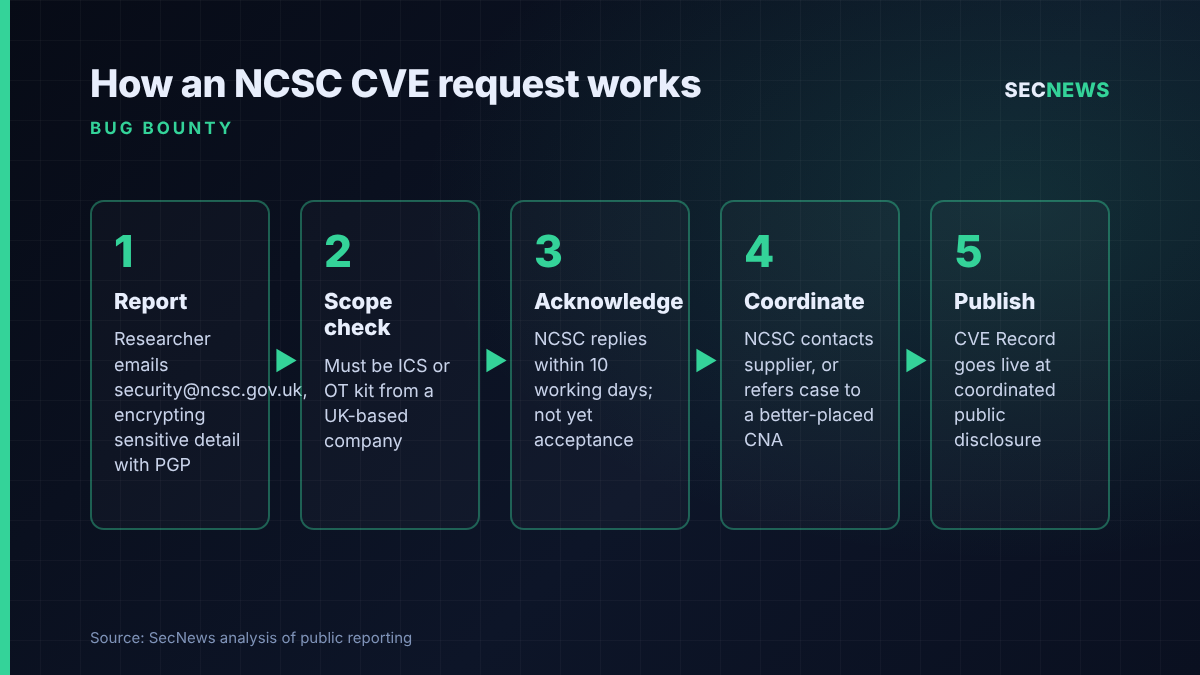
The remit is deliberately tight. The NCSC will only issue identifiers for vulnerabilities in industrial control system or OT products, and only where a UK-based company develops or maintains the product. It acts as a coordinator for other organisations’ products, not as a vendor handling its own bugs.
The CVE Program’s public partner list now carries an entry for “NCSC-UK” under the identifier CNA-2026-0090, classed as both a CERT and a researcher-type CNA, with MITRE as its top-level root. The suffix matters: the plain “NCSC” label already belongs to the NATO Cyber Security Centre.
National centres in the Netherlands, Finland, Switzerland and Slovakia already assign identifiers, broadly for any software reported to them that no other CNA owns. The UK has drawn a much narrower circle around British industrial technology.
The detail
The policy sets out six conditions, and every one has to be met before the NCSC will hand out an ID. The product must be ICS or OT. Its developer or maintainer must be based in the UK. The NCSC must have received, found, researched or coordinated the issue. There must be reasonable evidence of a CVE-eligible flaw. The vulnerability must be public already or expected to become so. And no other numbering authority with a better claim can be handling it, unless the case has been formally referred or escalated to the NCSC through CVE Program processes. Outside that box it will not assign an ID, and where another CNA is better placed it will refer the request or coordinate with that CNA.
Reports go to security@ncsc.gov.uk, and anything sensitive should be encrypted with the PGP key published in the NCSC’s security.txt file. The centre wants what any good report contains: supplier, product and versions, a technical description, reproduction evidence, any exploitation seen, mitigations, the supplier’s response so far and a proposed disclosure date. It explicitly asks reporters not to send personal data, credentials or live secrets unless they are essential.
The NCSC commits to acknowledging a request within 10 working days, while stressing that acknowledgement is not acceptance. From there it may ask for more information, take on coordination, reserve or assign an ID, liaise with the supplier or another CNA, redirect the reporter, or decline. It promises good-faith efforts to bring the supplier in and says any assigned ID will be passed back to the researcher.
Two caveats are worth underlining. Reserving an ID does not make a flaw public; the NCSC aims to publish the record at the point of coordinated disclosure, within CVE Program deadlines. And CNA status is not an endorsement: the centre says it does not certify severity or guarantee that a fix exists.
Why it matters for UK organisations
OT is where disclosure tends to go worst. Many industrial vendors, particularly smaller British manufacturers of controllers, building management systems and sensors, have no CNA status, no bug bounty and sometimes no published reporting route at all. Researchers finding flaws in UK-built controllers have typically been left to chase the vendor directly or go through an overseas coordinator.
That gap has real consequences. A CVE ID is what gets a flaw into scanners, asset inventories, threat feeds and procurement checklists. Without one, operators of water, energy, manufacturing and transport sites can be running vulnerable kit with no reliable way of tracking it. A national coordinator that can issue the identifier itself removes one of the main excuses for silence.
It also arrives as disclosure volumes explode. The Register, citing VulnCheck, reported that the number of CVEs published in 2026 passed 100,000 on 13 November, more than double last year’s total, with AI-assisted bug hunting the main driver. The same reporting noted that VulnCheck’s honeypots saw probing of newly disclosed refrigeration controller flaws within minutes of publication. In that environment, OT vendors that cannot coordinate quickly will have their flaws published for them.
Expert view
When we test industrial environments, the hardest conversations are rarely about the technical finding. They are about who to tell, and what happens next. In my experience, smaller OT suppliers are often willing to fix problems but have no process for receiving a report, no idea how CVEs work and real anxiety about publicity. A government body sitting in the middle changes that dynamic. A vendor is far more likely to engage when the NCSC is coordinating than when an unknown researcher emails a sales address.
The narrow scope is sensible. Trying to coordinate every bug in every British product would swamp a small team, particularly with AI tools now generating reports at industrial scale. Focusing on OT, where safety and national resilience are directly at stake, is where a state coordinator adds most value.
There are limits, though. A CVE ID is not legal cover. Nothing in the policy changes the legal position of a researcher who has to probe a live system to find a flaw; that question still rests on the slow reform of UK hacking law. The policy also gives no target for how long coordination should take beyond the 10-day acknowledgement. The real test will be how it handles a vendor that simply stops responding.
What to do now
- OT vendors: publish a vulnerability disclosure policy and a security.txt file now, name an owner for incoming reports and decide how you will work with the NCSC when it contacts you.
- Researchers: for UK-made ICS and OT flaws where the vendor is unresponsive or has no route, use security@ncsc.gov.uk, encrypt sensitive detail and supply the full evidence pack the policy lists. Do not include credentials or personal data.
- Operators of OT estates: build an accurate asset inventory that records supplier and firmware versions, so new CVEs against UK-made kit can be matched to your sites. This underpins the Cyber Essentials security update management control, even where OT sits outside formal certification scope.
- Procurement teams: add disclosure questions to OT tenders: does the supplier have a VDP, how quickly does it patch, and will it coordinate CVE assignment?
- Security teams: monitor the NCSC’s reports and advisories page alongside existing feeds, and segment OT networks so a newly published flaw is not immediately reachable from corporate IT or the internet, in line with the Cyber Essentials firewall and secure configuration controls.
Bottom line
The NCSC has quietly closed a long-standing gap: British industrial technology now has a home-grown body that can coordinate disclosure and issue the identifier that makes a flaw visible. The scope is small and the legal protections for researchers remain unfinished business, but for UK OT vendors the direction is clear. Disclosure is coming whether they are ready or not, and the sensible move is to be ready.