OpenAI and security firm Calif say GPT-6 Cyber helped them find around 35 flaws across Apple’s products, including a partial Lockdown Mode bypass. Apple’s own security notes tell a more complicated story about who found what, and that matters for anyone running a bounty or disclosure programme.
What happened
On 17 November 2026, Forbes reported that OpenAI and Calif, a security research firm already using OpenAI’s models, had spent several months using GPT-6 Cyber to hunt for weaknesses in Apple hardware and software. The tally was “some 35” issues of varying severity, spread across iPhone, iPad, Mac, Vision Pro, Apple Watch and Apple TV. According to the report, the most serious would have allowed takeover of an iPhone or Mac by luring its owner to a booby-trapped page, and the team used the model to write an exploit that stripped away some of the protections in Lockdown Mode.
According to Calif, speaking to Forbes, Apple has since patched a good share of the reported bugs. OpenAI confirmed that Apple had credited it for some findings but declined to say more, and Apple had not commented when the story ran. In a separate post, Calif put its own count at 36 vulnerabilities reported to Apple “since March”. Calif’s chief executive, Thai Duong, still recommends Lockdown Mode for people who need it and says the bypass does not make the feature ineffective.
GPT-6 Cyber is OpenAI’s restricted offensive model, released to vetted users on 5 November.
The detail
Rather than take the headline number on trust, I went through Apple’s published security notes for every release with CVE entries between 14 September and 13 November: 35 advisories covering iOS, iPadOS, macOS, watchOS, tvOS, visionOS, Safari, Xcode and HomeView, listing more than 600 distinct CVE IDs between them.
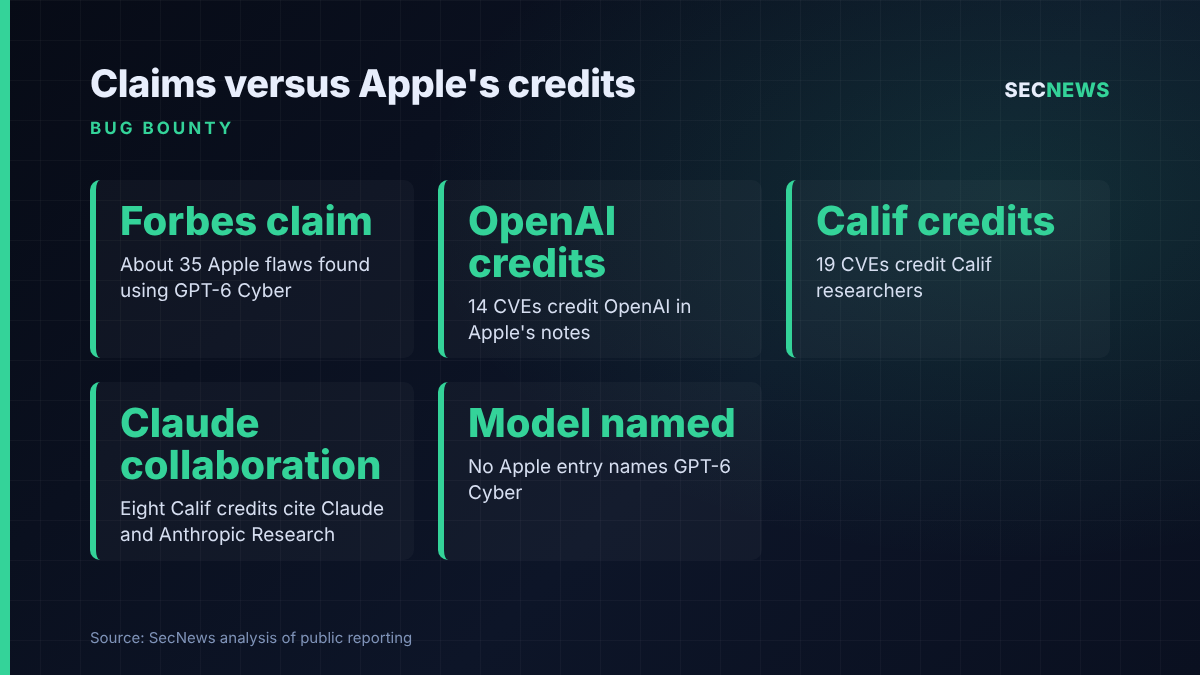
By my count, Apple credits OpenAI on 14 CVEs. Twelve name “OpenAI Codex Security” with researcher Amy Burnett, nine of those in the visionOS 27 notes alone. Two more credit “OpenAI” plainly, one alongside researchers from STAR Labs. Calif researchers appear on 19 CVEs. Eight of those Calif credits carry the words “in collaboration with Claude and Anthropic Research”, which points to Anthropic’s model, not OpenAI’s.
That gives 33 CVEs credited to OpenAI or Calif in total, with no overlap between the two. Not one entry names GPT-6 Cyber or any other OpenAI model. Many of the credits are shared: one WebDAV flaw fixed in macOS Golden Gate 27 lists ten separate reporters, a Calif researcher among them. Calif has said a flaw used in its testing was fixed in iOS 27.2.1 on 9 November, but none of the entries in Apple’s 27.2.1 notes names Calif.
None of this makes the Forbes report wrong: credits can be withheld, findings bundled, and fixes still pending. Forbes did not say whether Apple paid bounties for any of the reports, and neither Apple nor the researchers have said so publicly. What the public record does show is that the paperwork does not, on its own, tie these findings to GPT-6 Cyber, and that some of the credits point to a rival model.
Why it matters for UK organisations
Most UK organisations will never get a report from OpenAI’s red team. They will, however, receive a growing number of submissions that were found or written with AI help, and they will face the same questions Apple faces: was this really new, who found it first, and does the reporter deserve credit or payment?
The duplicate problem is the one I would watch. When ten people independently find the same bug, it is a sign that the barrier to finding it has collapsed. In most bounty programmes only the first valid report is paid, so as discovery gets cheaper, more researchers will do real work for nothing. Some will lose patience: this month a researcher dumped N-able zero-days after earlier reports went unfixed.
Lockdown Mode matters here too. It is the setting UK journalists, politicians, lawyers and NGO staff are told to switch on when they are likely targets of commercial spyware. A demonstrated partial bypass, even a patched one, is a reminder that hardening settings shrink the attack surface rather than remove it.
There is also a reputational angle for vendors. According to The Hack Academy, Apple told the Financial Times in August that it had limited how many reports a single researcher can have open at once, as AI-assisted reports piled up. Any UK firm that writes a vulnerability disclosure policy now needs to plan for the same flood.
Expert view
In my experience, the hardest part of a disclosure programme has never been receiving reports. It is triage: reproducing the issue, deciding its real severity and working out whether you have already seen it. AI tools are now very good at the first half of the job and, if Forbes is right, increasingly good at weaponising what they find. Duong himself expects things to get worse before they get better, with a possible turning point when models can generate patches on their own.
What the Apple credits show is that the industry has no common language for AI-assisted findings. “OpenAI Codex Security” is a product name. “In collaboration with Claude” describes a method. Neither says how much a human did, which model was used or whether the finding was checked before it was sent. For a bounty programme that pays per valid report, that matters. Paying a human for a bug that a model found and a human rubber-stamped is a policy choice, and few UK programmes have made it explicitly.
When we test client estates, we judge a finding by whether we can reproduce it, not by how it was found. Vendors should apply the same rule to incoming reports, and be open about how they credit and reward machine-assisted work.
What to do now
- Patch Apple devices. Make sure managed iPhones, iPads and Macs are on the current 27.2.1 releases or the supported older branches. This maps directly to the Cyber Essentials security update management control.
- Review Lockdown Mode use. Identify staff who are high-risk targets and confirm Lockdown Mode is on and their devices are fully updated. Do not treat it as a substitute for patching.
- Update your disclosure policy. State whether you accept AI-assisted reports, what evidence you need (a reproducible proof of concept, affected versions) and how duplicates are handled.
- Define credit rules. Decide how you will credit a person, a company and a tool, so researchers know what to expect before they report.
- Resource triage. If you run a bounty or VDP, budget for more reports and more duplicates. Consider whether your platform’s AI filtering is good enough.
- Track vendor advisories, not headlines. Use the vendor’s own security notes to decide what to patch, and treat large headline numbers as a cue to check those notes.
Bottom line
AI models are now finding real flaws in some of the best-defended consumer software in the world, and reportedly writing exploits for them. The harder questions are about disclosure: who gets credit, who gets paid and how a finding is verified. Apple’s own advisories show those questions are already unresolved. UK organisations running disclosure programmes should settle their answers before the reports arrive.
Sources
- Forbes: OpenAI’s New Hacking Model Found Dozens Of Holes In Apple Tech
- Apple: Apple security releases
- Apple: About the security content of iOS 27 and iPadOS 27
- Apple: About the security content of macOS Golden Gate 27
- Apple: About the security content of visionOS 27
- Apple: About the security content of iOS 27.2 and iPadOS 27.2
- Apple: About the security content of iOS 27.2.1 and iPadOS 27.2.1
- The Hack Academy: GPT-6 Cyber Apple flaws: what the public record supports
- NeoTeo: GPT-6 Cyber: Apple vulnerability report explained
- BankInfoSecurity: Researcher Drops More Zero-Day Exploits for N-Able Software
- FourWeekMBA: OpenAI’s GPT-6 Cyber found ~35 Apple flaws; Apple credits 5