Researchers at TU Berlin have shown that someone with a screwdriver and a small custom board can wipe the TPM’s record of failed PIN guesses, turning a short Windows Hello or BitLocker PIN into something that falls in hours or days. AMD has confirmed a firmware flaw, Intel and Winbond dispute or defer, and UK organisations that followed NCSC advice to use pre-boot PINs now need to check how long those PINs are.
What happened
A Technische Universität Berlin team, whose authors include Christian Werling and Jean-Pierre Seifert, has published “Hello Again” (arXiv 2611.18126, a revised version of a paper published at ACM CCS ’26). It concludes that, on a range of shipping x86 hardware, the firmware TPM’s defence against repeated PIN guessing can be undone by anyone able to open the case.
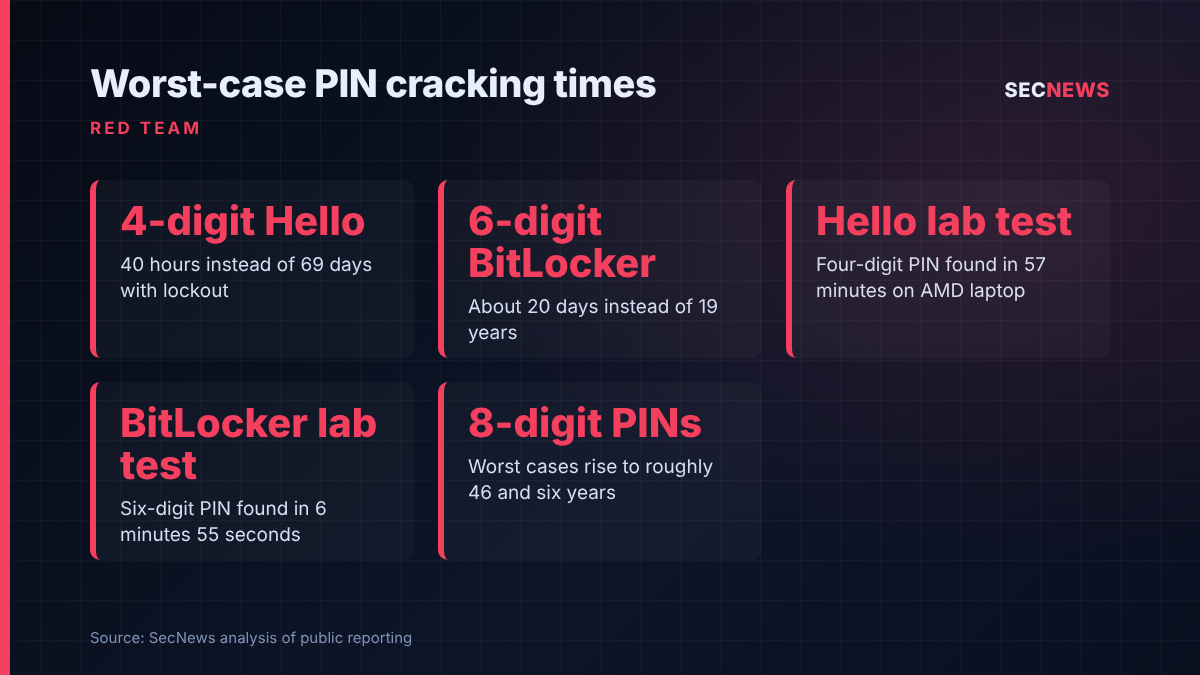
In the lab, a four-digit Windows Hello PIN fell in 57 minutes on a locked, encrypted HP OmniBook 3 (AMD Ryzen AI 5 330). A six-digit BitLocker startup PIN fell in six minutes and 55 seconds on an Intel-based Framework Laptop 13 fitted with Winbond flash. Both test PINs sat early in the search order, but the worst-case figures are still striking: roughly 40 hours for any four-digit Hello PIN instead of 69 days, and about 20 days for a default six-digit BitLocker PIN instead of 19 years.
AMD published bulletin AMD-SB-7079 on 17 November, assigning CVE-2026-43613 with a CVSS score of 5.1 and scheduling firmware fixes between November 2026 and February 2027. Intel’s announcement of 16 November states that the research did not show a flaw in any Intel component. According to the researchers, Microsoft, notified in April, graded the Hello report moderate, issued no CVE and says it will lift its suggested Hello PIN minimum to six digits. Winbond, according to the researchers, is still studying the problem and has promised no fix or date.
The technical picture
Short PINs are only tolerable because the TPM enforces an anti-hammering policy. By Microsoft’s defaults it locks after 32 wrong guesses and forgives one failure every ten minutes.
The weakness lies in where that counter lives. Most current machines use a firmware TPM inside the processor, which has no secure storage of its own, so its state, including the failed-attempt tally, is kept encrypted on the motherboard’s SPI flash. Restore an older copy of that state and the tally goes backwards.
Newer platforms are meant to block such rollbacks with Replay Protected Monotonic Counters (RPMC), a JEDEC standard in which the flash chip keeps a signed counter that should only ever increase. The researchers found two ways round it:
- AMD: the processor’s non-volatile storage controller does not confirm that a counter increment actually took effect, so a board placed between processor and flash can suppress the update while reporting success.
- Winbond RPMC flash: a precisely timed voltage glitch can leak the HMAC key that authenticates counter values, allowing any value to be forged. The paper puts Winbond’s NOR flash market share above 25 per cent.
Two AMD desktops without RPMC flash proved weaker still: writing back an old flash image with an ordinary programmer reset the count. Three Intel systems spotted the same trick. The researchers expect AMD machines using Microsoft Pluton as their TPM to be affected but did not test this. They also argue, without demonstrating it, that a recovered Hello PIN unlocks device-bound keys and Hello-based enterprise single sign-on.
Why it matters for UK organisations
NCSC device security guidance recommends that BitLocker require a PIN before it decrypts a drive, and an August NCSC blog, prompted by the YellowKey bypass, described BitLocker without a PIN as “a half measure”. It also suggested letting users share one PIN between Hello and BitLocker.
That advice remains sound. A PIN still blocks the recovery-environment attacks that plague TPM-only BitLocker. What the Berlin research changes is the assumption that the PIN can be short because the TPM will rescue it. If the lockout counter can be rewound, the strength of the PIN itself becomes the control, and a four or six-digit number is not much of one. A shared Hello and BitLocker PIN also means that cracking one hands over the other.
The threat model is a stolen or seized laptop in the hands of a capable, patient adversary: a state service, a well-resourced criminal group or someone targeting a specific executive. That is exactly what full-disk encryption is for, and what UK GDPR breach assessments hinge on when a device goes missing. Organisations that tell the Information Commission a lost laptop was “encrypted, so no risk” should be confident that claim survives this kind of attack.
Expert view
On physical engagements, the encrypted laptop left in a car or a hotel room is a classic objective. In my experience, most organisations that bother with BitLocker run it TPM-only, and those that add a PIN usually accept the six-digit default because users complain about anything longer. This research quietly removes the safety net behind that compromise.
Perspective matters. This is not remote or plug-and-play, and the RPMC attacks need the authors’ own boards. No exploitation outside the lab has been reported. But the attack firmware, board designs and scripts are public, and hardware attacks have a habit of becoming cheaper once the hard thinking is done.
I am less comfortable with the vendor responses. AMD accepts a firmware flaw while saying physical attacks sit outside its threat model, though RPMC exists to stop exactly this. Intel is technically right that its silicon is not the culprit, but the test laptop’s firmware reusing the same value at every boot made the Winbond weakness far worse. Microsoft’s six-digit advice helps only modestly: worst cases of about 168 days for Hello and 20 days for BitLocker. Eight digits raises them to roughly 46 and six years.
What to do now
- Lengthen PINs by policy. Raise the Windows Hello for Business “Minimum PIN length” setting and BitLocker’s “Configure minimum PIN length for startup” to at least eight digits, as the researchers suggest adding two digits as a minimum. This sits squarely within Cyber Essentials secure configuration.
- Allow enhanced BitLocker PINs. Letters and symbols at startup put brute force out of practical reach.
- Do not drop pre-boot PINs. NCSC’s reasoning still holds; this research is an argument for stronger PINs, not for going back to TPM-only.
- Track AMD firmware. Apply OEM BIOS updates carrying the AMD-SB-7079 fix as they land (Cyber Essentials security update management).
- Identify Winbond RPMC exposure. With no fix promised, ask suppliers which models use affected flash.
- Revisit lost-device playbooks. Revoke Hello credentials and device certificates promptly when a device goes missing, and use conditional access so a recovered PIN alone cannot reach sensitive services.
- Add tamper evidence for travelling staff. Chassis seals and checks on returned devices are cheap for high-risk travel.
Bottom line
The TPM lockout was never meant to carry a four-digit secret alone, yet many fleets rely on it. TU Berlin has shown that, on common AMD and Winbond-equipped hardware, the lockout can be rewound by someone with physical access and modest kit. Keep the pre-boot PIN the NCSC recommends, make it long enough to stand on its own, and patch AMD firmware as it arrives.
Sources
- arXiv: Hello Again: Exploiting Replay Protected Monotonic Counters to Brute-Force Windows Hello PINs
- The Hacker News: New Attack Bypasses TPM Lockout to Crack Windows Hello and BitLocker PINs in Days, Not Years
- Neoteo: Attaque du TPM : les objectifs de correctifs d’AMD
- NCSC: How BitLocker PINs help protect your data and devices