N-able has confirmed that an intruder reached a server behind its Mail Assure and SpamExperts hosted email security cloud, and the management portal, APIs, quarantine and logging have been switched off in every region. Mail is still being filtered, but the managed service providers who run these services for their customers cannot see what the filter is doing.
What happened
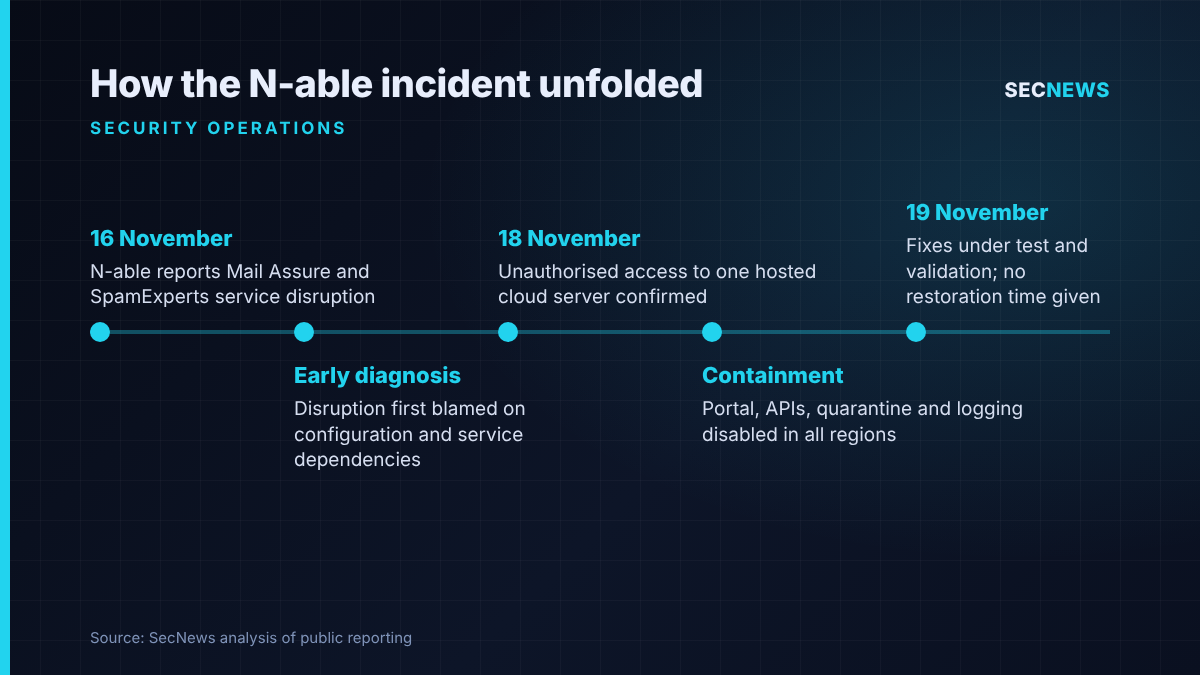
The problems began on 16 November 2026, when N-able told customers that Mail Assure and SpamExperts Hosted Cloud were disrupted and that it was investigating. The first explanation pointed to platform configuration and dependencies between services. On 18 November the company changed its account: the disruption had been caused by a security incident, and an unauthorised party had accessed one server in the hosted cloud environment.
N-able responded by disabling the management interface and the APIs across its Americas, Europe and Asia-Pacific regions. Inbound and outbound filtering has continued throughout, so end users are still sending and receiving mail. What administrators have lost is the control layer: the dashboard, API access, quarantine, logging and mailbox synchronisation. According to Cybersecurity News, N-able reported at 00:01 UTC on 19 November that it had begun testing fixes in a controlled environment. By its 08:00 UTC update that day, teams were still validating and hardening the portal and its supporting services, and no restoration time had been given.
The company says that “at this time we do not have evidence that customer data was compromised”, a statement that covers tenant mailboxes, though the investigation is ongoing. It has contacted partners directly to tell them whether their environment needs any action. It has not said who got in, how or for how long. N-able says the incident is unrelated to the separate N-central security problems it dealt with earlier in November.
The technical picture
Hosted email security platforms of this type split into two layers. The filtering nodes sit in the mail path, accept inbound connections, score messages and hold anything suspicious. The management plane is where partners and administrators set policy, add domains, release quarantined messages, read logs and connect their own tools through the API. TheCyberSecGuru points out that the filtering tier keeps enforcing the last policy it received. If the filter is briefly unavailable, sending servers queue mail and retry. That separation explains why delivery survived while administration went dark.
It also explains why N-able took such a blunt containment step. The control plane is the most valuable part of an email security service to an attacker. With administrative reach there, someone could quietly add allow-list entries, change routing, read quarantined messages or search the logs, and mail would keep flowing as if nothing had changed. Brandefense notes that the portal and API were both disabled while the investigation continues. Turning off everything that can change or read configuration, then bringing each service back only after it passes validation, is a reasonable way to rule out tampering. It is also why restoration is slow.
The open questions matter more than the confirmed ones. A single compromised server is the only intrusion N-able has confirmed. The loss of management access in all three regions is a precaution and does not mean every region was breached. Until the company publishes a root cause, partners cannot judge whether their own admin or API credentials, integration tokens or quarantined content were within the intruder’s reach.
Why it matters for UK organisations
Mail Assure is largely sold through managed service providers, and SpamExperts has long been offered through hosting providers, so many UK small and medium-sized businesses may rely on it without knowing the brand name. For them the immediate effect is subtle. Email arrives, but if a legitimate invoice or contract is sitting in quarantine, nobody at the MSP can currently find or release it. When a customer calls to say “we never got the email”, the support desk has no logs to check.
There is a data protection angle too. Quarantine stores are full of real business correspondence, much of it containing personal data. N-able says it has seen no evidence of access, but UK organisations acting as controllers should record the incident and their assessment now. If the vendor’s findings change, they will need to decide quickly whether the ICO’s 72-hour notification clock applies. MSPs should also keep in mind that the UK’s Cyber Security and Resilience legislation is intended to bring managed service providers under regulatory oversight. Incidents in a provider’s supply chain that disrupt customer services are exactly the sort of event that regime is designed to capture.
Expert view
In my experience, the dangerous phase of a vendor incident like this is not the outage itself but the point when the lights come back on. Teams are relieved, the backlog is large, and nobody wants to check configuration line by line. Yet that is when you find out whether anything was changed while you were blind. When we assess email security set-ups, the allow-lists and bypass rules are usually where the real risk sits. They build up over years, nobody reviews them, and a single extra entry for an attacker-controlled domain would be very hard to spot.
I would also give N-able some credit for reclassifying the event openly rather than keeping it labelled as a configuration fault. The initial misdiagnosis is a familiar pattern. Plenty of intrusions first look like instability, and the lesson for any SOC is to keep a security hypothesis open whenever a platform starts behaving strangely. The communication gaps remain, though. Partners need to know which credentials to rotate and what the intruder could reach, not only that customer data appears safe.
What to do now
- Follow the vendor’s guidance for your tenant. Act on N-able’s direct partner notice. If you have not received one, contact its technical support and get the answer in writing.
- Run a manual process for missing mail. Log every “missing email” and quarantine release request with timestamps, then reconcile them later.
- Treat outage-themed messages with suspicion. Verify any password reset, quarantine release or “restoration” email through a known support channel before acting on it (Cyber Essentials: user access control and secure configuration).
- Rotate credentials when access returns. Change administrator passwords and API keys, and reissue integration tokens. Confirm MFA is enforced for every portal user.
- Audit configuration against a known-good baseline. Compare allow-lists, block-lists, routing, domain lists, outbound relay settings and user accounts with exports or screenshots taken before 16 November.
- Back-fill your monitoring. While the vendor’s logs are unavailable, rely on Microsoft 365 or Google Workspace message trace and your mailbox audit logs. Hunt for unexpected forwarding rules and unusual sign-ins over the outage window.
- Record your data protection assessment. Note what personal data your quarantine held, what N-able has told you, and when, so that you can meet ICO deadlines if the picture changes.
Bottom line
N-able’s choice to keep mail flowing while locking down its control plane limits the immediate damage. It does, however, leave MSPs operating a security control they cannot see into. Use the downtime to prepare: have a configuration baseline, a credential rotation plan and independent message tracing ready, so that when the portal returns you can confirm nothing changed while it was offline.
Sources
- The Hacker News: Hackers Breach N-able Cloud Server, Disrupting Email Security Management Across 3 Regions
- Cybersecurity News: N-able Confirms Server Breach, Disables Mail Assure and SpamExperts Management Access
- GBHackers: N-able Confirms Security Breach in Mail Assure and SpamExperts Hosted Cloud
- TheCyberSecGuru: N-able Mail Assure Breach: Mail Flows, Portal Stays Dark
- Brandefense: N-able Mail Assure Incident: Service Matrix