Attackers have used a critical Cisco Expressway flaw to get root on clustered gateways, in what security firm F6 says is the first confirmed real-world attack using the bug. Cisco shipped a fix a month ago, yet its advisory still says it knows of no malicious use.
What happened
On 18 November, the threat intelligence company F6 published findings from an incident at a Russian organisation, and SecurityWeek reported them the following day. Attackers had exploited CVE-2026-76466, a vulnerability in Cisco Expressway rated 9.8 on the CVSS scale, to gain root-level command execution on the organisation’s collaboration gateways. F6 describes it as the first known case of the bug being used in a live attack.
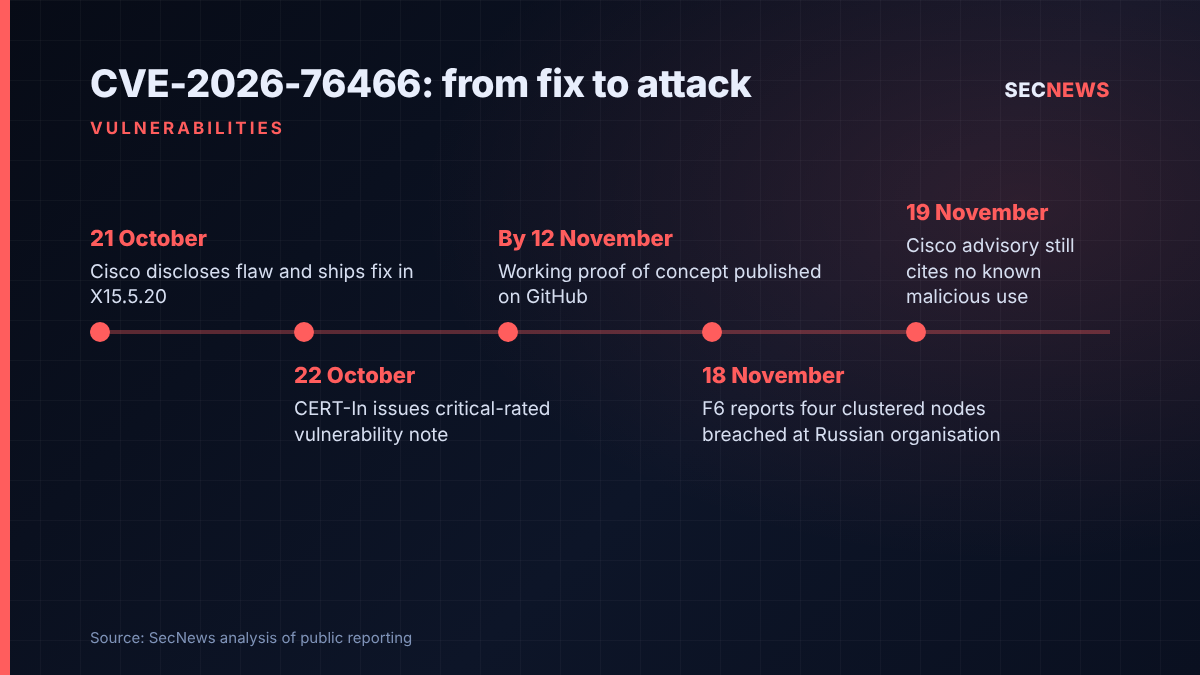
The timeline is short. Cisco disclosed the vulnerability on 21 October 2026 and fixed it in Expressway X15.5.20. India’s CERT-In issued a critical-rated note the next day. By 12 November, a researcher had published a working proof of concept on GitHub, along with a tool for spotting exposed clusters. According to F6, the intrusion came soon after the exploit appeared.
The attackers first got into two internet-facing Expressway nodes running X15.5.3. From there they reached two more nodes in the same cluster on the internal network, so four devices were compromised in total. Once they had root, they started building Python tooling to move further into the estate. F6 says the scripts were written to scan the internal network, enumerate SMB shares, talk to Microsoft SQL Server and Windows Remote Management, and trawl GitLab repositories for credentials and other secrets.
F6 has not named the victim or tied the activity to a known group. It did find something noteworthy in the code: the scripts appear to have been edited during the operation, with comments that suggest an AI assistant helped write the changes. At the time of the reports, Cisco’s advisory had not been updated and still said the company was unaware of any malicious use.
The technical picture
Expressway is the gateway pair Cisco customers use to give remote staff, partners and guests access to voice, video, messaging and content sharing without putting every user on a VPN. Expressway-C sits inside the network and Expressway-E sits at the edge. Both come as appliances or virtual machines, and larger estates cluster them for resilience.
The flaw is in the database service that keeps cluster members in sync. Cisco puts it down to persistent cookies combined with inadequate checking of client certificates, even when the cluster’s TLS Verify Mode is switched on. An unauthenticated attacker who can reach that service and holds the relevant cookie material can issue remote procedure calls that end in operating system commands running as root. Standalone, unclustered Expressway systems are not affected by this particular bug, according to Cisco.
Two points matter for defenders. First, there is no workaround: Cisco’s only remedy is upgrading to X15.5.20, and customers still on X14 or earlier have to migrate to a supported, fixed train. Second, TLS Verify Mode is not a safety net here, because the certificate validation failure happens inside that mode. Cyber Press noted that the public exploit was validated against a two-node X15.3.2 Expressway-C cluster, and that Expressway-E, X14 and the stricter TLS settings were not tested.
Why it matters for UK organisations
None of the published reporting puts a number on Expressway deployments in Britain. The risk does not depend on how widespread the product is, though. Any UK organisation that runs Cisco on-premises calling or video and lets people connect from outside probably has an Expressway pair somewhere, and the edge half of that pair is internet-facing by design. That is exactly the starting point in the F6 case.
The incident also shows that root on a comms appliance is a means, not an end. These boxes sit between the internet and internal networks, often have routes to directory services and databases, and are rarely watched by endpoint detection tools. What the F6 attackers went for next (SMB shares, SQL Server, WinRM and source code repositories holding credentials) looks like the opening moves of a much larger intrusion. I would expect any UK organisation hit this way to treat it as a full network compromise, not a device problem.
There is a compliance angle as well. Cyber Essentials requires updates that fix critical or high-risk vulnerabilities to be installed within 14 days of their release. This fix has been out for four weeks. Any organisation still running an affected clustered build is past that deadline and, until it upgrades, exposed to a bug with public exploit code.
Expert view
This follows a familiar pattern. A vendor publishes a critical advisory, the fix sits in a change queue because unified communications kit is seen as fragile and business-critical, then a proof of concept lands and the gap between “patch available” and “patched” turns into an attack window. When we test collaboration estates, the Expressway and call control layer is often the part that has drifted furthest behind, because nobody wants to be the person who broke the phones.
The AI angle is interesting but should not distract anyone. Whether or not a model helped tidy the attackers’ Python, the important facts are that the initial access needed no credentials and that the tooling was aimed straight at lateral movement and secret harvesting. In my experience, appliance compromises like this are also where credential reuse bites hardest: service accounts, database connection strings and repository tokens found during post-exploitation are usually what turn one foothold into a domain-wide incident.
Nor would I read much into Cisco’s “no known exploitation” wording: advisories often lag third-party incident reports. A public exploit plus a published intrusion is reason enough to act.
What to do now
- Inventory first. List every Expressway-C and Expressway-E instance, physical and virtual, with its software version and whether it is clustered. Put internet-facing clustered nodes at the top of the list.
- Upgrade to X15.5.20. Move X14 and older systems onto a supported fixed release. This maps directly to the Cyber Essentials security update management control.
- Restrict cluster traffic if you cannot patch today. As a temporary measure, F6 suggests limiting TCP ports 4371 and 4372 to trusted cluster peers only, and Beazley Security advises keeping the database service unreachable from the internet.
- Hunt for compromise. Check the Erlang logs on Expressway nodes for unexpected cluster node connections, look for unfamiliar Python files on the appliance storage, and review F6’s published IP indicators against firewall and proxy logs.
- Look beyond the box. Review unusual SMB, SQL Server, WinRM and GitLab activity that originates from Expressway address ranges.
- Assume exposure if you find anything. Preserve evidence, isolate the affected nodes where you can, scope lateral movement, and rotate any credentials and tokens the appliances or nearby systems could reach. Patching a compromised node does not evict the attacker.
Bottom line
CVE-2026-76466 has now been used in a real attack: an unauthenticated route to root on a perimeter collaboration gateway, with public exploit code and a confirmed intrusion behind it. The fix has been available since 21 October, and there is no supported workaround. If you run clustered Expressway, upgrade this week and check for signs of compromise at the same time.
Sources
- SecurityWeek: Hackers Exploit Cisco Expressway Vulnerability Soon After PoC Release
- Techgenyz: Cisco Expressway Vulnerability: Critical 9.8 Flaw Exploited
- Beazley Security: Critical Remote Code Execution Vulnerability in Cisco Expressway Series (CVE-2026-76466)
- Cyber Press: Critical Cisco Expressway Flaw Allows Hackers to Execute Root Commands, Public PoC Released