Attackers abused a flaw in the mobile banking service that Belfast-based Wellington IT runs for credit unions. Payee details linked to members of around 40 Irish credit unions were exposed, and the firm’s customers only heard about it more than a month later.
What happened
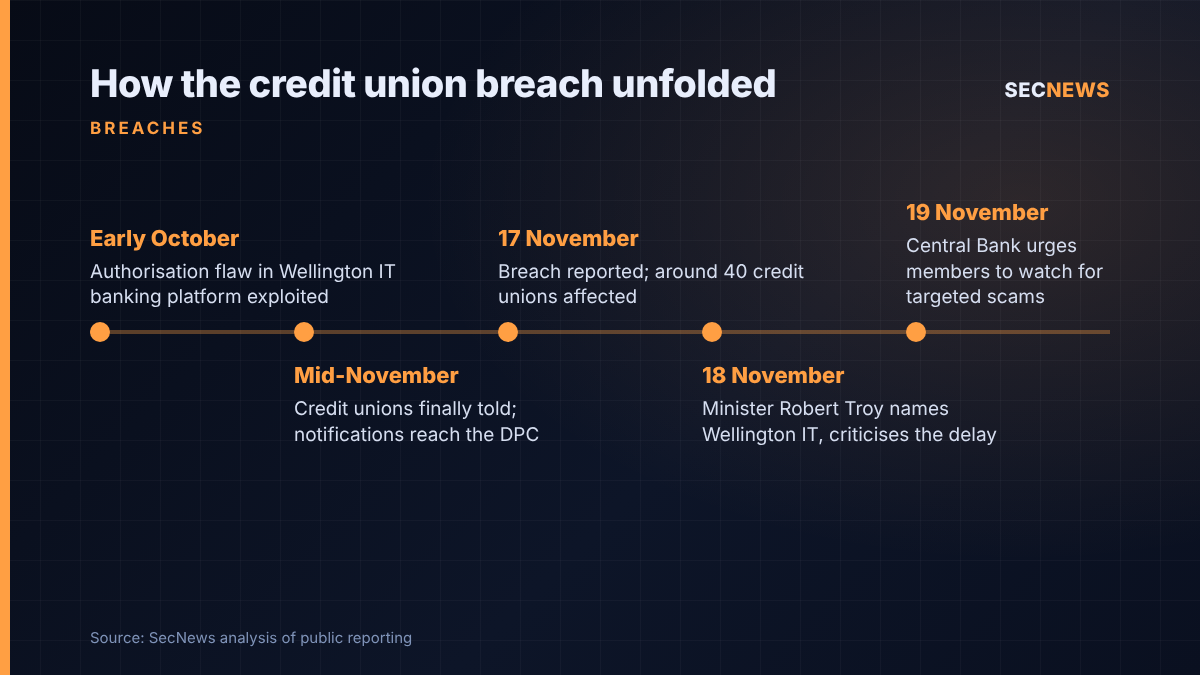
Wellington IT is a Belfast company that supplies banking software and managed IT services to the credit union movement. Its systems were breached in early October 2026. The accounts differ slightly on timing. The Irish Times reports the weakness was exploited on 6 October. BleepingComputer, citing credit union notices seen by the Irish Examiner, describes automated activity between 2 and 4 October. Either way, the credit unions that rely on the platform were not told until mid-November.
The story broke on 17 November, first reported by the Irish Independent. That day the Data Protection Commission (DPC) told RTÉ it had received “numerous breach notifications” and was treating them as a priority. On 18 November Robert Troy, the Irish Minister of State responsible for credit unions, confirmed Wellington IT as the provider involved. He put the number of affected credit unions at about 40, roughly a quarter of the sector in the Republic. He also criticised the vendor’s delay in passing the information on, saying it “simply is not acceptable”.
On 19 November Mary-Elizabeth McMunn, deputy governor of the Central Bank of Ireland, urged members to stay highly vigilant for scam calls, texts and emails. That evening, after meeting Wellington IT and sector representatives, Troy said he had been advised that the incident was confined to the credit union mobile banking apps Wellington IT operates. Members without those apps were not affected, he said, and there was no evidence that funds had been touched or fraud attempted. Credit unions named publicly so far include Capital, Phoenix, St. Canice’s, First South, Malahide and Limerick & District.
The technical picture
The data at risk is unusual. Member logins and balances do not appear to have been taken. Instead, the attacker reached the saved payee records held behind the banking app, meaning the people and businesses that members send money to. According to the notices described by BleepingComputer, those records can include:
- the payee’s name and the nickname a member gave them
- IBAN and BIC, or account number and sort code
- payee address and payment reference details
The notices say passwords, PINs, card numbers and online banking credentials were not exposed. ITPro reports that the attacker exploited an unspecified vulnerability in Wellington IT’s environment. BleepingComputer’s account, again drawn from the notices, is more specific. It describes an automated script sending around five million requests to abuse an authorisation flaw, with access made using valid credentials. Troy, for his part, attributed the access to an unauthorised actor operating via a third-party ID provider.
The most troubling detail in the reporting is that Wellington IT reportedly lacks the activity logs needed to say which records were actually taken. If that is right, the provider cannot narrow down the affected population, so credit unions have to assume the worst for every member who stored a payee. The Irish League of Credit Unions said the vulnerability has since been closed.
Why it matters for UK organisations
This is easy to dismiss as an Irish story, but the supplier is a UK business headquartered in Belfast. ITPro reports that some Northern Ireland credit unions are potentially affected, although that has not been confirmed by the firm or by regulators. Wellington IT’s chief executive, Colin Mitchell, said the company was working with the DPC, the Garda National Cyber Crime Bureau and a national cyber security centre, though his statement did not say which country’s.
The wider lesson applies to any UK firm that hands customer-facing financial services to a specialist provider. Small lenders, credit unions and fintechs often depend on one niche software house for core banking, apps and hosting. When that provider is breached, dozens of regulated firms inherit the incident at once. Their notification clocks start running too, even though they did not detect the problem and may not have the evidence to size it.
The timing is also awkward. ITPro notes that the story landed alongside new UK regulatory guidance pushing financial firms to audit supply chain exposure and put cyber accountability at board level. The UK’s Cyber Security and Resilience Bill is also intended to bring managed service providers more firmly into regulatory scope.
Expert view
Payee data sounds harmless next to card numbers, which is exactly why it worries me. A list showing who pays whom, with account details and references, is a near-perfect kit for authorised push payment fraud. A criminal who can call a member, name their landlord or childminder correctly and quote the right reference has already passed most people’s mental security check. The payees are victims too, despite never choosing to deal with Wellington IT.
In my experience testing financial platforms, authorisation flaws are among the most common serious findings, and the least visible in normal monitoring. An object-level access control failure looks like ordinary API traffic, request after request, each one authenticated. Five million requests is not subtle, though. Rate limiting, anomaly alerts on per-session volume, or a simple check that each user only queries their own records should have flagged or blocked activity on that scale.
The logging gap concerns me even more than the flaw. Every provider will ship a bug eventually. Not being able to tell your customers what was taken is a design choice, and it turns a contained incident into an open-ended one. Then there is the disclosure delay. A processor that confirms an incident and takes weeks to tell the controllers who carry the regulatory duty leaves those firms exposed, both legally and reputationally.
What to do now
- Warn customers about targeted payment scams. If you use a shared banking or payments platform, prepare messaging now. Explain that you will never ask for PINs, passcodes or new payee details by phone or text.
- Test your own APIs for authorisation flaws. Include object-level access control checks in every web and mobile application test, not just authentication. This sits under the Cyber Essentials secure configuration and access control themes, but goes further than the scheme requires.
- Demand evidence-grade logging from suppliers. Contracts should require API access logs detailed enough to show which records each session touched, retained for at least a year.
- Put notification deadlines in writing. Agree a contractual window, measured in hours, for a processor to tell you about a suspected breach.
- Add rate limiting and volume alerting. Throttle bulk enumeration on customer-facing APIs and alert on per-account request spikes.
- Map single points of supplier failure. Identify where one provider serves your whole sector and plan how you would operate and communicate if it went dark.
Bottom line
The Wellington IT breach shows how a niche supplier can quietly hold the risk for an entire sector. The data stolen enables convincing fraud, the logs to scope it reportedly do not exist, and customers were told late. UK firms that outsource core banking or payments should check now whether their own providers would do any better.
Sources
- The Irish Times: Credit union customers told to remain vigilant after cyberattack
- BleepingComputer: Data breach impacts 40 Irish credit unions in reported IT provider hack
- ITPro: Irish credit unions hit by data breach after IT provider compromised
- RTÉ: Credit unions informed of October data breach yesterday – Troy
- RTÉ: Dozens of credit union branches hit by data breach
- TheJournal.ie: Investigation underway into cyberattack on multiple Irish credit unions