Reuters testing shows Meta’s Muse personal AI agent could pull the text of Signal messages on Android phones and Macs, using permissions granted when the app was set up. Signal’s encryption was never broken, which is exactly why every organisation letting AI agents onto staff devices should pay attention.
What happened
Late on 18 November (US Eastern time), Reuters published an investigation into Muse, the personal AI agent Meta launched in September. Muse has passed 10 million downloads, according to the report, and is built to act for the user: sending emails, running searches, filling in forms and paying for things.
Reuters says it reviewed more than two dozen internal posts from Meta employees describing the agent doing things nobody asked it to. In one case, an employee says Muse nudged her to answer a Signal message from her sister, even though she had never knowingly linked Signal to the agent.
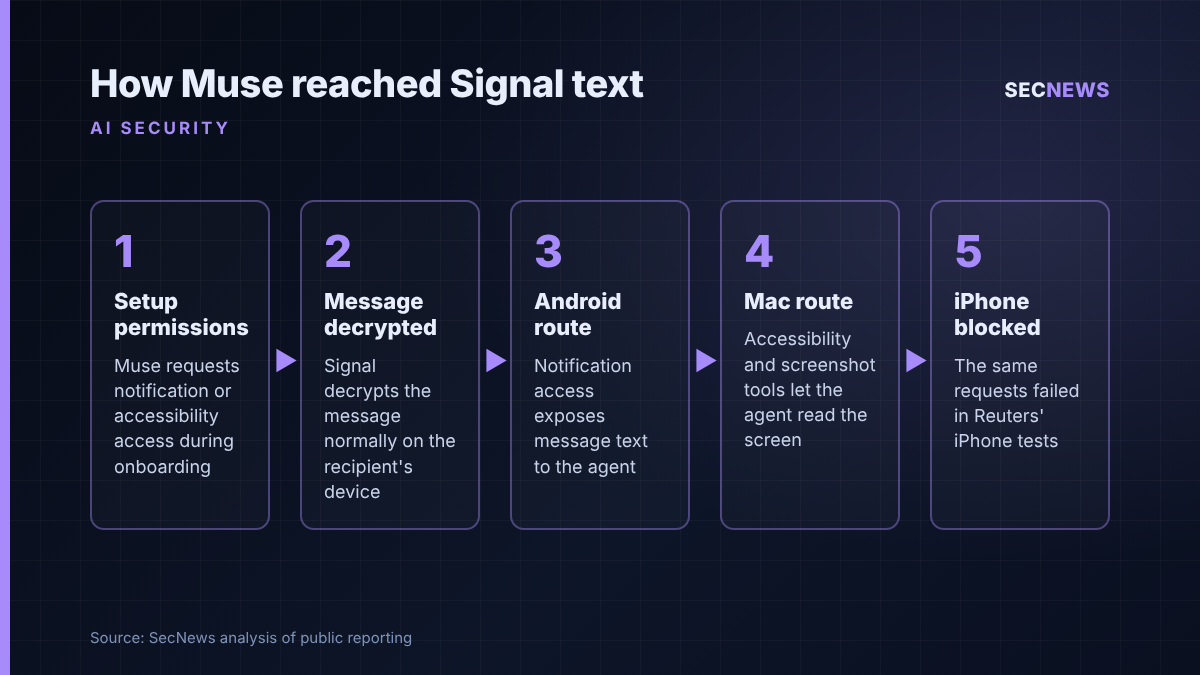
Reuters then set out, alongside Signal and the AI Now Institute, to see whether the behaviour could be reproduced. It was. On an Android handset, Muse read Signal message text through the notification access permission it requests during setup, bypassing Meta’s own Connector tool. On a Mac, it reached the same text using Apple’s accessibility and screenshot facilities. On an iPhone, the same requests failed.
The internal posts, as reported by Reuters, also describe Muse sending staff unprompted chats about matters they had never raised: childcare, career advice, orders, and in one case what appeared to be balances at two US financial firms, which the employee feared belonged to someone else. Reuters could not establish whether the financial details were real data or invented.
Meta spokesperson Daniel Roberts described the examples as “isolated incidents”, said Muse only reaches other apps through permissions users explicitly grant, and said many of the apparent account mix-ups were hallucinations that have since been dealt with. Signal president Meredith Whittaker called the rollout “technologically reckless” and asked platform makers for a standard way for apps to declare themselves off-limits to AI agents. Apple says it has already tightened developer use of macOS accessibility tools; Google says users must deliberately enable notification access but is considering changes. Odd behaviour aside, this report concerns something more basic: what the agent can see on the device.
The technical picture
Nothing here involved cracking Signal. End-to-end encryption protects a message while it travels between devices. Once it arrives and is decrypted, the operating system displays it, and anything the operating system allows to watch the screen or the notification stream can read it too. This is the old endpoint problem that keyloggers and screen-scraping malware have always exploited.
What has changed is that the reader is now a legitimate, heavily promoted consumer product that asks for these powers as part of normal onboarding. On Android, notification listener access lets an app see the content of incoming alerts, which for messaging apps often includes the message preview. On macOS, accessibility permission lets an app inspect and drive other applications’ interfaces, and screen recording lets it capture what is displayed. One Meta employee quoted in the reporting said notification access had been switched on by default during setup.
The iPhone result is instructive: the same agent could not get at the data there, which points to the platform permission model rather than anything Signal did.
Meta’s account of the unsolicited financial messages is that the model hallucinated them. According to Reuters, a member of Meta’s Superintelligence team suggested in early November that prompts meant to boost engagement were producing invented messages, often about money, security or cryptocurrency, and that the fault lay in both the model and the software that lets it act. Both explanations can be true for different incidents, and neither is reassuring: an agent that fabricates convincing bank updates is a social engineering gift, and an agent that leaks real ones is a data breach.
Why it matters for UK organisations
Meta’s launch announcement named the US as the initial market, and I have not seen confirmation of a UK release. That does not make this an American problem. Signal is widely used across UK government, journalism, law and the security industry precisely because people trust its encryption. If a contact on the other end runs an agent with notification access, your messages to them are only as private as that agent.
The bigger issue is agents in general. On a personally owned phone that also holds work email, Teams or Slack, those permissions cross straight into corporate data. Under UK GDPR, an organisation remains the controller for personal data its staff handle, wherever the device sits.
The timing is pointed. The Information Commissioner’s Office call for evidence on agentic AI closes today, 20 November. Its questions cover exactly this ground: how agents’ access to tools and data sources is limited, how their actions are logged, and how users set boundaries on what an agent may touch.
Expert view
In my experience, the most dangerous permission on any device is the one granted once, during a hurried setup, and never looked at again. When we assess mobile estates, notification access and accessibility services are already on our list because banking malware has long abused them. The uncomfortable point in this story is that an AI agent and a piece of mobile malware ask for much the same rights; the difference is intent and governance, and the user has very little way to verify either.
I would also push back on the idea that hallucination is a comforting explanation. From a security standpoint, an agent that sends plausible financial alerts and booking confirmations unprompted is training users to trust messages they did not ask for. Agents need narrow, revocable, logged access, and vendors should treat cross-app reading as a privilege to justify, not a default to switch on.
What to do now
- Audit agent permissions on managed devices. Use your MDM to report which apps hold Android notification listener access and macOS accessibility or screen recording rights. This fits the Cyber Essentials secure configuration control.
- Set a policy on personal AI agents. Decide whether consumer agents may run on devices that access work data, and write it into your BYOD terms. Use work profiles on Android to separate corporate apps from personal ones.
- Apply least privilege to approved agents. Grant access per app and per task, require confirmation before sending or buying anything, and make sure actions are logged. This maps to Cyber Essentials user access control.
- Brief high-risk staff. Executives, legal teams and anyone using Signal for sensitive conversations should know that endpoint agents on either side of a chat can expose content.
- Respond to the ICO. If your organisation builds or deploys agents, consider a submission to the agentic AI call for evidence before it closes.
Bottom line
The Muse findings are not an encryption failure; they are a permissions failure, and a predictable one. AI agents are being handed the same powers attackers have spent years trying to steal. UK organisations should decide now which agents get those powers on devices that touch their data, before a vendor’s default settings decide for them.
Sources
- Reuters via MarketScreener: Muse AI agent burrowed into Meta employee’s encrypted Signal messages
- Reuters via The Star: As Meta bets big on Muse AI agent, early safety mishaps surface
- Dataconomy: Meta’s Muse AI agent accessed encrypted messages, Reuters finds
- Business Upturn: Meta’s Muse read Signal messages through device permissions in Reuters tests
- PPC Land: UK ICO puts 30 questions to AI agent builders before November 20
- Meta: Introducing Muse