A flaw in RDM refrigeration controllers, the kit behind much of Britain’s supermarket cold chain, led to a quiet November operation to pull thousands of exposed devices off the internet. Behind the clean-up sits a coordinated disclosure that worked in the end, though only after researchers worked around a thin vendor advisory and, according to PTP, a report the NCSC never acknowledged.
What happened
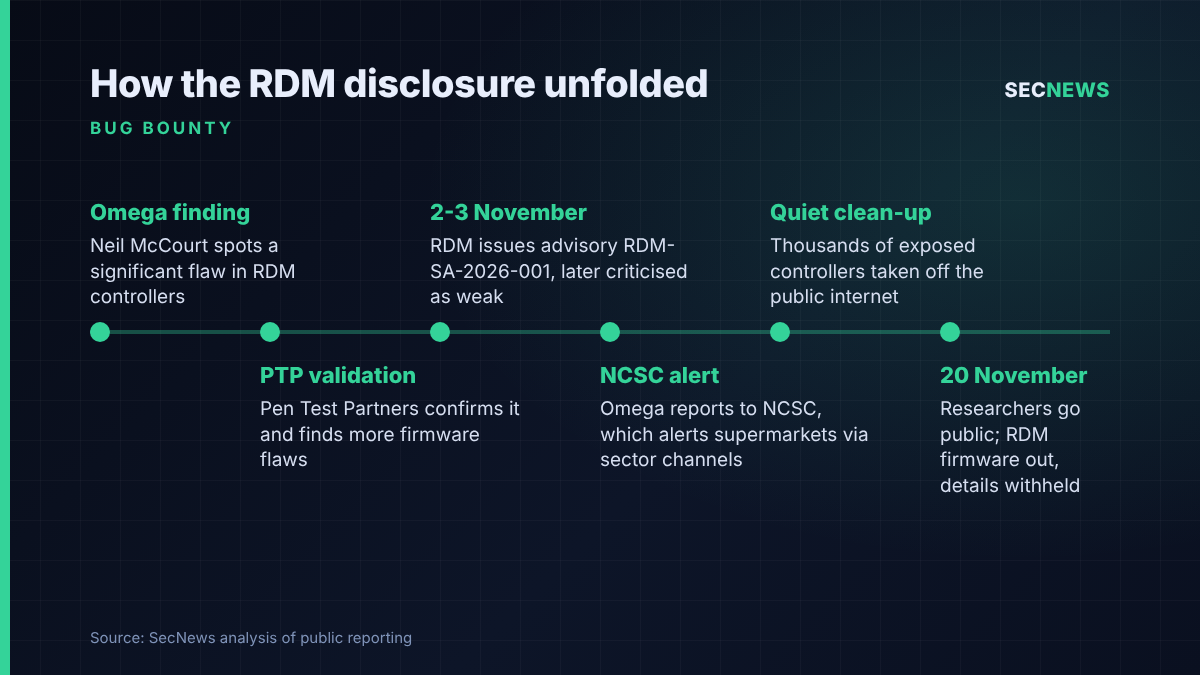
On 20 November 2026 Pen Test Partners (PTP) published its account of how a weakness in controllers made by Resource Data Management (RDM), the Glasgow manufacturer that dominates UK supermarket refrigeration controls, was found, confirmed and contained. The original finding came from Neil McCourt of Omega Solutions, a Yorkshire fridge telemetry firm, who was helping a UK retailer check its estate after this autumn’s attacks on Danfoss controllers on the Continent.
Omega asked PTP to help validate the issue and push it through to a fix. Andrew Tierney and the PTP hardware team confirmed McCourt’s work and found several more vulnerabilities in the firmware, which they reported directly to RDM. RDM has since released new firmware which, according to PTP, should address the serious issues.
What made this unusual was the remediation. Working alongside the NCSC, the British Retail Consortium, Defra and the Food Standards Agency, the researchers and retailer security teams set out to find exposed controllers and get them off the public internet before anyone else found the weakness. Eastern Eye, citing BBC reporting, says several thousand controllers, between them running tens of thousands of fridges and freezers, were disconnected, some by staff physically unplugging network cables and logging temperatures by hand. Restaurants, petrol stations and stadiums were caught up too, and the effort was kept quiet until this week.
The detail
PTP and Omega are deliberately withholding technical specifics, as they do not know how far down the food supply chain the warnings have reached. Ken Munro of PTP told the BBC, as reported by Eastern Eye and Tech Times UK, that the controllers had a weak-password problem comparable to the flaws exploited in the European attacks. PTP adds that some earlier design decisions by RDM make the UK issues harder to discover than the Danfoss ones, but it is blunt about what that means: “That buys time, not protection.”
The disclosure timeline is where this story becomes instructive. RDM sent customers an advisory, RDM-SA-2026-001, on 2 November and revised it on 3 November. PTP calls it weak. In its view the advisory did not say what an attacker could actually do, offered no independent check that the new firmware fixed the problem, did not credit whoever reported it, and gave no assurance that operators further down the supply chain had been told. PTP also says it knows of no attempt by RDM to inform the NCSC, despite the obvious national infrastructure angle.
Omega filled that gap itself and sent the NCSC a far more detailed report. According to PTP, the NCSC never acknowledged receiving it but did push an urgent alert to supermarkets through its sector channels. PTP met the NCSC in person that afternoon, then rang every supermarket security contact it had to check the alert had landed.
To reach operators the alerts had missed, the researchers used Shodan to locate internet-facing controllers, then used location clues and other open-source data to work out who ran them. Devices that could not be attributed without logging in were left alone.
RDM’s account differs on severity. Chief executive Ged Evans said the flaw was found in a test environment and that the research went beyond normal procedure, including dismantling the company’s hardware. According to Tech Times UK, RDM argues an attacker would first need a specific piece of hardware; the researchers counter that it is easy to buy online. RDM says it has found no evidence of malicious activity and is still working with the NCSC.
Why it matters for UK organisations
This is a rare public test of UK coordinated disclosure against a domestic operational technology supplier whose failure would be felt in shops within hours.
First, the vendor advisory is a security control in its own right. An advisory that does not describe impact gives a facilities manager nothing to rank against the rest of the patch queue, and one that does not confirm downstream notification leaves installers and third-party operators guessing.
Second, the reporting route to government matters. Omega’s report reached the right place and the NCSC acted on it, but silence after a critical report from a small firm is exactly what pushes researchers towards public disclosure. PTP does say later NCSC engagement was very helpful.
Third, the legal backdrop. Researchers here mapped exposed devices and contacted owners without accessing them, stopping short of anything that could risk prosecution under the Computer Misuse Act 1990. A promised statutory defence for good-faith research has yet to appear in legislation.
Expert view
In my experience, OT disclosures go wrong in the gap between vendor and operator. The manufacturer patches, the integrator who fitted the kit five years ago has moved on, and the site running it never hears a word. A vendor advisory needs to say who has been told, not just what has been fixed.
The critique of RDM should be read carefully. PTP is frank that, once it reached the chief executive and chief technology officer, the company was open, worked around the clock on firmware and took advice. The failure was in the first written response. Any manufacturer selling into UK critical supply chains should have that advisory template agreed before the call comes in.
When we test building management and refrigeration estates, a controller on a SIM card with a public address is a recurring finding, because it sits outside both the corporate firewall and IT’s asset register.
What to do now
- Find every controller. Inventory RDM and any other refrigeration or building controllers, including units installed and managed by contractors. Cyber Essentials expects this asset scope to be known.
- Get them off the internet. Confirm none are reachable from the public internet. Where cellular modems are used, move to a VPN or private APN, as PTP advises. This maps to the Cyber Essentials firewall control.
- Apply RDM’s latest firmware. Treat it as a security update under the Cyber Essentials patching control, and obtain written confirmation from maintenance contractors that it has been installed.
- Change default and weak credentials on controllers and supervisory software, in line with the secure configuration control.
- Check your supply chain. Ask cold storage, logistics and food manufacturing suppliers whether they received the alert and have acted.
- Fix your own disclosure route. Publish a security.txt and a vulnerability disclosure policy, acknowledge reports within days, and agree an advisory template that states impact, credits the reporter and confirms who has been notified.
Bottom line
The UK appears to have avoided a cold chain incident because a small telemetry firm noticed something, a pen testing firm knew how to escalate it, and retailers worked through their evenings and weekends. That should not be the plan. Vendors need advisories that inform, the NCSC needs to close the loop with reporters, and the law needs to protect the people doing this work.
Sources
- Pen Test Partners: The fridge hack UK supermarkets narrowly avoided?
- Cooling Post: Swift action to secure UK supermarket controls
- Eastern Eye: A hidden weakness in supermarket fridges put Britain’s food supply at risk
- Tech Times UK: UK secures thousands of supermarket fridges from hackers in a secret cybersecurity operation