The FBI is reportedly investigating an intrusion into the National Crime Information Center, the database American police query for warrants, wanted persons and background checks. The bureau has not confirmed anything, but the incident is a sharp reminder for anyone running or supplying a shared national policing system.
What happened
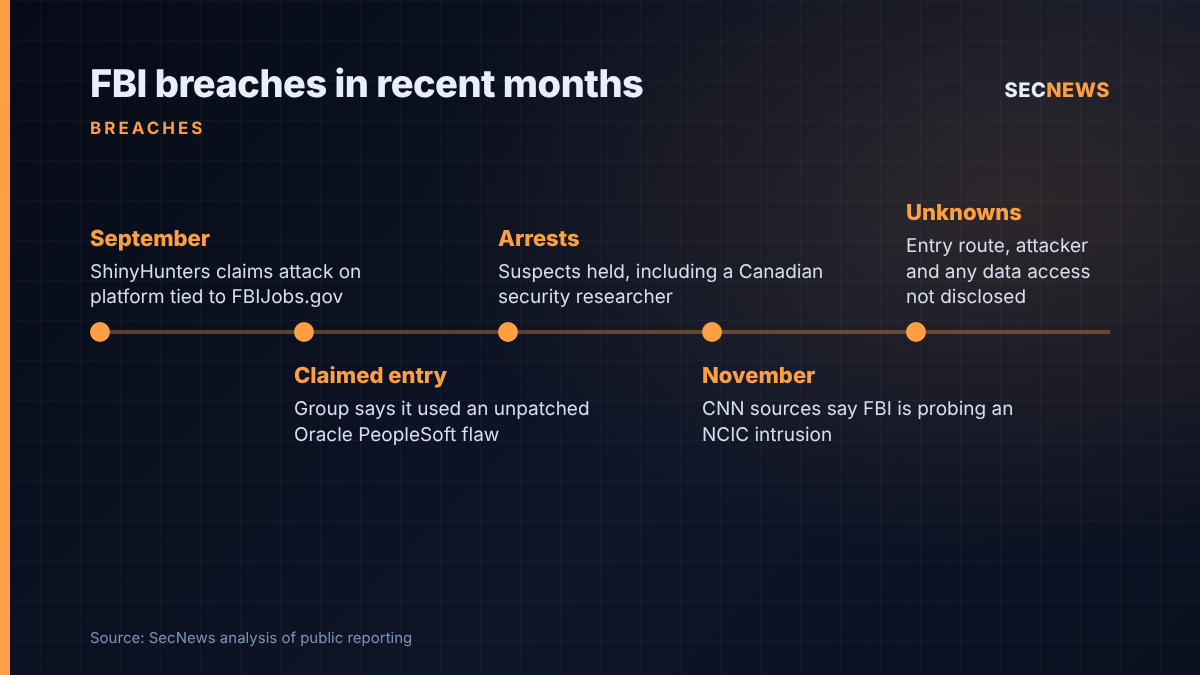
According to CNN, which cited two people briefed on the investigation, the FBI is looking into an apparent breach of the National Crime Information Center (NCIC). The intrusion is said to have come to light in the last few days. Reuters and BleepingComputer have followed up. The FBI did not respond to requests for comment from CNN or BleepingComputer and has not confirmed the incident publicly.
What we do not know is considerable. There is no public detail on when the attackers got in, how they did it, who they are, or whether any records were viewed, copied or changed. BleepingComputer also notes it is unclear whether the system’s availability to police was affected.
If the reporting is accurate, this is the second time the bureau has been breached in a matter of months. In September the ShinyHunters extortion group claimed an attack on a third-party platform linked to the FBIJobs.gov recruitment site, and said it had stolen personal data on FBI staff. BleepingComputer reports that the group said it got in through an unpatched Oracle PeopleSoft flaw. That case led to arrests, including a Canadian described by CNN as a cyber security researcher and author. At present nothing links the NCIC intrusion to ShinyHunters or to the September attack.
The timing is awkward for the bureau. CNN reports that on Thursday, after officials had learned of the intrusion, Director Kash Patel used a Fox News interview to promote the bureau’s cyber security work, including Operation Winter Shield, which CNN says had ended months earlier.
The technical picture
NCIC is not a single application sitting in one data centre that only the FBI touches. It is a national clearing house for criminal justice information, queried by federal, state and local agencies. Officers use it at the roadside to check a driver or vehicle, investigators use it to look up warrants and protection orders, and it supports background checks. Records cover wanted and missing people, stolen vehicles and firearms, and other law enforcement data.
We have no facts about how this intrusion happened, but systems like NCIC have a huge number of legitimate users and connection points: police forces, interface agencies, contractors and the suppliers who build terminals and middleware. Each is a potential way in, and valid stolen credentials on a trusted connection can look a lot like normal use.
The September incident is a useful pointer, if only by analogy. That attack, as claimed, did not hit a core FBI system directly but a third-party platform running a known vulnerable product. Supplier-managed components remain the soft edge of many government estates.
The most worrying outcome is not necessarily theft. A former FBI official quoted by CNN said the bigger question is whether hackers could undermine the reliability of the records that officers act on. In a policing database, an altered warrant flag or a deleted stolen-vehicle entry could have real consequences on the street, and integrity tampering is much harder to spot than bulk exfiltration.
Why it matters for UK organisations
To be clear, nothing in the reporting suggests UK data or UK forces are affected. The relevance is the lesson, because the UK runs its own shared national policing systems with a very similar shape: the Police National Computer (PNC), the Police National Database (PND), and the Law Enforcement Data Service (LEDS) programme being built to replace and consolidate them. Like NCIC, these are queried by many forces and agencies, depend on networks of suppliers and integrators, and hold data where accuracy is as important as confidentiality.
The same applies to NHS, DWP and HMRC platforms and large commercial data hubs: many trusted connections, legacy components and a supply chain often less mature than the core operator. For suppliers, the September FBIJobs case is a direct warning, since, by the attackers’ own account, an unpatched product on a partner platform became the route to a federal agency’s data.
There is also a regulatory dimension. Personal data processed for law enforcement purposes in the UK falls under Part 3 of the Data Protection Act 2018, and a breach involving it would normally be reportable to the ICO unless unlikely to pose a risk to individuals. The Cyber Security and Resilience Bill would also bring managed service providers into the UK’s NIS regime and raise expectations on operators of essential services.
Expert view
In my experience, the hardest systems to secure are not the ones with the weakest technology but the ones with the most trusted connections. When we test large shared platforms, the core is usually reasonably well defended. The findings that matter tend to come from the edges: a partner’s VPN, a service account with far more rights than it needs, an interface server nobody has patched because it “just works”, or audit logs that exist but are never reviewed.
I would also caution against reading too much into an unconfirmed report. Two anonymous sources describing an investigation is not the same as a confirmed compromise of the whole database, and early reporting on incidents is often revised. What is worth taking seriously now is the integrity point. Most organisations plan for data leaving the building; far fewer can answer this with confidence: if an attacker had changed records in our most important system last month, how would we know?
What to do now
- Map every trusted connection. List each force, partner, contractor and integration that can query or update your shared systems, with the account types they use. Remove anything dormant. This sits squarely under the Cyber Essentials user access control requirement.
- Enforce strong authentication at the edges. Phishing-resistant MFA for remote and partner access, and tightly scoped service accounts with no interactive logon where possible.
- Patch supplier-facing platforms first. Internet-facing HR, recruitment and ERP systems, including Oracle PeopleSoft, should be on the shortest patch cycle you run, in line with the Cyber Essentials 14-day rule for high and critical fixes.
- Build integrity monitoring, not just leak detection. Log every change to high-value records, alert on unusual volumes or out-of-hours edits, keep tamper-evident audit trails off the primary system, and test rollback to known-good backups.
- Hold suppliers to evidence. Ask for patch metrics, penetration test summaries and incident notification timelines, and write them into contracts.
- Rehearse the uncertain phase. Run a tabletop exercise in which the first information is a press enquiry citing anonymous sources, and decide in advance who speaks and what you say.
Bottom line
The FBI has confirmed nothing, and the scale of any NCIC compromise is unknown. But a reported intrusion into a national policing database, months after a supplier-linked breach at the same agency, is exactly the scenario UK operators of shared public sector systems should be planning for. Lock down the trusted edges, watch for quiet changes as well as big exports, and make suppliers prove their security rather than promise it.