A day after Grand Theft Auto VI reached consoles, Bitdefender exposed a website selling Windows users a “cloud client” for a PC version that does not exist. Behind the trailer it plays is a three-stage chain that ends with a Rust infostealer hunting browser sessions, crypto wallets and AI developer keys.
What happened
Rockstar Games released GTA VI on 19 November 2026 for Xbox and PlayStation only. On 20 November, researchers Janos Gergo Szeles and Silviu Stahie at Bitdefender Labs published an analysis of gta6cloud.nexus, a site claiming its software lets PC owners stream the console game to Windows.
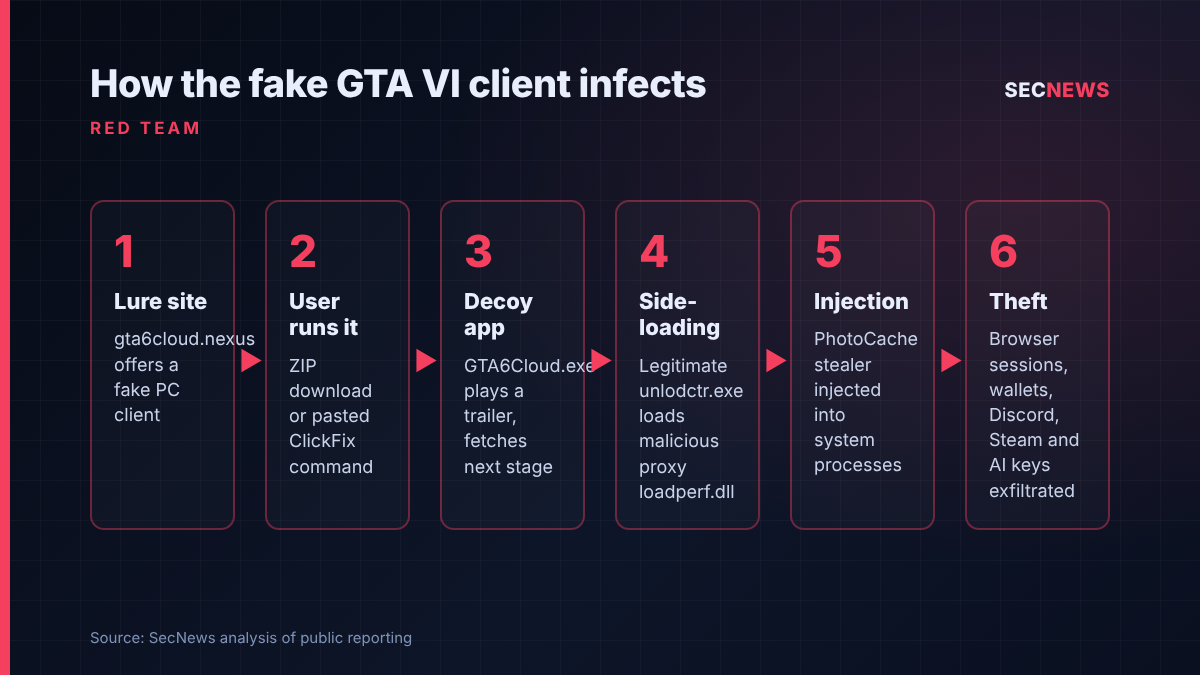
Visitors are offered two routes. One is an ordinary ZIP archive containing GTA6Cloud.exe. The other is a ClickFix-style prompt that asks the user to open the Windows Run box, paste a PowerShell one-liner and press Enter. Either route installs the same malware.
This is not an isolated lure. On 17 November Darktrace published its own review of GTA VI-themed activity, reporting that twelve customer environments had contacted gta6demo.asia, a domain publicly linked to a fake demo pushing the Vidar stealer, and that one of those was a UK-based customer. Across its GTA VI-themed detections, organisations included manufacturing, finance, and public administration and defence, which is a reminder that gaming lures land on corporate networks, not just bedroom PCs.
The technical picture
What stands out is how much effort has gone into a consumer lure. Bitdefender describes three stages.
Stage one: the decoy. GTA6Cloud.exe is built with Tauri, the lightweight framework for desktop apps built on web technology. It shows a GTA-themed window playing the official trailer, which gives the victim something plausible to watch. Meanwhile it pulls two files from a freshly registered domain into a folder buried under the user’s local Explorer icon cache path, then marks that folder hidden.
Stage two: side-loading. The two files are unlodctr.exe, a genuine Microsoft utility for removing performance counters, and a malicious loadperf.dll. Because the legitimate binary looks for that library in its own directory first, it loads the attacker’s copy. The rogue DLL is a proxy: it forwards each export to the real Windows library so the host does not crash, and only fires its payload when one specific export is called. It also checks that it has been loaded by unlodctr.exe, a check that defeats many sandboxes.
Stage three: injection and theft. Hidden in the DLL’s overlay is a further executable, PhotoCache.exe, which never touches disk. It is injected into a legitimate system process; Bitdefender saw waitfor.exe used, with where.exe, dllhost.exe, RuntimeBroker.exe and sihost.exe among the alternatives picked at random. The payload is a Rust stealer, possibly new or reworked, with a configuration protected by ChaCha20-Poly1305. It talks to its server over HTTP POST with a distinctive “PhotoCache/1.6” user agent and persists through a Run key in the user’s registry hive.
Its shopping list is broad: credentials, cookies and tokens from Chromium and Gecko browsers, Discord and Steam data, cryptocurrency wallets, clipboard contents and history, screenshots, and, notably, credentials and API keys for AI and developer services. Bitdefender lists the infrastructure as velmontriq.net for payloads, nimbuskeep.com for command and control, and 192.30.240.26 on port 7777.
Why it matters for UK organisations
Grand Theft Auto is a British success story; Rockstar North is based in Edinburgh, and the franchise’s last big security moment was also British. Arion Kurtaj, who leaked early GTA VI footage in 2022, pleaded guilty at Woolwich Crown Court this month.
The risk to businesses is not that staff will play games at work. It is that the same person often uses one browser profile, one password manager and one set of logged-in sessions across personal and work life. A stealer that lifts cookies and tokens can hand an attacker live Microsoft 365, Slack or GitHub sessions without ever needing a password or tripping MFA. The explicit targeting of AI and developer API keys is the sharpest edge here. A developer who installs this on a home machine that also holds a cloud or model provider key could expose far more than their gaming account.
Darktrace’s data suggests GTA VI lures are already reaching corporate networks in our region, including public administration and defence organisations, although via a different fake demo. With home working and BYOD, many UK firms cannot see the device where infection starts.
Expert view
When we run phishing and initial access simulations, the payloads that succeed are rarely clever exploits; they are believable stories that persuade a user to do the work for us. ClickFix is the purest form of that. Asking someone to paste a command themselves sidesteps email attachment filtering and download reputation checks, and because the user starts the process, many controls treat it as intended behaviour.
The side-loading choice is also telling. Pairing an obscure but signed Microsoft binary with a proxy DLL is the kind of technique that used to be the preserve of state-backed operators and red teams. Seeing it in a game-launch lure confirms what many of us in the testing community have been saying for a while: commodity crime now ships with tradecraft that was considered advanced a few years ago. In my experience, application control rules that only trust “anything signed by Microsoft” are exactly what this approach is designed to defeat.
Finally, the process injection into system binaries means defenders relying solely on file scanning will miss the stealer entirely. Behavioural telemetry, such as waitfor.exe making outbound web requests, is far more useful.
What to do now
- Block the known indicators. Add gta6cloud.nexus, velmontriq.net, nimbuskeep.com and 192.30.240.26 to web and DNS filtering, and load Bitdefender’s published file hashes into your EDR. Check proxy logs for the “PhotoCache/1.6” user agent.
- Restrict scripting for standard users. Use Group Policy or Intune to limit PowerShell and the Run dialogue for users who do not need them, and enable PowerShell script block logging. This supports the Cyber Essentials secure configuration control.
- Tighten application control. Under the malware protection control, move beyond trusting all Microsoft-signed binaries; consider blocking rarely used utilities such as unlodctr.exe from running out of user-writable folders like AppData.
- Hunt for side-loading and injection. Alert on signed system binaries loading DLLs from non-system paths, and on processes such as waitfor.exe or where.exe opening network connections.
- Protect sessions, not just passwords. Shorten session lifetimes for high-value SaaS, use token protection or device-bound sessions where your identity provider supports them, and revoke all sessions for anyone who reports running a “GTA client”.
- Secure developer and AI keys. Keep API keys in a secrets manager rather than browsers or local files, scope them tightly, and rotate any held on a device that may be compromised.
- Brief staff now. Tell them there is no PC version of GTA VI, and that no genuine site asks them to paste commands.
Bottom line
This campaign pairs a perfectly timed lure with genuinely competent tradecraft: user-run commands, signed-binary side-loading and fileless injection. It targets gamers, but what it steals, from session cookies to AI keys, is exactly what an attacker needs to walk into a corporate tenant. Treat game-launch season as a phishing season, restrict what users can run, and assume any device that ran the fake client is compromised.
Sources
- Bitdefender Labs: Fake GTA VI PC Client Spreads Malware Through a ClickFix Attack
- Hackread: Fake GTA VI Streaming Client Installs Data-Stealing Malware on Windows PCs
- Darktrace: GTA VI Cyber Threats: Fake downloads, ransomware and account hijacking
- The Record: Autistic teen hacker pleads guilty to leak of Grand Theft Auto VI footage