
Rapid7 has found a rebuilt SoftEther VPN Bridge, branded internally as NtMonitor VPN, that it links with moderate confidence to the China-aligned Webworm group. There is no malware in it to catch, so UK defenders need to hunt for an unexpected network bridge rather than wait for an antivirus alert.
What happened
On 19 November 2026 Rapid7 Intelligence published its analysis of a custom tool built from the open-source SoftEther VPN project. The sample is a 64-bit Windows build of the SoftEther VPN Bridge, version 4.44 build 9807, rebuilt from source and given a new identity. Its file metadata calls it “Network Monitor Software” from a company called Network Systems Solutions Inc., and its original filename is netcapa.exe. Inside the binary, many references to SoftEther have been renamed NtMonitor VPN.
Rapid7 attributes the tool to Webworm with moderate confidence. Webworm is a China-aligned espionage group that ESET has tracked moving from Asian targets towards European government bodies. In May 2026 ESET described Webworm targeting government organisations in Belgium, Italy, Poland, Serbia and Spain. In 2024 it had already reported the group swapping its backdoors for a stock SoftEther bridge at several EU government bodies.
The finding that should worry SOC teams most is how little detection the tool gets. Rapid7 says only one antivirus engine on VirusTotal flagged the sample when it analysed it, even though the file had been public since January. Rapid7 has released indicators, YARA rules and a configuration decryptor.
The technical picture
Rapid7 compared the sample with the matching tag of the public SoftEther repository and found no added backdoor and no command execution feature. The tool is still a VPN bridge. It joins (“cascades”) a remote network controlled by the operator into the victim’s local network. That gives the attacker a persistent network route into the estate without a shell or implant that endpoint tools are built to spot.
What the operator changed is the detection surface. Rapid7 lists several deliberate changes:
- Masquerading metadata: the version field is the only part of the file properties that still matches the official vpnbridge_x64.exe build.
- Renamed web endpoints: SoftEther’s well-known /vpnsvc/ handshake paths were replaced with update-style paths, /update/alive.cgi and /update/picture.cgi.
- New handshake watermark: the stock GIF byte pattern that SoftEther peers exchange was replaced with a truncated PNG of the Windows logo. This means stock clients cannot connect and signatures written for the standard watermark miss it.
- No tell-tale files on disk: the hamcore.se2 resource archive, which normally sits next to the executable, was cut down and embedded inside the binary. This makes the file about 1.5 MB larger than the official build.
- Encrypted configuration: the plain-text vpn_bridge.config was renamed setting.conf and encrypted with a custom RC4-like cipher. These files begin with the ASCII marker RCEN.
The rebranding is not complete, and that helps defenders. The Windows service still runs as SEVPNBRIDGE, many registry paths still refer to the SoftEther Project, and a developer PDB path inside the file reveals where it came from. In the configurations Rapid7 decrypted, remote peers that did not look like tests sat in AS20473, run by The Constant Company (parent of Vultr). Webworm has used that hosting network before. Rapid7 treats this as supporting evidence for the attribution, not proof.
Why it matters for UK organisations
Neither Rapid7 nor ESET names a UK victim, and nothing published so far suggests that UK bodies have been hit. The pattern still matters here. Webworm focuses on European government networks, and UK central and local government, defence suppliers and the consultancies that serve them sit in the same diplomatic and supply-chain circles. A publicly available sample that only one antivirus engine flagged, months after it surfaced in January, is a reminder that many UK SOCs still rely on signatures and endpoint alerts that this kind of intrusion is designed to avoid.
In 2024 ESET advised treating SoftEther binaries on a network as suspicious, especially ones with unexpected filenames. Rapid7 describes this sample as a hybrid: legitimate software that has not been trojanised, but rebuilt from source to remove its fingerprints. Any rule that relies on stock SoftEther strings, file names or handshake bytes needs revisiting.
Expert view
In my experience, a rogue VPN bridge is one of the hardest things for a typical SOC to catch. It looks like a service doing service things: it starts at boot, opens outbound web connections and adds a firewall rule. When we test detection capability, an unapproved tunnel often outlives a noisy implant, because few teams know which machines should hold long-lived sessions to cloud hosts.
The lesson from this research is to hunt for behaviour and relationships, not for names. The NtMonitor branding, the endpoint paths and the PNG watermark are all trivial for the operator to change next time, and Rapid7 says as much. The things that are harder to change are structural. A new Windows service appears and creates firewall rules. A host keeps a persistent session to a VPS provider, and traffic starts flowing from that host to internal systems it has never talked to before. Correlating those signals across endpoint, firewall and proxy logs catches the whole class of attack, not one build.
I would also caution against treating a hit as a simple clean-up. If you find an unauthorised bridge, the compromised host was a doorway, and the real question is what the operator reached through it. Before you remove anything, preserve the binary, its configuration and the connection logs, then scope every system the host could reach.
What to do now
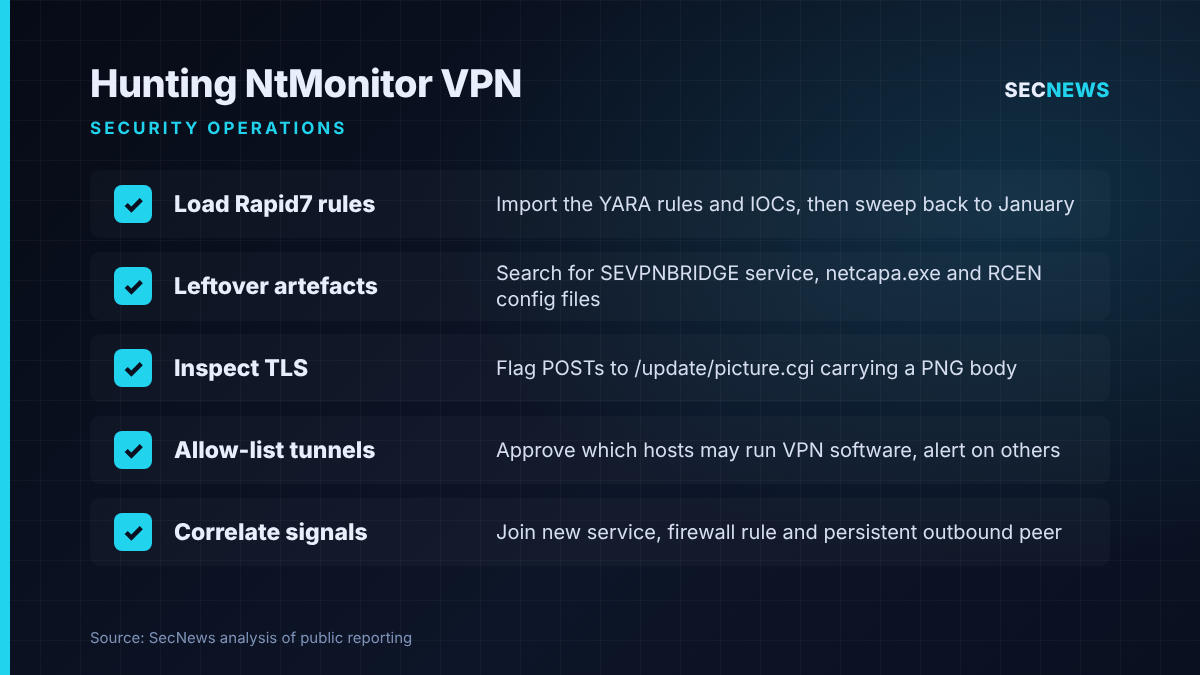
- Load the published detections. Import Rapid7’s YARA rules and indicators of compromise into your EDR and retrospective search tooling, and sweep back to at least January, when Rapid7 says the sample became public.
- Hunt for the leftover SoftEther artefacts. Search for the SEVPNBRIDGE service name, registry keys mentioning the SoftEther Project, files named netcapa.exe or setting.conf, and configuration files that begin with RCEN.
- Use TLS inspection where it is authorised. Rapid7 rates POST requests to /update/picture.cgi with an image/jpeg content type and a body that starts with a PNG signature as one of the most reliable network detections available now.
- Build an allow list for tunnelling software. Record which VPN products are approved, which hosts may run them and which remote networks they should reach. Treat anything else as an incident. This maps to the Cyber Essentials secure configuration and firewall controls.
- Tighten egress. Long-lived outbound connections from servers to general cloud hosting ranges deserve an alert, and in most estates a default-deny egress policy from server networks is realistic.
- Correlate, do not isolate. Write analytics that join three things: a new service, a new firewall rule and a new persistent outbound peer on the same host. Any one of them alone is noise. Together they point to something serious.
Bottom line
Webworm’s NtMonitor VPN shows a state-aligned operator carefully stripping a legitimate tool of every easy fingerprint while leaving its function untouched. Signature updates should now catch this build. The next one will need defenders who know what normal tunnelling looks like in their own estate and who hunt for anything that does not fit.
Sources
- Rapid7: Spying on Governments with Zero Lines of Malware: A Custom SoftEther Bridge in Webworm’s Toolkit
- Cyber Security News: Hackers Turn Legitimate VPN Software Into a Stealthy Tool for Spying on Government Networks
- ESET: China-aligned Webworm targets European governments
- TechRadar: Chinese hackers are using this open-source VPN to mask spying activities