A new Brit Insurance survey of 500 UK small and medium-sized firms finds AI-driven attacks are pushing owners towards cyber insurance, with most existing policyholders planning to raise their cover. Yet price still decides most purchases, and many firms lack the basic controls that make a policy worth having.
What happened
On 19 November 2026 Brit Insurance, the specialty insurer that writes business through Lloyd’s, published A Turning Tide, research based on a survey of 500 senior decision-makers at UK SMEs. Fieldwork ran from 19 to 27 August 2026, so the answers predate some of the autumn’s bigger incidents but follow a long run of headline retail and manufacturing attacks.
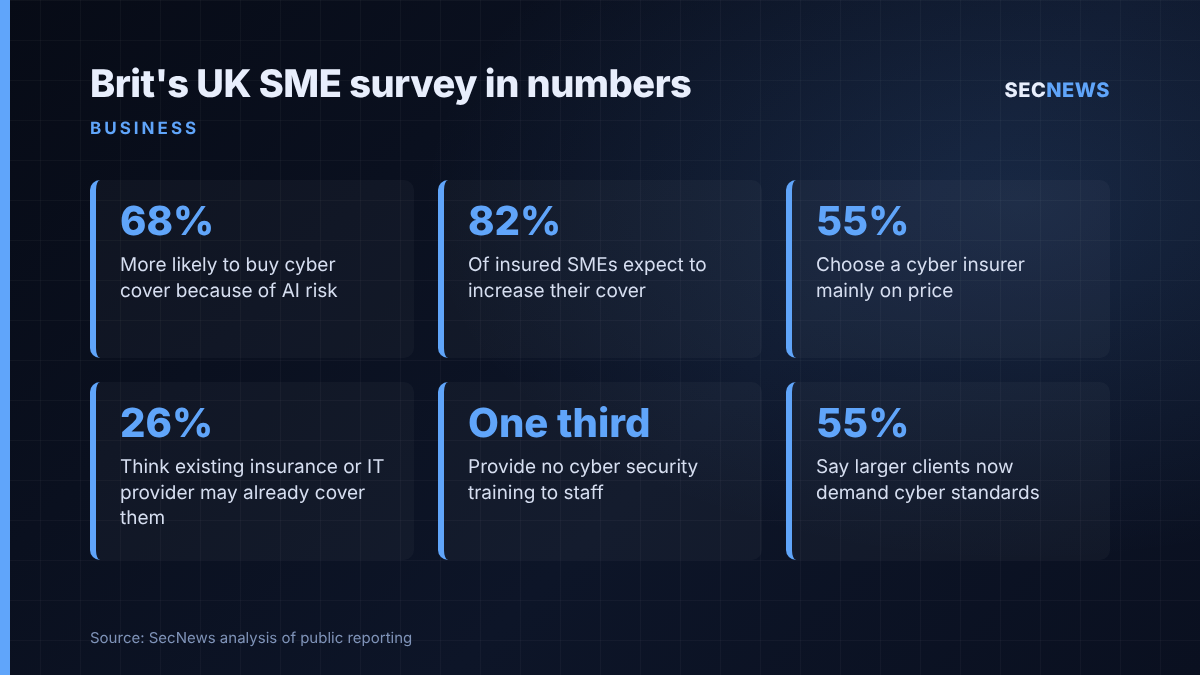
The headline is demand. Some 68% of respondents told Brit that AI-related risk has made them more inclined to buy cyber cover, and 79% think AI is helping attackers become more capable and harder to stop. Among firms that already hold a policy, 82% expect to increase their protection over the coming year, while 37% of uninsured firms say they are very likely to buy one. Nearly two-thirds (64%) now place security near the top of their agenda, and 45% plan to spend more on it.
The less comfortable findings sit underneath. More than a third have no dedicated cyber budget or team, about a third give employees no security training at all, and 55% say price is the single biggest factor when choosing an insurer. A further 26% think an existing business policy or their outsourced IT provider may already have them covered.
The detail
Brit’s respondents ranked autonomous or AI-enabled attacks as their biggest worry (27%), ahead of ransomware and outdated or unpatched systems, which were each named by 19%. Human error still features heavily: 30% put staff mistakes, such as falling for phishing or using weak passwords, in their top three threats.
Growth is the other driver. Almost two in five SMEs say their defences may not keep pace with expansion plans, and that rises to 58% among the smallest firms, those turning over less than £500,000. Of the businesses planning to spend more, 43% cite growth as the main reason. Supply chain pressure is real too: 55% say larger customers now expect them to meet defined cyber standards, and 61% worry they could be held liable if an attack on them disrupted a client.
Survival is a genuine concern. A third of respondents doubt their business would survive a cyber attack, with that fear strongest in the North of England, at 40%, and London, at 39%. Brit points to government research putting a small firm’s typical recovery bill after a serious incident at almost £8,000, with total losses able to pass £50,000 once lost trading and reputational harm are counted. According to Insurance Business, the report also cites a 2026 claim reserved at £350,000 on a policy costing under £3,500 a year.
Brit’s Adelle Gruber, class underwriter for cyber and technology, highlighted that 74% of SMEs intend to take some action within 12 months, adding that cover should not be seen “simply” as “a payout after an attack”.
Why it matters for UK organisations
For the insurance market, this is a growth story at a time when rates are soft. Insurance Business notes UK cyber rates have fallen by around 7% on average through 2026 and, citing GlobalData, puts SME take-up at roughly 40% against about 70% for FTSE 100 companies. Insurers and brokers clearly see the small business segment as where new premium will come from.
For buyers, the risk is that anxiety about AI turns into purchases made on price alone. A cheap policy bought by a firm with no training, no tested backups and no clear owner for security is likely to come with tight conditions, higher excesses or awkward questions at claim time. The 26% who assume they are already covered are a different problem: many standard small business packages either exclude cyber events or are silent on them, and outsourcing IT does not move responsibility for customer data, contracts or keeping the business running.
The supply chain figure matters for larger organisations as well. If more than half of SMEs report that customers are imposing standards, procurement teams are already using cyber requirements as a gate. The Cyber Security and Resilience Bill, which would pull managed service providers into regulation, will add to that pressure further down the chain.
Expert view
Surveys sponsored by insurers naturally lean towards the conclusion that more firms should buy insurance, and this one is no exception. That does not make the numbers wrong, but the useful part is the gap it exposes between concern and capability. In my experience, the small firms that struggle after an incident are rarely undone by a novel AI technique. They are undone by an exposed remote access service without multi-factor authentication, a shared admin password, or backups sitting on the same network as everything else.
The AI worry is understandable, and attackers are certainly moving faster. But the controls that blunt an AI-assisted phishing run or an automated scan are the same ones that have always worked: patching, strong authentication, least privilege and staff who know to verify a payment change by phone. When we test smaller environments, those basics are where most of the findings sit.
The better cyber policies do bring real value beyond the cheque: incident response retainers, legal and forensic support, and help with notifying the ICO. For an SME without a security team, that access can matter more than the limit. The sensible approach is to treat insurance as one layer of a plan, not the plan itself.
What to do now
- Check what you actually hold. Read your current business policy for cyber exclusions or silence, and ask your broker in writing whether data breaches, ransomware, business interruption and funds transfer fraud are covered.
- Get the fundamentals in place first. Cyber Essentials covers firewalls, secure configuration, user access control, malware protection and security update management. Certification lowers your risk and can help at renewal.
- Turn on multi-factor authentication everywhere. Prioritise email, remote access, finance systems and admin accounts, in line with the Cyber Essentials user access control requirements.
- Train staff and set payment rules. Short, regular phishing awareness and a mandatory call-back to a known number for any change of bank details will stop a large share of fraud claims.
- Test your backups and response plan. Keep at least one offline or immutable copy, rehearse a restore, and know who you would call in the first hour.
- Compare cover, not just premium. Look at sub-limits, waiting periods, excesses, panel response services and the conditions attached to controls before choosing on price.
- Clarify responsibilities with your IT provider. Agree who monitors, who patches and who leads during an incident, and record it in the contract.
Bottom line
Brit’s research shows UK small businesses are finally taking cyber risk seriously, with AI acting as the spur and demanding customers as the enforcer. The danger is that firms buy the cheapest policy and stop there. Insurance works best for businesses that have already done the basics, and those basics remain the most cost-effective defence any SME can buy.