Two US House committees want Chinese-developed open-weight AI models pulled out of federal systems and high-risk critical infrastructure, after finding them embedded in products at Airbnb, DoorDash and Cursor maker Anysphere. The report is aimed at Washington, but its central warning, that nobody really knows which models are running where, applies equally to UK organisations.
What happened
On 20 November 2026 the House Committee on Homeland Security, chaired by Andrew Garbarino, and the House Select Committee on the Chinese Communist Party, chaired by John Moolenaar, published a joint investigative report on American companies building open-weight AI models from the People’s Republic of China into their products. The investigation began in April 2026 and drew on hearings, classified briefings and submissions from Airbnb, DoorDash and Anysphere, which makes the Cursor coding platform.
The findings are specific. Airbnb runs customised versions of Alibaba’s Qwen models on US-based infrastructure, including a customer assistant handling around 80,000 interactions a day. Anysphere built its Composer 2 coding model on Moonshot’s Kimi K2.5, a fact that only became public after an outside developer identified the base model. DoorDash reported 25 Chinese model families in non-trivial use and told the committees that swapping out a single embedded model might need as long as six months.
The committees compare the situation to Huawei and ZTE equipment, which spread through US networks before anyone tried to remove it. The report makes 12 recommendations, from an AI bill of materials to a ban on Chinese-developed models and their derivatives in federal systems and federal contract work. In their foreword the chairmen argue that “Beijing is using stolen intelligence to close the gap”, a reference to what US agencies describe as industrial-scale distillation of American frontier models through fraudulent accounts and proxy networks.
The technical picture
It is worth being precise about what the report claims. It does not allege a confirmed backdoor in any Chinese model. Its concern is that hidden or conditional behaviour is hard to detect and grows more dangerous as capability rises. It cites CrowdStrike research finding that a DeepSeek reasoning model was up to 50% more likely to produce badly flawed code when prompts touched politically sensitive topics, and Booz Allen testing in which three of four Chinese models wrote more vulnerable code when the user claimed to work for the US government.
Offensive capability is the second strand. According to the report, NIST judged Zhipu’s openly available GLM-5.3 the most cyber-capable open-weight model released so far, about four months behind the American frontier on government cyber benchmarks. Its safeguards were reportedly stripped back, cutting its refusal rate on harmful requests from about 95% to between 3% and 6% for roughly $4,400.
The third strand is provenance. Chinese models made up 41% of Hugging Face downloads in the prior year, the report says, and Qwen alone has more than 151,000 derivatives there. Because downloaded weights generate no invoice or contract, spending data badly understates use. Models can be fine-tuned, merged and renamed until their origin is buried several layers deep. The committees accept that self-hosting keeps prompts and customer data away from Chinese servers, but call secure deployment “necessary but not sufficient”, because it does nothing about how a model was trained, aligned or might behave under specific triggers.
Why it matters for UK organisations
The report is a US document with US recommendations. Its main UK reference is a call to widen joint model testing with allied AI security institutes, following a joint US-UK assessment of Kimi K3; footnotes also cite an MI5 espionage alert. Nothing in it binds British firms. What follows is my own reading of what it means here.
The same models are freely available to UK developers, and the economics that drove Airbnb and DoorDash apply in Manchester as much as in San Francisco. Based on published API prices, the report estimates that leading US proprietary models cost six to 30 times more than Chinese ones for an equivalent workload. Any UK software house, SaaS provider or managed service provider under margin pressure faces the same temptation, and the Anysphere case shows the end customer may never be told. If you use a commercial coding assistant, customer service bot or document summariser, there is a real chance a Chinese-developed base model sits somewhere in the stack.
For UK operators of essential services and their suppliers, the questions the committees raise are ones regulators and auditors will eventually ask: what models are you running, where did they come from, and could you replace them?
Expert view
I think the most useful part of this report is not the geopolitics but the supply chain lesson. When we test environments now, AI components are almost always outside the asset register. Teams know which SaaS platforms they use, but not which model sits behind a vendor’s chatbot or which open-weight checkpoint an internal team pulled down for a prototype that quietly went into production.
DoorDash’s approach, as described in the report, is a sensible baseline: treat model inputs, outputs and actions as untrusted, check model file hashes and accept only safe file formats. That is good practice whatever the country of origin. The weakness the committees identify is that company submissions said far more about model performance and security controls than about how the firms had assessed the developers themselves. A model can pass every benchmark you run and still carry behaviour triggered by inputs you never thought to try.
I would caution against reading this as purely a China problem: backdoored fine-tunes and hijacked packages can come from anywhere. Provenance and replaceability apply to every model you deploy.
What to do now
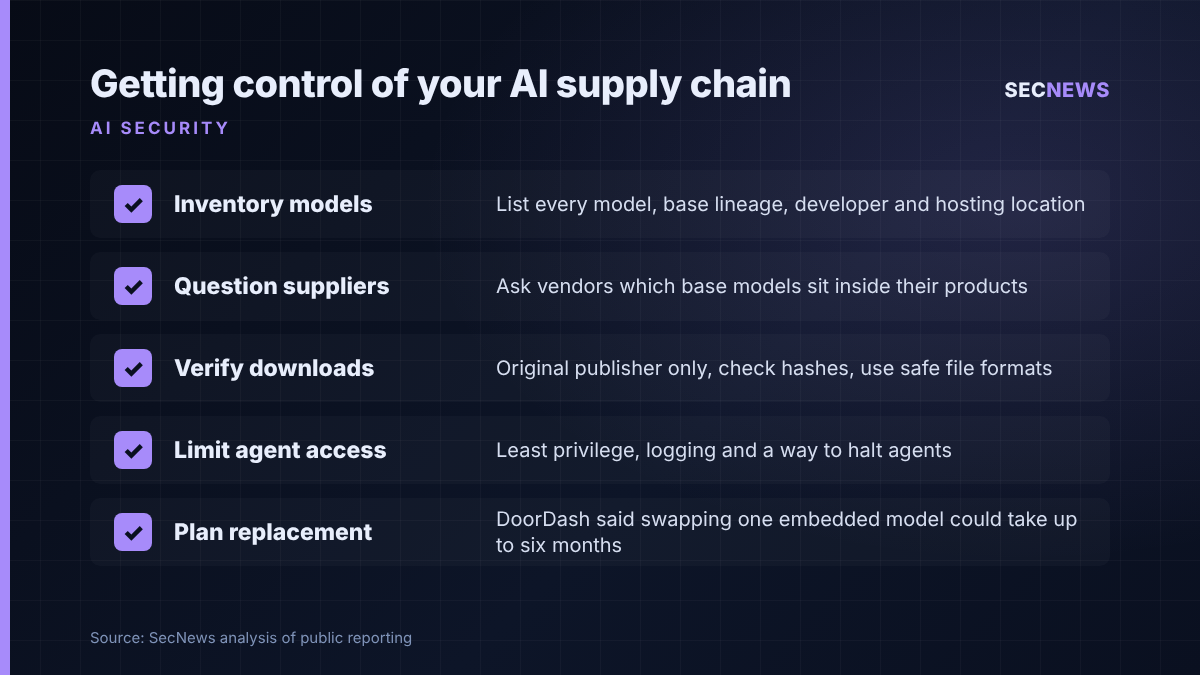
- Build an AI inventory. List every model in use, including those inside third-party products, with base model, developer, version and hosting location. Treat it as part of the software inventory that Cyber Essentials secure configuration and patch management already expect.
- Ask suppliers directly. Add questions on base model lineage, fine-tuning sources and country of development to procurement and annual supplier reviews, and require notice of changes.
- Verify what you download. Pull weights only from the original publisher, check hashes, prefer safe serialisation formats and keep approved models in a private registry.
- Limit what models can do. Apply least privilege to AI agents and the accounts they use, in line with Cyber Essentials user access control. Log their actions and keep a way to halt them.
- Test for conditional behaviour. Include context-varied prompts, such as claimed identity, sector or sensitive topics, in pre-deployment testing, especially for code generation.
- Plan for replacement. For any model in a critical workflow, document an alternative and estimate the time to swap it. DoorDash’s six-month figure is a useful reality check.
Bottom line
The House report is a political document with a US policy agenda, and UK organisations do not need to adopt its conclusions wholesale. But it shows, with named companies and hard numbers, how quickly foreign-developed models have spread into everyday products without customers knowing. If you cannot say which models your business relies on, where they came from and how long it would take to replace them, that is the gap to close before a regulator, a customer or an incident forces the issue.
Sources
- House Committee on Homeland Security: Chairmen Garbarino, Moolenaar release joint investigative report urging removal of PRC open-weight models
- House Committee on Homeland Security and Select Committee on the CCP: Joint report on PRC-developed AI models (PDF)
- The Record: US companies’ use of Chinese open-weight AI draws criticism from House committee chairs