VirusTotal and Google Threat Intelligence now tag a sample as ransomware only after their sandboxes watch it destroy real user documents. For UK security operations teams, the change offers cleaner triage signals and a new way to find lockers that static engines are still missing.
What happened
VirusTotal has introduced three linked changes to how its dynamic analysis identifies ransomware, rolled out across both VirusTotal and Google Threat Intelligence. The changes were described in a VirusTotal blog post by Karl Hiramoto dated 20 November 2026 and reported by Cyber Security News over the weekend.
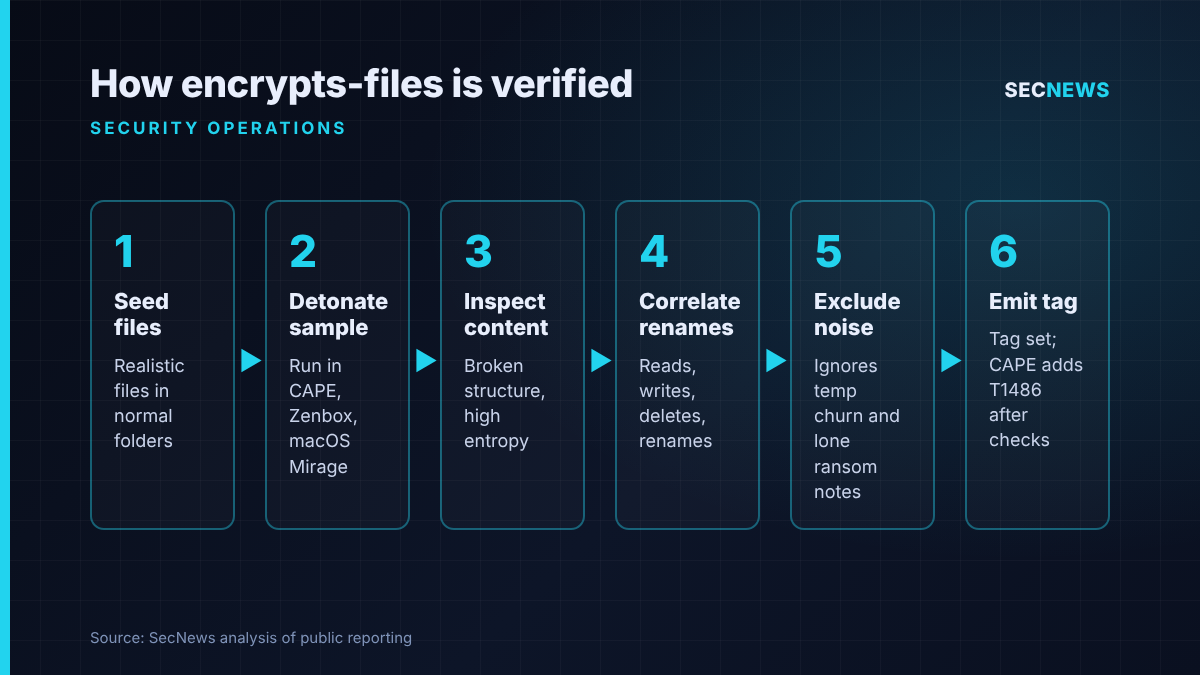
The first is a new behavioural tag, encrypts-files, which appears on a sample only when one of three sandboxes confirms that user documents were genuinely encrypted during detonation. The sandboxes are CAPE and Zenbox on Windows and macOS Mirage on Apple Silicon. The second is a tightening of how the CAPE sandbox maps activity to MITRE ATT&CK technique T1486, Data Encrypted for Impact. The third is support for real-time alerting on the new trait through VirusTotal Livehunt and the YARA-X rule engine.
VirusTotal reports that, across 328,257 new unique files analysed since 17 November, the tag fired on 55. Every one of those matches was reviewed by hand and none was benign software. One of the most striking finds was a Python locker, system_update.pyw, linked to a campaign that appends a .k404 extension to victims’ files. It scored zero out of 75 antivirus engines when it was analysed, yet the Zenbox sandbox watched it rewrite Desktop documents into ciphertext.
The technical picture
The problem VirusTotal is tackling is familiar to anyone who has triaged sandbox output. Plenty of legitimate software uses cryptography and churns through thousands of temporary files, so “calls crypto APIs” or “writes lots of files” is a weak indicator of ransomware. Meanwhile, modern ransomware-as-a-service payloads written in Rust, Go or .NET often bundle their own AES or ChaCha20 code and never touch the operating system’s crypto libraries, so hooking those libraries misses them.
The new approach judges the outcome rather than the method. Each sandbox is seeded with realistic documents in normal user profile folders. During and after detonation, the system inspects what happened to those files on disk, looking for broken file structures, raised entropy and non-text byte patterns. It also correlates reads, writes, renames and deletions to spot the classic pattern of originals being replaced by copies carrying a uniform new extension. Installers, self-extracting archives, compilers, browser caches and logs are excluded when they only generate routine temporary files, and dropping a ransom note or calling a crypto function is not enough on its own. Because it examines results rather than API calls, VirusTotal says the method catches AES, ChaCha20, XOR and intermittent (partial) encryption alike.
The T1486 change matters just as much for analysts. Previously, generic CAPE file-churn signatures could earn the T1486 label without any proof of encryption. According to VirusTotal, CAPE was producing 1,039 such hits a day, 78.5% of them on files no antivirus engine flagged. With the new gate, platform-wide T1486 volume fell from 7,238 files a day to 171, a 97.6% reduction.
The blog gives worked examples beyond the .k404 campaign: an INC Ransom sample using Windows I/O completion ports to encrypt documents at speed, a BlackWizardLock sample that displays a full-screen lock screen and threatens the Master Boot Record, and a native Apple Silicon sample, Heartbreaker, that installs a LaunchAgent and encrypts files in Downloads.
Why it matters for UK organisations
Ransomware remains the threat that keeps UK boards awake, and the decisive moments in any such incident are the early ones: recognising that encryption is under way, isolating hosts and protecting backups before they are reached. Anything that shortens the gap between “suspicious binary” and “confirmed encryptor” helps.
Most UK SOCs, whether in-house teams or managed service providers, already lean on VirusTotal during triage, often through SOAR enrichment. A trustworthy behavioural verdict changes the conversation in a live incident. An analyst who sees a crypto behaviour flag only knows that encryption code exists; seeing encrypts-files alongside T1486 tells them the sample has actually destroyed documents in a controlled run. That is the difference between a ticket and an incident bridge.
There is also a reminder here about detection gaps. A locker scoring 0 of 75 is a snapshot taken at analysis time, not proof that every endpoint product would fail, but it underlines that smaller organisations relying purely on signature-based antivirus are exposed to fresh script-based payloads.
Expert view
In my experience, alert fatigue does more damage to SOC effectiveness than any single missing signature. A MITRE label that fires on installers and updaters trains analysts to ignore it, and that habit is dangerous when the real thing arrives. Cutting T1486 noise by almost the whole volume, while keeping a high-confidence signal, is the sort of unglamorous engineering that actually improves response times.
I would caution against reading too much into the clean early numbers. Fifty-five matches over a few days is a small sample, and VirusTotal itself is candid that the tag is built for precision, not completeness. It lists the common ways ransomware will slip past: builds that need a password or command-line argument to run, samples that detect virtual machines or sleep beyond the analysis window, lockers waiting on an unreachable key server, DLLs needing a specific export, and families that only target network shares. When we run ransomware simulations for clients, share-only encryption is exactly the behaviour that matters most in a real estate, and a single-host sandbox will not see it. So treat the presence of the tag as strong evidence, and its absence as no evidence at all.
The most interesting use for mature teams is probably the corpus angle. Purple teams and storage teams testing rollback or anomaly detection need samples that verifiably encrypt, and filtering on this tag provides them.
What to do now
- Update triage playbooks. Treat encrypts-files plus T1486 as a trigger for immediate containment and backup isolation; do not treat a missing tag as a clean verdict.
- Re-check old lookups. Cached reports keep their historical tags. For samples from open cases, use Reanalyze in the VirusTotal interface; VirusTotal says this queues dynamic runs only on eligible sandboxes that have not yet analysed the hash.
- Add a low-detection hunt. If you hold a Livehunt licence, deploy a rule on the ENCRYPTS_FILES trait with a threshold of fewer than ten engine detections, as VirusTotal suggests, and route matches to your threat intelligence queue.
- Protect sensitive samples. Files from client or regulated incidents should go through Private Scanning rather than the public corpus.
- Close the basics. Behavioural detection on endpoints and application allow-listing for script hosts such as pythonw.exe in user profiles support the Cyber Essentials malware protection and secure configuration controls. Offline or immutable backups sit outside the scheme’s five controls but decide how fast you recover.
Bottom line
VirusTotal has turned “is this really ransomware?” from a judgement call into a verified sandbox signal, and cleaned up a noisy ATT&CK label at the same time. UK SOCs should fold it into triage and hunting now, while remembering that a sandbox can only confirm what it manages to see.