Chainalysis, whose blockchain tracing tools are used by law enforcement agencies and have counted the UK’s National Crime Agency among their users, says an intruder using “offensive agentic techniques” reached its internal systems this month. Customer names, work email addresses and role labels were taken, which turns a modest-sounding leak into a ready-made target list for phishing.
What happened
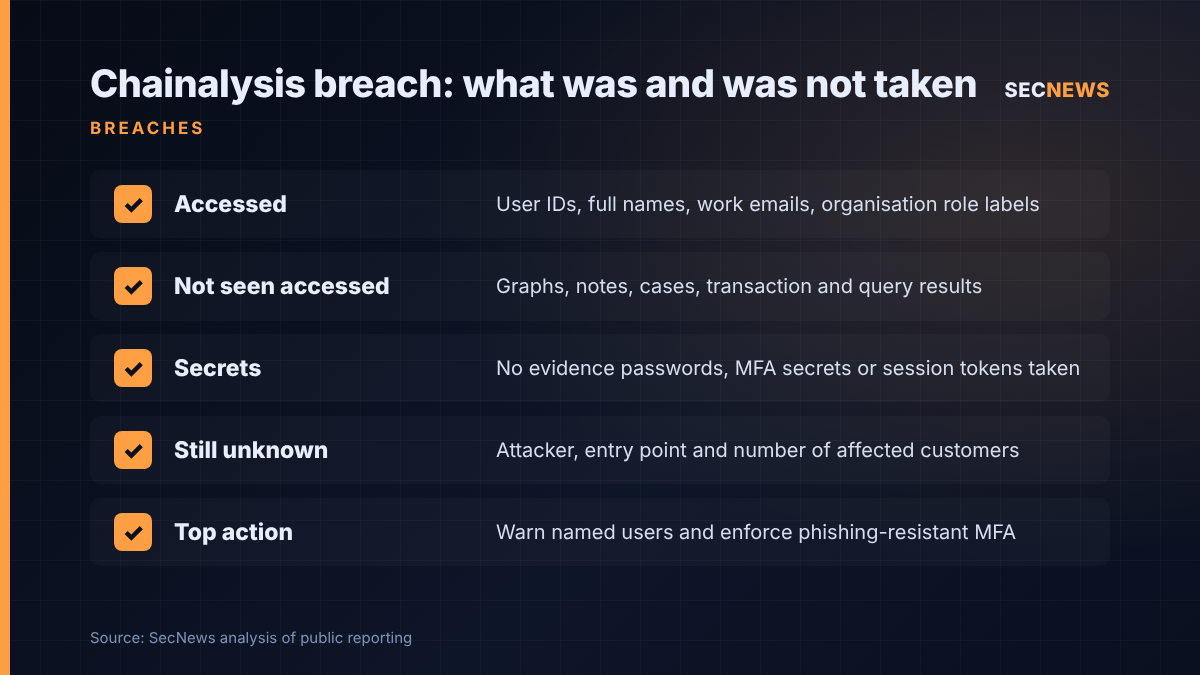
On 30 October 2026, Chainalysis published a security notice confirming that an external attacker had gained unauthorised access to its systems and internal tools during October. According to the notice, as reported by Blockchain.News, Cyber Security News and FinanceFeeds, the data accessed covered user IDs, full names, email addresses and organisation role labels for people provisioned on the Chainalysis platform.
The company described that information as non-sensitive. It said that, on the evidence gathered so far, there is no sign the intruder reached case material (graphs, notes, cases) or transaction and query results. It also said it had found no indication that clear-text passwords, multi-factor authentication (MFA) secrets or user session tokens were accessed.
Chainalysis says it has notified customers, brought in outside incident response specialists, and is patching the weaknesses that were abused while hardening the wider platform. The number of affected users and customer organisations has not been disclosed. Instead, the company has promised each organisation a breakdown of its own records once the analysis is finished. FinanceFeeds reports that the customer email, which the company published in full, says some customers had been told earlier and were now receiving an update.
The firm also went out of its way to say the intrusion has nothing to do with this week’s $6.3bn theft from Binance, which it has been helping to trace.
At the time of writing, I could not find the notice on a Chainalysis domain, and none of the major security titles had covered the story. The account here rests on consistent reporting across several specialist and crypto news outlets that quote the notice and the customer email.
The technical picture
The phrase doing most of the work in this disclosure is “offensive agentic techniques”. In general use, “agentic” describes AI systems that can chain together multi-step tasks, such as reconnaissance, probing and data collection, with limited human steering. Chainalysis has not explained what it means in this case. It has not named a model, an initial access route, the vulnerabilities involved or a timeline of movement through its environment. Cyber Security News makes the fair point that the notice supports saying agentic methods were used. It does not support claims that an AI planned and ran the whole intrusion on its own.
The data set itself is more telling than the label. User IDs, names, emails and role labels are the kind of thing stored in an identity or customer management layer, or exposed through internal admin tooling, rather than in the analytics back end where case material lives. That fits the company’s claim that investigation data stayed out of reach. It is also consistent with an attacker who reached a support or administration tool with broad read access to account records. That is my inference, not the company’s.
Chainalysis adds that LLMs are supporting a broader security review beyond the exploited flaws. Expect defenders to lean on the same tooling more often.
Why it matters for UK organisations
Chainalysis is not a household name, but its customer list is unusual. Its software is used by police, tax authorities, other government agencies, banks and crypto exchanges to follow illicit funds. The UK’s National Crime Agency has been listed among its customers. FinanceFeeds puts the client count at more than 1,500 organisations worldwide. In the UK, that is likely to include financial crime teams, compliance functions at FCA-registered crypto firms, and specialist investigators across policing and government. Chainalysis has not said which customers were affected.
So the real exposure is not the records. It is the map they provide: who in which organisation works on crypto investigations or compliance, under what job title, at what email address. A message that appears to come from Chainalysis, quoting the incident, addressed to the right person by name and role, and asking them to “reset” their credentials, is exactly the pretext this breach creates.
There is a data protection angle too. Names and work email addresses of identifiable people are personal data under UK GDPR. UK customer organisations should establish whether their staff are in scope and record their own assessment. Depending on whether Chainalysis acts as controller or processor for those account records, the decision on reporting to the ICO may rest with the customer.
Expert view
In my experience, breaches that are dismissed as “contact data only” are the ones that come back to bite. When we run social engineering engagements, the hardest and slowest part is building an accurate list of names, roles and email formats. This incident hands that list over, already filtered for exactly the people an attacker would most like to fool.
I would also be cautious about the reassurance on session tokens and MFA secrets. “No evidence so far” is an honest phrase, but it is a statement about the investigation’s progress, not a guarantee. Until Chainalysis publishes a root cause and the per-organisation breakdown, customers should plan as if their users’ identities are in a criminal’s hands and act accordingly.
The “agentic” framing may well be accurate, but it can also become a convenient explanation that draws attention away from the basic question of which control failed. The lessons for defenders do not change: limit what internal tools can read, monitor bulk access to customer records, and treat admin tooling as a crown jewel.
What to do now
- Find out if you are affected. If your organisation uses Chainalysis products, contact your account manager, ask for the per-organisation breakdown and record the answer for your UK GDPR breach log.
- Warn the named users directly. Brief investigators and compliance staff that targeted phishing quoting this incident is likely. Tell them to verify any password reset or login prompt through a known channel, not a link.
- Enforce MFA everywhere. Chainalysis recommends turning on two-factor authentication where it is not yet active. Prefer phishing-resistant methods such as FIDO2 keys for privileged and investigative accounts (Cyber Essentials: user access control).
- Tighten email defences. Add detection rules for lookalike Chainalysis domains and for messages referencing the incident. Make sure DMARC, SPF and DKIM are enforced on your own domains (Cyber Essentials: secure configuration).
- Review your own internal tools. Audit which support and admin systems can read customer or staff records in bulk, apply least privilege and alert on unusual export volumes.
- Update supplier risk records. Log the incident against Chainalysis in your third-party risk register, and ask what root cause analysis and assurance it will share when the investigation closes.
Bottom line
Chainalysis says no investigation data or login secrets were touched, and if that holds, the direct damage is limited. But a list of who investigates crypto crime, and where, is valuable in itself. UK customers should assume a phishing campaign will follow and get ahead of it now, rather than wait for the promised breakdown.
Sources
- Blockchain.News: Chainalysis says cybersecurity incident exposed some customer data
- Cyber Security News: Chainalysis Confirms Cyberattack Using Agentic Techniques That Exposed Customer Data
- FinanceFeeds: Chainalysis Discloses Breach by Attacker Using ‘Agentic’ AI Techniques
- TokenPost: Chainalysis Says AI-Driven Attack Exposed Customer Data
- CoinGape: Crypto Hack Tracker Chainalysis Confirms It Was Hit by Agentic AI-Driven Cyberattack
- Wikipedia: Chainalysis