Microsoft has told customers, according to notices reported by BleepingComputer and others, that attackers abused a bug in the Entra Connect Health cloud API to read administrator contact details and tenant configuration data for an undisclosed number of organisations. There is nothing to patch, so the work for UK security teams is verification, phishing preparation and focused log review.
What happened
Microsoft has started telling customers, through security advisories in Azure Service Health, that an unauthorised party exploited a flaw in the API behind Microsoft Entra Connect Health. Connect Health is the cloud service many organisations use to watch over their hybrid identity estate: directory synchronisation, AD FS and domain controllers running on their own servers, viewed from the Entra admin centre.
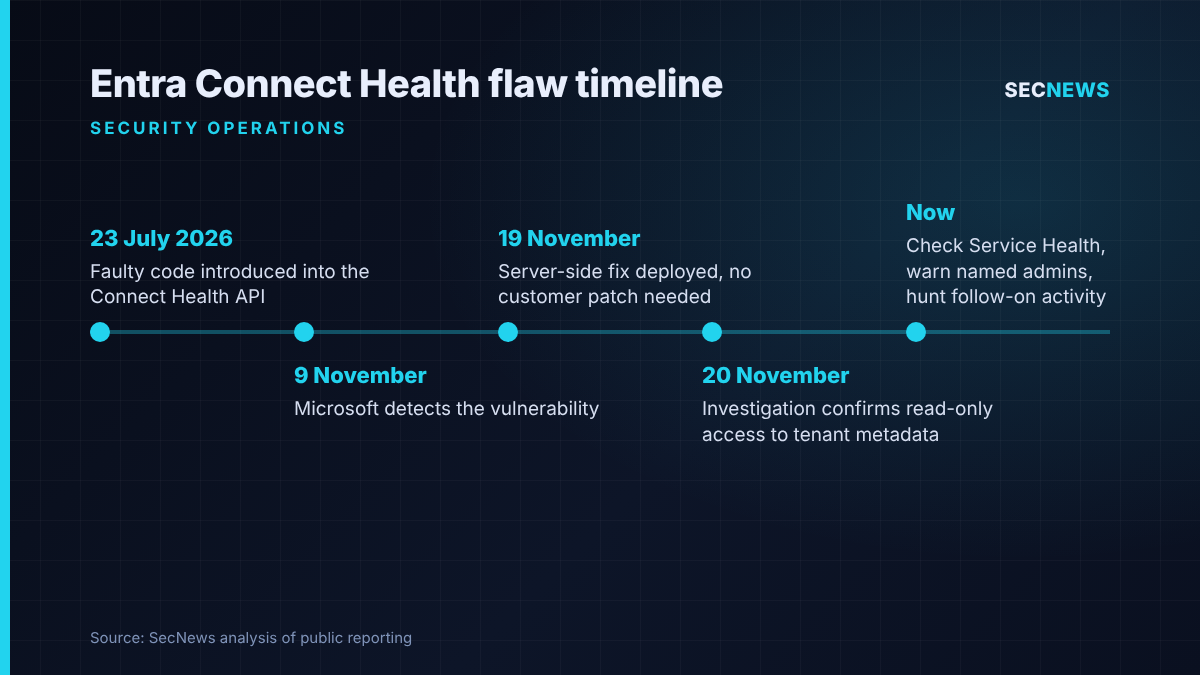
According to the customer notice, which administrators shared publicly and which BleepingComputer reported on 21 November 2026, the faulty code went live on 23 July 2026. The notice says Microsoft spotted the problem on 9 November, shipped a server-side fix on 19 November and finished reviewing its telemetry on 20 November, concluding that read-only access to tenant metadata had taken place.
In a statement given to BleepingComputer, a Microsoft spokesperson said the issue could have allowed unauthorised access to contact and configuration metadata at tenant level. The company has not said who was responsible, when the unauthorised queries started, or how many tenants were affected. Administrators commenting on the original Reddit thread, including managed service providers who received several notices for separate customer tenants, suggest the reach is wider than a handful of organisations, but those reports are anecdotal and are not a count.
The technical picture
This was a leak of metadata, not of credentials. Across the reporting, the exposed fields are consistent: the email addresses of each affected tenant’s technical contact and administrator accounts, the tenant ID, display name, initial domain, country code and regional scope, the Entra licence tier, whether directory sync is switched on and when it last ran, and whether Connect Health had been onboarded.
The API also handed back an expired certificate once used to enrol Connect Health agents into a Microsoft back-end service that was retired in late 2024. Microsoft told customers, as quoted by SecurityOnline, that the certificate “poses no risk and is no longer used by that service”. It had simply never been cleaned out of storage.
The notice, as reported, is clear about what was not exposed: no passwords or their hashes, no sign-in tokens or valid keys, and no Azure subscription data or on-premises Active Directory topology. The bug could in principle have allowed changes to Connect Health monitoring settings, but Microsoft reportedly found no evidence of any modification.
One awkward point for defenders, raised by analysis cited on WindowsForum, is that the attacker’s own queries are unlikely to appear anywhere a customer can see them. Reads against this Microsoft-run API are neither directory events in Entra audit logs nor control-plane writes in the Azure Activity Log. Microsoft’s telemetry is effectively the only record of which tenants were touched, which is why the Service Health notice matters so much.
Why it matters for UK organisations
Hybrid identity is the norm across UK councils, NHS bodies, universities, law firms and mid-sized businesses, and many of them run Entra Connect with Connect Health for monitoring. A single MSP looking after smaller firms may have several affected tenants.
The data stolen is exactly what a social engineer wants. It names the people who hold the most privilege, confirms the organisation syncs from on-premises Active Directory, shows roughly when sync last ran and hints at which security features the licence includes. That is enough to write a believable “Entra sync failure” email to the right administrator, or to make a convincing call to the service desk using the real tenant name. UK organisations have had painful recent lessons in help desk impersonation, and this incident hands attackers better scripts.
There is also a governance question. Administrator email addresses are personal data under UK GDPR. Microsoft is likely to be acting as a processor here, but controllers should record the notice, assess the risk to the individuals named and decide, with their data protection officer, whether anything needs reporting. Firms in regulated sectors should check their own third-party incident obligations too.
Expert view
In my experience, the reconnaissance phase is where a well-run intrusion gets most of its advantage, and most of the information gathered is never treated as sensitive. When we test, a significant part of early effort goes into working out who the administrators are and how identity is wired together. This flaw did that work for the attacker at scale, quietly, for up to four months.
I would give Microsoft some credit: eleven days from detection to notification, with a specific list of what was and was not exposed, is better than many cloud providers manage. The harder lesson is about visibility. Customers had no way to detect this themselves and no patch to apply. That is the shared responsibility model in practice: when the provider’s side fails, your controls have to be ready for what comes next rather than for the breach itself.
The stale certificate is a telling detail: leftover data from retired services is worth hunting down in your own estate too.
What to do now
- Check Azure Service Health directly. Sign in to the Azure portal yourself and look for the security advisory rather than following any link in an email. MSPs should check every customer tenant separately. No notice means Microsoft’s review did not flag that tenant.
- Warn the named people and the service desk. Tell administrators and technical contacts to expect phishing or calls that quote real tenant details. Accurate details do not prove a message is genuine. Reinforce call-back verification for any password or MFA reset (Cyber Essentials: user access control).
- Move privileged accounts to phishing-resistant MFA. FIDO2 keys, passkeys, Windows Hello for Business or certificate-based authentication. SMS codes and push approvals are not enough for Global Administrators.
- Cut standing privilege. Use Privileged Identity Management where your licence allows, so admin roles are activated only when needed, and review who holds Connect Health Owner, Contributor and Reader roles.
- Hunt for the follow-on activity. You will not see the API reads, but you can see what an attacker does next: unusual or failed sign-ins against the named accounts, new MFA method registrations, suspicious OAuth consent grants and unexpected changes in Entra audit logs and the Azure Activity Log.
- Review Connect Health settings. Confirm notification recipients and contact details are current. Microsoft’s read-only script at aka.ms/ConnectHealth/scripts shows the types of fields involved, but only current values, so it is not a forensic record of what was read.
- Treat sync infrastructure as tier zero. Entra Connect servers and Connect Health agents deserve domain controller levels of hardening and monitoring (Cyber Essentials: secure configuration).
Bottom line
Nothing needs patching, but the incident is not over for affected organisations. Attackers now hold an accurate list of who runs your identity platform. Confirm whether your tenant was flagged, prepare the people named for targeted phishing, and make sure your privileged accounts cannot be taken with a convincing email and a stolen code.
Sources
- BleepingComputer: Microsoft Entra Connect Health flaw exploited to steal tenant data
- Cyber Security News: Hackers Exploit Microsoft Entra Connect Health Flaw to Access Admin Emails and Organization Data
- SecurityOnline: Microsoft Entra Connect Health exposure
- Ma-no: Microsoft confirms Entra Connect Health metadata was stolen
- WindowsForum: Microsoft Entra Connect Health API flaw exposed admin emails and tenant data
- Wisevoter: Microsoft Discloses Entra Connect Health API Flaw