Xalgorix, a new open-source AI penetration testing tool, says it cuts false positives by making a second agent re-exploit every bug before it is reported. The idea is sound, but there are no published results yet, and the way it runs raises questions that UK testing teams and pentest buyers should ask before it goes anywhere near a client network.
What happened
On 23 November 2026 Help Net Security profiled Xalgorix, a self-hosted AI penetration testing platform released on GitHub under the Apache-2.0 licence. It is a Go binary with a local dashboard. An LLM agent equipped with browser and shell access follows a 22-stage plan, from reconnaissance to a PDF report, calling familiar tools such as Nmap, Nuclei and SQLmap.
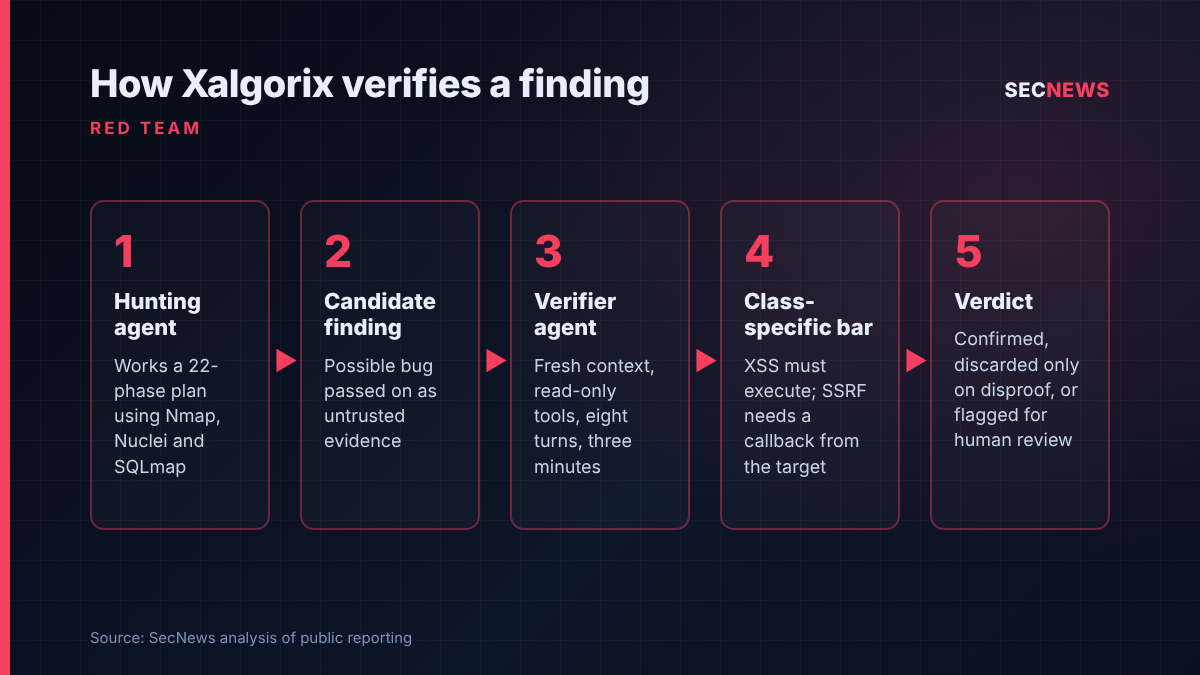
The selling point is verification. When the hunting agent thinks it has found a vulnerability, a separate verifier agent tries to reproduce it before it reaches the report. Founder Krishna Kumar told Help Net Security that the verifier is “a separate agent role” rather than the original agent looking twice. Findings the verifier can neither prove nor disprove stay in the results, marked for a human to review, rather than being dropped.
Kumar said the team relies on internal tests against vulnerable and patched builds and has started on, but not finished, the 104 XBOW validation benchmarks, and has no plans yet to publish results.
The technical picture
According to Kumar’s interview, the verifier begins with a clean context. It treats the hunting agent’s evidence as untrusted, gets only read-only tools, and has at most eight turns and three minutes per check. The bar for confirmation depends on the bug class. Cross-site scripting counts only if the script actually executes; reflection alone is not enough. For server-side request forgery, the target itself must make an HTTP request to a newly issued token without following redirects; DNS lookups alone, or traffic originating from the scanner, are rejected.
Kumar said the code also overrides the model: a claimed confirmation without a successful re-test is downgraded to inconclusive. A finding is discarded only when it is positively disproved, for example when the behaviour turns out to be by design. Anything that needs a second user account, or that triggers outside the verifier’s view, goes to manual review.
Operationally, Xalgorix supports seven model providers, including local models through Ollama. Kumar named Claude Opus 5.5 as the strongest performer so far, adding that less capable models break tool calls or lose their place during long scans. Help Net Security reports that a scope guard blocks tool calls to hosts outside the configured targets and their subdomains. Local and private address scanning is off by default.
The Docker image is where caution is needed. It runs as root and expects either –privileged or a set of added capabilities (NET_ADMIN, NET_RAW, SYS_PTRACE) with seccomp turned off. It ships a large offensive toolset and keeps apt, go, cargo, pipx and npm available, so the agent can install missing tools while a scan is running. The maintainers say to treat it as a throwaway, network-isolated sandbox.
Why it matters for UK organisations
Requiring a second, independent attempt at exploitation before reporting a bug is a sensible answer to the main complaint about automated testing: reports full of findings that are not real.
The trouble is that none of it has been measured in public. The README’s comparison table rates its false-positive load as low, but without numbers that is only a claim. The yardstick the team is using is also weaker than it sounds: the XBOW repository itself now describes those 104 challenges as saturated, with industry performance close to 100 per cent as of mid-2026. A perfect score would say little. And verification only filters false positives. It does nothing about false negatives, the vulnerabilities the hunting agent never found, which no public data covers either.
For UK buyers this links directly to NCSC guidance. The NCSC says a penetration test exists to give assurance over your own vulnerability management, not to be your main way of finding flaws, and that test quality depends heavily on the skill of the testers. Under the CHECK scheme, risk ratings must be HIGH, MEDIUM, LOW or INFORMATIONAL, and CVSS scores can supplement those ratings but cannot replace them.
Expert view
In my experience, the hardest part of any engagement is not running tools. It is staying inside the rules of engagement while still being thorough. Several features here need checking against that standard. As described, the scope guard treats a target’s subdomains as in scope, but on real estates subdomains often point to third-party SaaS or hosting that the client has no authority to let you test. Wildcard and multi-target modes make that more likely, not less. “The agent did it” is a poor position under the Computer Misuse Act.
Data handling is the second issue. The README says scan context goes to whichever model provider you configure, and that blind-vulnerability callbacks go to public Interactsh servers unless you run your own. On client work, that can mean request and response data, possibly including credentials or personal data, leaving your environment. Under UK GDPR and most testing contracts, that should be agreed in advance.
Third, the README promotes a sponsored residential proxy partner and the tool supports optional proxy rotation. On authorised work, clients usually need to know your source IP addresses so their SOC can tell your test from a real attack. Rotating exit points would defeat that.
Finally, a privileged root container with live package managers, steered by a language model, demands a lot of trust. I would run it on dedicated, throwaway infrastructure and nowhere else.
What to do now
- Testing teams: run it in the lab first. Measure false positives and missed bugs against your own vulnerable and patched builds before any client work.
- Isolate the host. Use a dedicated VM or cloud account with no route to corporate networks, set your own dashboard credentials rather than relying on a password printed to logs, and never expose the dashboard publicly. This follows Cyber Essentials secure configuration and access control principles.
- Pin versions. Use fixed image tags and log what the agent installs mid-run, while still updating promptly under the Cyber Essentials security update management control.
- Lock down scope and egress. List exact hosts rather than relying on subdomain matching, turn off wildcard discovery unless it is in the contract, run your own callback server, and use fixed, declared source IPs.
- Decide where the data goes. Prefer a local model, or document the model provider as a data processor in the engagement terms.
- Pentest buyers: ask suppliers directly. Which AI tools will they use, where will your data go, and does a qualified human validate every finding and assign the risk rating? For HMG work, insist on CHECK-compliant reporting.
Bottom line
Xalgorix shows a credible engineering idea: make automated findings earn their place in the report by reproducing them independently. But it has no public evidence of how well that works, and its recommended Docker deployment is privileged and its scope rules broad. Treat it as an interesting lab tool to evaluate, not as a substitute for a scoped, accountable test carried out by qualified people.