Bell Canada has confirmed that an intruder broke into a pre-production copy of the system it uses to order and provision network circuits, and took data on its business customers. The breach is a reminder that test environments holding real data need the same protection as live ones.
What happened
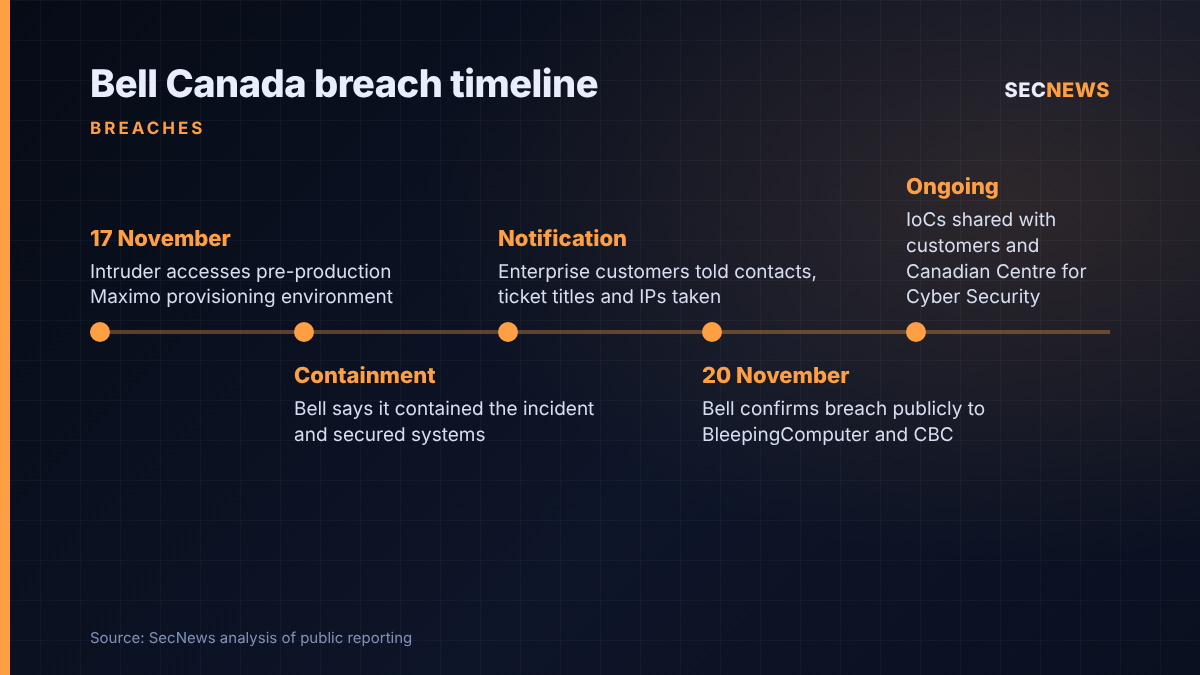
Bell Canada, one of the country’s largest telecoms providers, has told enterprise customers that their data was stolen in an intrusion on Tuesday 17 November 2026. The company confirmed the incident publicly on 20 November, after BleepingComputer was tipped off by a customer who had received a breach notification from Bell’s information security team. CBC News reported the same details after speaking to the company.
According to BleepingComputer, the attacker reached a pre-production environment of Bell’s Maximo system. Bell uses Maximo to order and provision telecommunications network connections, so the data it holds describes how business customers are connected rather than consumer accounts. Bell described the attacker as an “agentic” threat actor but has not said what it means by the term or how the intrusion began.
Bell says it contained the incident quickly and secured its systems, and that customer services were not affected. Public affairs manager Zoe Chapman told CBC there had been “no impact to customer services”. The company says it is contacting affected customers directly. It is sharing indicators of compromise with enterprise customers and the Canadian Centre for Cyber Security, and CBC reports it has also gone to the RCMP’s cybercrime unit.
Bell has not said how many organisations are affected or how much data was taken. It says it does not know who carried out the attack, and CBC reports that no one has contacted the company to claim responsibility.
The technical picture
The detail we have comes from Bell’s notification to customers, as reported by BleepingComputer, and from Bell’s statements to CBC. On that basis, the stolen data may include:
- business contact details: names, job titles, phone numbers, work email and postal addresses
- information contained in ticket titles
- some IP addresses associated with network elements or systems
- limited contextual information around those records
Bell says the dataset did not include credentials, highly sensitive personal information, PDFs or file attachments. That is reassuring as far as it goes, but it does not make the data harmless. A provisioning system records who manages which circuit, what was ordered and roughly where it lands on the network. Ticket titles often name sites, services and faults in plain language. Joined to IP addresses of network equipment, that is a useful reconnaissance pack for anyone planning to target those customers or to pose as their telecoms provider.
The location of the breach matters too. Pre-production and staging environments are built to mirror live systems, so they often hold copies of real customer data for testing and migration. In my experience they rarely get the same monitoring, access review or patching as production. When we test large estates, a forgotten staging instance with live data and a weaker login process is one of the most common ways in. Bell has not said how the attacker got in, so nobody should assume the method.
Why it matters for UK organisations
This is a Canadian incident, but there are three reasons UK organisations should pay attention.
First, the follow-on risk is impersonation. Bell has itself warned customers to watch for unsolicited contact and social engineering from people pretending to be the company. Any UK business with Canadian offices, or with circuits ordered through Bell, should assume its network contacts may now get convincing approaches that quote real ticket references. CBC notes that Canada has recently seen a run of voice phishing attacks on legal and financial firms, a reminder of how readily contact data can be turned into convincing calls.
Second, UK telecoms providers have legal duties that bear directly on this kind of failure. The Telecommunications (Security) Act 2021 and the security regulations made under it, overseen by Ofcom, expect providers to protect the systems that support network management and provisioning, not just the core network. A pre-production copy of a provisioning system holding real customer and network data is in scope in practice, whatever its label says. A UK operator would struggle to argue otherwise after an incident.
Third, business contact data is still personal data under UK GDPR. Names, job titles and work phone numbers identify individuals. If a UK organisation keeps comparable data in a test or staging environment and it leaks, the ICO will expect the same breach assessment, and possibly the same notification, as if the records had come from production. “It was only test data” is not a defence when the test data was copied from live.
Expert view
What stands out to me is how ordinary this attack path probably is, even though the headlines focus on the word “agentic”. Whatever tools the intruder used, the target was a non-production system holding data that was useful once taken. Most large organisations have environments like this: built for a project, filled with live data, then left half-managed.
Bell deserves some credit. It notified customers directly, gave specific categories of exposed data, said what was not affected and brought in the national cyber centre and the police. That is better than the vague “cyber incident” statements that UK organisations too often issue. But BleepingComputer says Bell did not respond to a request to publish its indicators of compromise, and keeping them to its own customers limits their value. Telecoms providers are a common route into their customers, and wider sharing through bodies such as the NCSC and its Canadian counterpart would help other operators check their own estates.
What to do now
- If you buy services from Bell: check whether you have received a notification, and warn your network, procurement and service desk teams to verify any contact claiming to be from Bell through a known number, not one given in the message.
- Audit your non-production environments: list every staging, test and pre-production system that holds copies of live data. Remove or mask real data where you can. This maps to the Cyber Essentials requirement to know and manage what is in scope.
- Apply production-grade access control: enforce multi-factor authentication, remove dormant and shared accounts and restrict administrative access on test systems (Cyber Essentials user access control).
- Patch and harden them too: non-production servers should follow the same update and secure configuration baseline as live ones (Cyber Essentials security update management and secure configuration).
- Monitor them: send logs from staging and pre-production into your SIEM, and alert on bulk exports or unusual queries.
- Prepare for impersonation: brief staff who deal with network suppliers on call-back verification for change requests, and include provider impersonation in phishing awareness exercises.
Bottom line
Bell says no credentials were taken and the data relates to business customers, but the breach exposed exactly the kind of data an attacker needs to target business customers or pose as their telecoms provider. The lesson for UK organisations is not about new attack tools. It is that test environments holding real data are production in all but name, and need to be secured, monitored and regulated as such.