A report filed through DigitalOcean’s Intigriti bug bounty programme has led to a fix for CVE-2026-99312, a Linux KVM flaw that let a guest VM read the memory of its AMD host. The disclosure shows what a cloud bounty can achieve when provider, researcher and kernel maintainers work in step, but most distribution kernels still had no fix on 21 November.
What happened
Oren Yomtov, a researcher at Terra Security, reported a guest-to-host isolation failure in Linux’s in-kernel KVM hypervisor to DigitalOcean through its bug bounty programme, which runs on the Intigriti platform. DigitalOcean reproduced the problem on its own infrastructure, rated it critical and kept it under wraps while a fix was prepared. It also encouraged Terra to take the bug to the upstream KVM maintainers rather than treat it as a DigitalOcean-only issue.
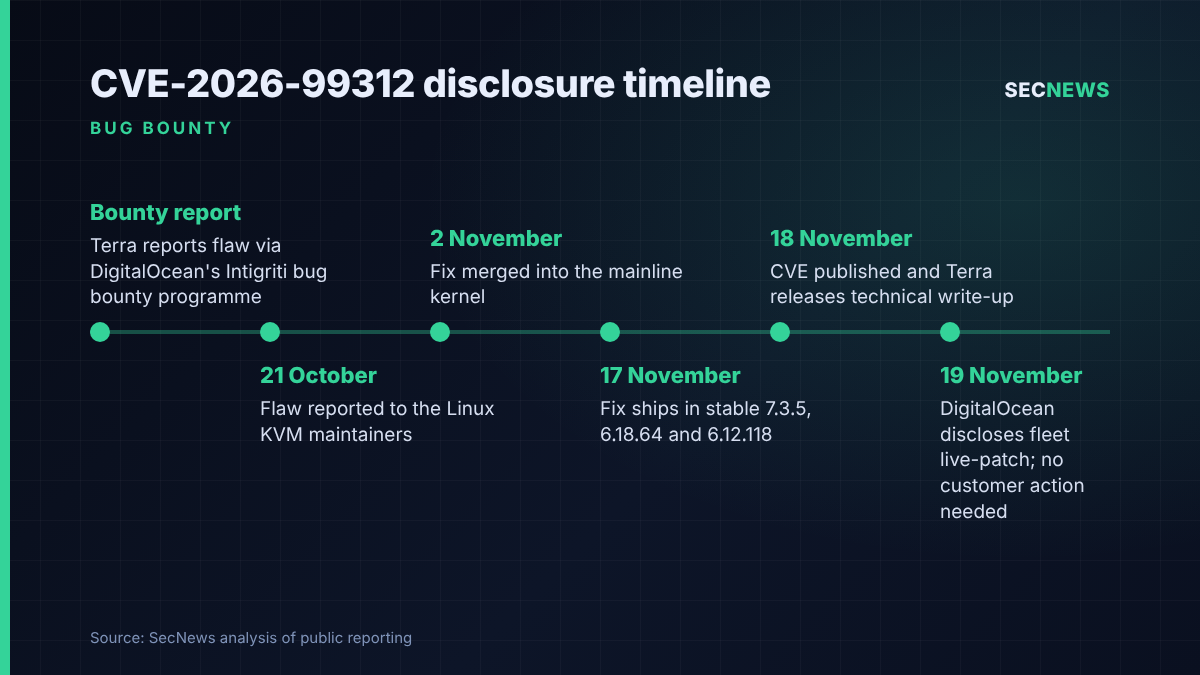
The timeline is short. Terra says it reported the flaw to the KVM maintainers on 21 October 2026. A fix was merged into mainline on 2 November and first appeared in the 7.4-rc2 tag on 9 November. Stable kernel 7.3.5 and the long-term 6.18.64 and 6.12.118 releases carried it from 17 November. The kernel CVE team, through Greg Kroah-Hartman, published CVE-2026-99312 on 18 November, the same day Terra released its technical write-up. DigitalOcean published its own disclosure on 19 November, saying it had live-patched its hypervisor fleet and that Droplet customers needed to do nothing.
Neither DigitalOcean nor Terra has said how much was paid for the report.
The technical picture
The flaw only matters on hosts with AMD processors where nested virtualisation is switched on, meaning a VM is allowed to run VMs of its own. Intel-based KVM hosts are not affected. According to the kernel advisory and Terra’s analysis, a particular kind of reset of a nested guest left KVM using an out-of-date reference to memory it had already released. Once the kernel reused that memory, a guest with root privileges could influence how its own addresses were translated to host memory and reach pages it was never given.
Terra proved the read side on a live DigitalOcean Droplet, mapping roughly 127 GB of host RAM read-only and finding the host kernel’s version string. It ran the write test only on dedicated hardware it controlled, changing a small number of bytes in host kernel memory. That restraint is exactly right on shared infrastructure.
Two other details stand out. The bug was introduced by the 2022 fix for an earlier KVM flaw, CVE-2022-3344, and sat in the kernel for nearly four years. Severity scores also differ: the kernel CNA gives it 8.8 under CVSS 3.1, while Red Hat first rated it Moderate at 5.6, treating it as denial of service only, before raising it to Important at 7.8 on 21 November. No public exploit and no use outside research had been reported at the time of writing, according to virtualisation vendor VirtFusion.
Why it matters for UK organisations
Many UK businesses rent compute from hosting firms running KVM, and plenty of universities, public bodies and MSPs run their own KVM estates on AMD hardware. On a shared host, reading the host’s memory can mean reading other customers’ workloads. The usual multi-tenancy promise, that a neighbour’s VM cannot see yours, is exactly what this bug undermined.
Patching is the awkward part. DigitalOcean fixed its fleet before going public, but distribution kernels lag behind upstream. When this was written, Debian’s tracker showed every release still vulnerable, with only unstable fixed, Ubuntu rated the issue High with no fixed package, and Red Hat listed Enterprise Linux 9 and 10 as affected with no erratum yet (Enterprise Linux 8 is unaffected). VirtFusion’s operator guidance notes that nested virtualisation is enabled by default in the kvm_amd module, so a host is exposed unless someone turned it off on purpose.
The bounty angle carries a lesson too. Under the Computer Misuse Act as it stands, a UK researcher probing a provider’s hypervisor without permission would be taking a real legal risk. A published bounty programme with clear scope gives both sides cover. Reforms to give good-faith researchers a statutory defence have been debated for years but are not yet in force, so for now a programme’s terms are the main legal protection most researchers have.
Expert view
This is close to a model disclosure. The researcher used the front door. The provider validated the finding quickly, treated it as critical and, crucially, pushed the bug upstream rather than quietly patching its own hosts and leaving every other KVM operator exposed. Maintainers turned round a fix in under a month. Everyone published within two days of the stable release. Compare that with the uncoordinated zero-day drops we have seen this month, which leave defenders with nothing but workarounds.
It also shows what a cloud bounty is worth. A hypervisor escape is among the most valuable classes of bug in commercial infrastructure, and the alternative markets for one are not friendly. When a provider has a credible programme, a clear safe harbour and a reputation for paying, it becomes the easiest place to take that finding. In my experience, the providers with mature programmes are also the ones with live-patching and fleet tooling ready, because they expect findings like this.
The weak spot is downstream. A fix landing upstream does not protect the long tail of hosting firms, private clouds and appliance vendors whose kernels follow distribution schedules. When we test private cloud environments, nested virtualisation is often left on simply because it is the default, not because anyone needs it. That is the setting to check first.
What to do now
- Find exposed hosts. List every KVM hypervisor on AMD hardware and check whether nested virtualisation is enabled in the kvm_amd module. This is asset inventory and secure configuration under Cyber Essentials.
- Turn nested virtualisation off where you do not need it. Setting the kvm_amd nested parameter to 0 closes this path entirely. It needs a host reboot, and tenants who rely on running their own VMs will lose that ability, so warn them first.
- Patch the host kernel, then reboot. Move to stable 7.3.5 or the 6.18.64 or 6.12.118 long-term releases (or newer), or your distribution’s fixed package once it ships. Updating the kernels inside guest VMs does nothing for this flaw. This falls under the security update management control.
- Ask your providers. If you rent VMs or VPS capacity, ask your hosting firm in writing whether its AMD hypervisors were exposed and when they were fixed. Large providers have published statements; smaller ones often only answer when asked.
- Review your own disclosure route. If you run shared infrastructure, publish a vulnerability disclosure policy and security.txt, as the NCSC’s Vulnerability Disclosure Toolkit recommends, and consider whether a paid programme would put you first in line for findings like this one.
Bottom line
CVE-2026-99312 is a serious isolation flaw, but the way it surfaced is a good example of disclosure done properly: a bounty report, a provider that shared the fix upstream, and fast maintainers. The risk now sits with everyone running AMD KVM hosts on distribution kernels. Check the nested setting, turn it off if you can, and patch as soon as your vendor ships.
Sources
- DigitalOcean: Virtualization, Responsible Disclosure, and CVE-2026-99312
- Terra Security: CVE-2026-99312: KVM Guest-to-Host Escape
- linux-cve-announce: CVE-2026-99312: KVM: x86: Unconditionally reset MMU context when emulating INIT
- The Hacker News: Linux KVM Flaw CVE-2026-99312 Lets Guest VMs Access Host Memory on AMD Hosts
- VirtFusion: CVE-2026-99312 operator guidance