An attacker abused GL.iNet’s GoodCloud remote management service to run commands as root on travel routers and remote KVM switches, and on some devices the result was a live reverse shell. The vendor has closed the hole in the cloud and released fixed firmware, but independent analysis suggests its official infection check misses most of what was found in the field.
What happened
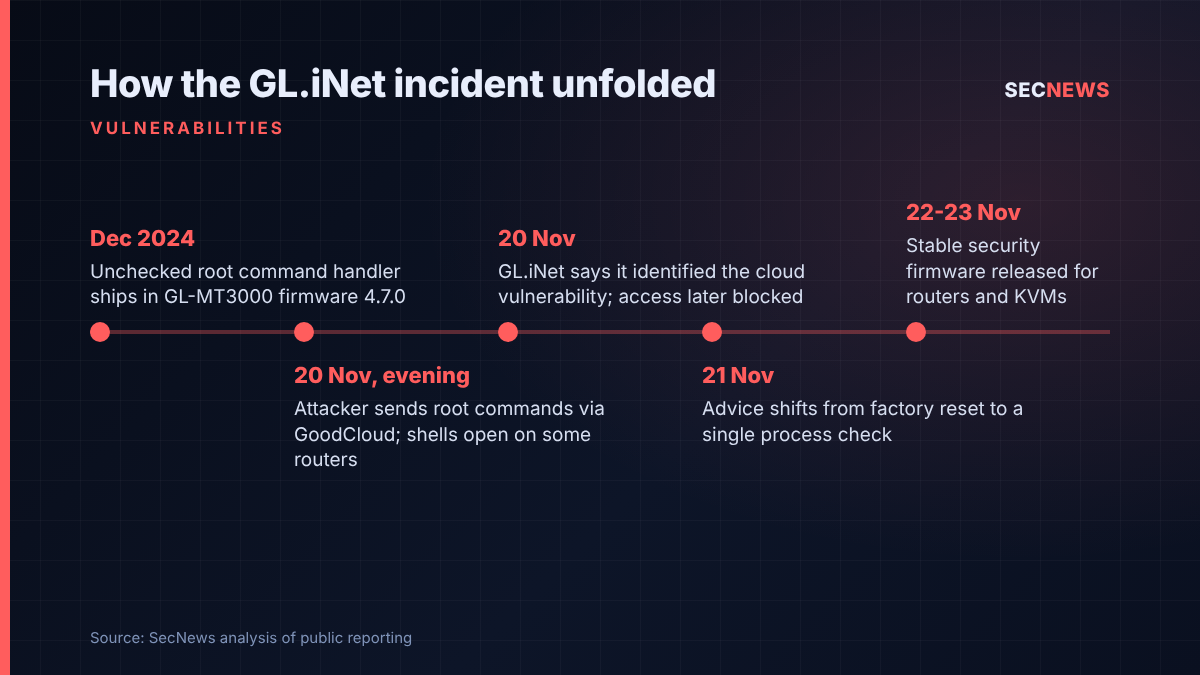
On 20 November 2026 GL.iNet said it had found a vulnerability in its cloud remote management platform, GoodCloud, and that an unauthorised party had used it to reach some of its routers and KVM-over-IP devices and install malicious software on them. In its security notice, last revised on 23 November, the company said it had fixed the cloud-side flaw and blocked the access used. New infections through that path should no longer be possible, but the cloud fix does nothing for a device that was already compromised.
Stable security firmware was published on 22 and 23 November. Router minimums include 4.11.1 for the GL-MT3000 and GL-MT6000 and 4.8.4 for the GL-AXT1800 family. The Comet-family KVMs (RM1, RM1V2, RM10, RM10RC, RM1PE and RM4PE) need 1.10.3, and the RMQ1 needs 1.8.7. GL.iNet warns that a model missing from its list is not necessarily unaffected. It has not given a CVE identifier, device count, attacker or malware name, and is still working out whether computers plugged into compromised KVMs were reached.
The fullest independent account comes from RemoteToHome Consulting, which manages a large estate of GL.iNet routers and has published its findings on GitHub. Of 199 routers it had reached by the morning of 23 November, 166 showed evidence of the 20 November attack, an older separate backdoor, or both. It stresses this is not a random sample. BleepingComputer, reporting on 22 November, also cited a GL-RM1 KVM owner who said the device was contacting around 1,800 residential IP addresses a day, although the purpose of that traffic has not been established.
The technical picture
GL.iNet has published no root cause. RemoteToHome says it found the weakness by reading the compiled GoodCloud client that ships on the routers: a value carried in a message from the cloud is handed to the shell and executed as root without validation. The code belongs to the AstroWarp SD-WAN handler but runs whether or not AstroWarp is used. They trace it back to GL-MT3000 firmware 4.7.0, released on 5 December 2024, so routers on affected firmware with GoodCloud enabled may have carried it for almost two years. When outsiders first gained the ability to send it is not known.
On most routers, the attacker ran a single root command; on the seven where the firm recovered it, the command checked for the folders of a KVM implant called “gl-helper” and reported back to 170.39.226[.]219, a server rented from a US hosting company, which has since suspended it. On at least 24 GL-AXT1800 and GL-MT6000 routers it went further and opened an interactive root shell to the same address, beginning between 20:06 and 21:40 UTC on 20 November. The KVMs received the gl-helper implant itself, which GL.iNet’s indicator appears to be designed to catch.
The detection gap is the uncomfortable part. GL.iNet’s notice tells owners to look for a process whose details contain “crond -i /tmp/.log”. RemoteToHome says it has not seen that process on a single router, including every one carrying a shell or the older backdoor. Several key traces vanish on restart. The firm also found that the vendor’s clean-up script is partial, and that in its test, settings preserved across an upgrade carried start-up entries onto fixed firmware, where they ran. A further cloud client weakness has been reported privately.
Why it matters for UK organisations
GL.iNet hardware is common in exactly the places that sit outside a typical asset register. Its travel routers are popular with consultants and hybrid staff who want a private VPN tunnel from a hotel or client site, and the Comet KVMs have become a cheap way for small IT teams and managed service providers to get out-of-band access to servers and branch PCs. A compromised KVM is effectively a remote keyboard and screen on whatever it is attached to.
The router compromise matters because of what these devices hold. VPN client profiles, WireGuard and OpenVPN keys, Wi-Fi passwords, dynamic DNS credentials and SSH keys are all readable to an attacker with root. Upgrading firmware does not undo that exposure. If one of your staff’s routers carried a shell, you should assume the credentials it held for your corporate VPN have been taken.
There is also a compliance angle. Under Cyber Essentials, a router your organisation supplies to a home or travelling worker is in scope, and critical or high-risk updates must be applied within 14 days.
Expert view
When we test small business and MSP networks, unmanaged edge kit like this is a recurring finding: bought on a card, configured once, cloud management left switched on for convenience and never inventoried. This incident is a textbook case of why a vendor’s remote management plane deserves the same scrutiny as any other privileged access route. A cloud channel that can run root commands on every endpoint is, in practice, a fleet-wide backdoor.
What concerns me more is the gap between the vendor’s guidance and the field evidence. The original advice on 21 November was to factory reset everything, which was then softened to a single process check and, by 23 November, to updating with settings kept. I would not follow the last version for any device that shows signs of compromise. In my experience the safest assumption with root-level compromise on a network appliance is that persistence has been placed somewhere you have not looked yet, and RemoteToHome’s test of settings surviving an upgrade supports that caution.
What to do now
- Find the devices. Ask staff and suppliers who uses a GL.iNet router or KVM for work, and check GoodCloud for linked devices.
- Collect evidence before rebooting. Run the community triage script by Admon (linked from both GL.iNet and RemoteToHome) after reading it, or check by hand for netcat shells, a named pipe at /tmp/f, an empty /etc/mp_ip_mapping_info dated 20 November or later on routers not using AstroWarp, and the older backdoor’s “monitord” and “ujaild” processes.
- Hunt on your side. Search firewall, VPN and proxy logs from 20 November onwards for 170.39.226[.]219, and for 66.245.219[.]252 or 65.20.71[.]131 (named by BleepingComputer).
- If anything is found, rebuild. Reinstall the fixed firmware with “Keep Settings” turned off, or factory reset and reconfigure by hand (Cyber Essentials: secure configuration).
- Rotate secrets server-side. Revoke VPN keys and SSH keys the device held, and change Wi-Fi, admin and DDNS passwords (user access control).
- Check KVM-attached hosts. Look for new accounts, scheduled tasks, startup items and browser extensions on any computer connected to an affected KVM (malware protection).
- Patch everything else and switch off GoodCloud unless you genuinely need it (security update management; firewalls).
Bottom line
GL.iNet has stopped new infections, but the fixed firmware is a patch, not a clean-up, and the official check is too narrow to trust on its own. Treat any GL.iNet device with GoodCloud enabled as potentially compromised until proven otherwise, and assume its stored credentials are gone.
Sources
- GL.iNet: Security Notice 2026-11-20, Router and KVM Security Incident
- RemoteToHome Consulting: GL.iNet cloud incident, November 2026
- BleepingComputer: Hackers exploit GL.iNet cloud flaw to infect routers, KVM devices
- Daily CyberSecurity: GL.iNet Cloud Zero-Day Exploited in the Wild Against Routers and KVMs
- GBHackers: Hackers Exploit GL.iNet Cloud Security Flaw to Infect Routers and KVM Devices