Attackers are exploiting a critical flaw in Idunno.AntiCsrf, a security add-on for ASP.NET WebForms sites whose last release dates from 2008. Nobody maintains it, so no fix will ever ship, and any UK organisation still running old WebForms applications needs to go looking for it now.
What happened
Mandiant has confirmed in-the-wild exploitation of CVE-2026-131914, an insecure deserialisation bug in Idunno.AntiCsrf, which some older ASP.NET WebForms applications used as a drop-in defence against cross-site request forgery. The flaw carries a CVSS 4.0 score of 9.3. It gives an unauthenticated attacker code execution on the web server.
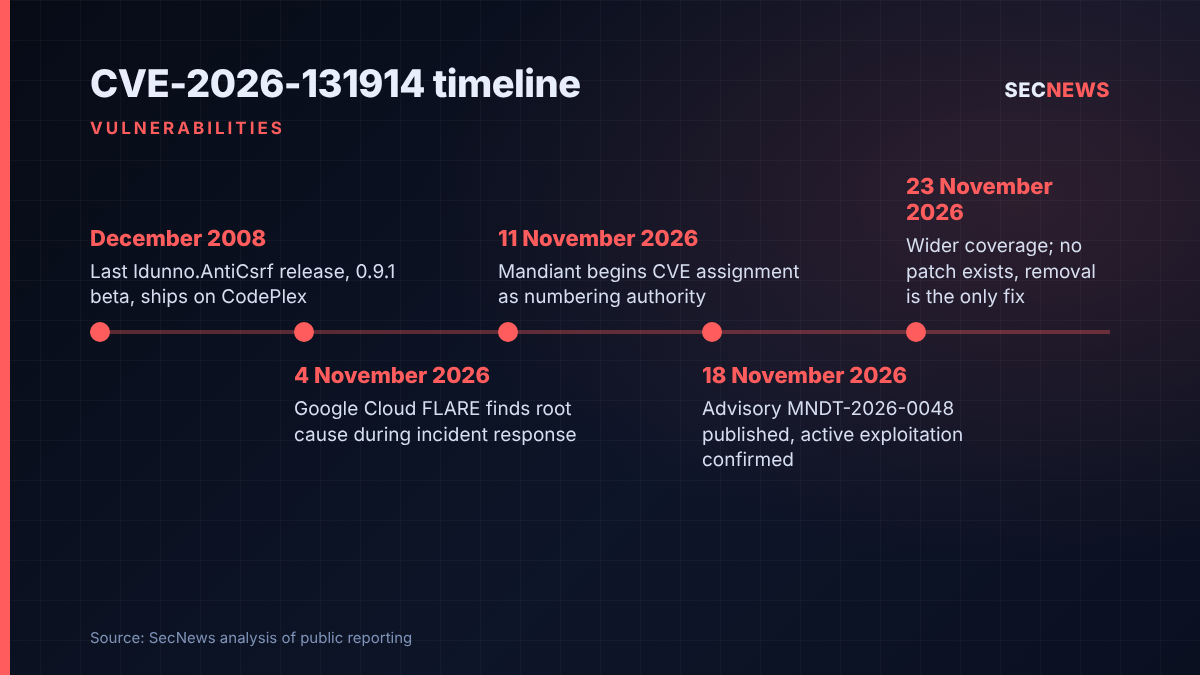
According to the advisory, Google Cloud’s FLARE team identified the root cause on 4 November 2026 while working on a live intrusion. Mandiant, acting as a CVE numbering authority, started the CVE assignment on 11 November and published advisory MNDT-2026-0048 on 18 November. Wider coverage followed on 23 November, from The Hacker News, Cyber Security News and SecurityOnline. Mandiant has not named the attackers, the victims or how many organisations were hit. It rates exploitability as high.
The unusual part is the remediation. Idunno.AntiCsrf was distributed through CodePlex, Microsoft’s long-closed open source hosting service, and its final build was a 0.9.1 beta. In Mandiant’s words there is “no active maintainer or official patch available”. The only remedy is to remove the component.
The technical picture
The library adds an HTTP module, AntiCsrfModule, to the IIS pipeline. On every POST to a WebForms page it compares a token held in a cookie with a token submitted in a hidden form field. The problem lies in how it reads that form value. The module hands the data to .NET’s ObjectStateFormatter for deserialisation, and it does so without a message authentication code or any signature check. Before doing this it only confirms that the cookie and the field are both non-empty.
Deserialising untrusted input with this formatter is a well-understood route to code execution in .NET (CWE-502). An attacker who controls the serialised blob can therefore get arbitrary code running inside the IIS worker process, w3wp.exe, with that application pool’s privileges.
Two details make this worse than a typical web application bug. First, the module runs early in request processing, before the page’s own Page_Load logic. Any authentication check done at page level comes too late to help. Second, Mandiant notes that pages without a server-side form are still reachable unless the developer explicitly suppressed the CSRF check. In practice one crafted request to almost any .aspx page on an affected site may be enough. I am deliberately not describing the request structure further here.
Affected builds are 0.9.1.0 and the 0.9.1 beta. The advisory notes that internally recompiled copies will have different hashes, so a file hash comparison will not catch every instance.
Why it matters for UK organisations
WebForms has not been the fashionable choice for new .NET projects for well over a decade, but it is far from gone. Across the UK, line-of-business portals, supplier extranets, HR self-service sites and local authority back-office systems were built on it in the late 2000s, often by contractors who have long since moved on.
That creates a visibility problem. The component is a single DLL in a bin folder plus a few lines of Web.config. It will not appear in most software asset registers and rarely in a modern software bill of materials. Many vulnerability scanners will also miss it, because no vendor package exists to fingerprint. Organisations that rely on patch compliance reporting may conclude they are clean when they simply cannot see the risk.
The regulatory angle matters too. A web server compromise that leads to personal data exposure is a reportable incident under UK GDPR. For organisations within scope of the Cyber Security and Resilience Bill’s changes to the NIS Regulations, it may also become a question of supply chain and asset management. “We did not know the library was there” is unlikely to satisfy the ICO.
Expert view
In my experience, the most dangerous code in a network is often the code nobody owns. When we test older .NET estates, an application that ran quietly for fifteen years nearly always has something like this inside it: a vendored helper library, a forgotten handler, a module that made sense at the time. What stands out here is that the vulnerable component was itself a security control. Teams added it to reduce risk, and it has become the way in.
This also shows the limits of patch-centric vulnerability management. Most programmes are built around a simple loop of vendor advisory, patch release and deployment. With an abandoned project there is no patch to deploy. The work becomes engineering: removing a dependency, replacing it with a supported equivalent and retesting the application, which is hard when a legacy system has no current owner.
The advice to rotate secrets deserves emphasis. On an IIS server, Web.config and applicationHost.config commonly hold machineKey values, connection strings and encryption keys. Once someone has run code as the worker process, assume those are compromised. Removing the DLL closes the door but does nothing about whoever may already be inside. As Cyber Security News notes, removal will not get rid of a backdoor that is already in place.
What to do now
- Hunt for the component. Search every IIS server, deployment share and source repository for Idunno.AntiCsrf.dll, and every Web.config for AntiCsrfModule, csrfSettings or Idunno.AntiCsrf. Match on names as well as the hashes in Mandiant’s advisory, since custom builds will differ.
- Remove it and replace it. Take out the module registration, the configuration sections, any SuppressCsrfCheck references and the DLL. Then implement a supported alternative such as System.Web.Helpers.AntiForgery, ViewStateUserKey alongside MAC-protected ViewState, or IAntiforgery if the application is being moved to ASP.NET Core. Retest the application afterwards.
- Contain what you cannot fix quickly. If removal needs a development cycle, take internet-facing instances offline or restrict them behind a VPN or an authenticating reverse proxy in the meantime. A web application firewall may help, but treat it as a stopgap, not a fix.
- Look for signs of compromise. Review IIS logs for odd POST requests to .aspx pages that returned HTTP 302 or 500, especially with unusually large request sizes. Check webroots for unexpected files, inspect IIS for unfamiliar modules, and look for unusual child processes of w3wp.exe in EDR telemetry.
- Rotate secrets if in doubt. Where exploitation cannot be ruled out, replace machineKey values, encryption keys and database credentials held in configuration, and preserve logs before you rebuild anything.
- Close the governance gap. Cyber Essentials expects software to be supported, and unsupported components to be removed or isolated. Extend that thinking to third-party libraries inside your own applications, and give every legacy application a named owner.
Bottom line
CVE-2026-131914 is a critical, actively exploited flaw that will never get a patch, sitting in a component most organisations do not know they have. It takes a single unauthenticated request against an old WebForms site to put attackers on the web server. Find the DLL, remove it, check whether anyone got there first, and use this as the push to inventory the abandoned code across your estate.
Sources
- Mandiant: MNDT-2026-0048, insecure deserialisation in Idunno.AntiCsrf
- The Hacker News: Hackers exploit critical ASP.NET anti-CSRF library flaw allowing unauthenticated RCE
- Cyber Security News: Critical ASP.NET AntiCsrf flaw under attack
- SecurityOnline: CVE-2026-131914, Idunno.AntiCsrf RCE actively exploited