A newly named espionage cluster broke into five South-east Asian government bodies, apparently without sending a single phishing email. Its route in was a handful of old, well-documented flaws in open-source software that UK public bodies run too.
What happened
On 26 November 2026 the SOCRadar Threat Research Unit (STRU) described a campaign it calls RedOps and attributed it to a cluster it has named WeaveLotus. SOCRadar assesses with moderate confidence that WeaveLotus is linked to Vietnam. The firm is careful about that judgement, and so should we be: SOCRadar itself says the evidence justifies tracking WeaveLotus as a separate cluster but does not conclusively establish state sponsorship, a caveat The Hacker News repeated a day later.
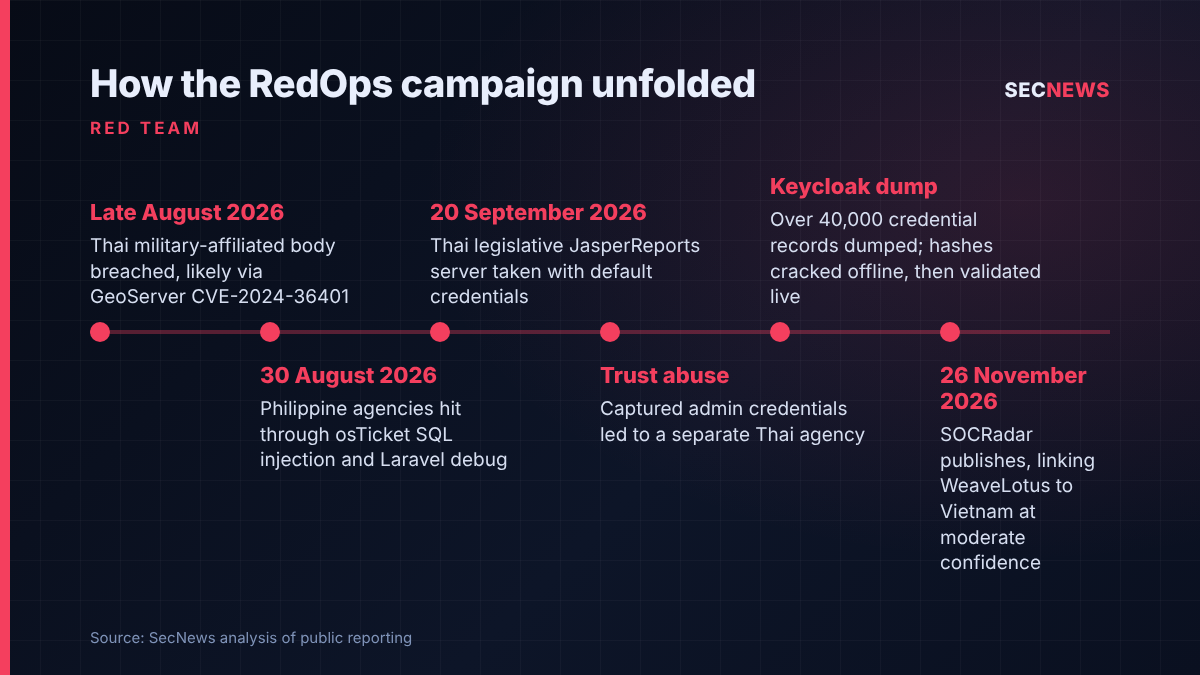
The activity ran from August to September 2026. SOCRadar confirmed five intrusions. Three were in Thailand: a military-affiliated organisation, a legislative body and a government agency. The other two were Philippine government organisations. The operators also carried out reconnaissance against more than 30 Indonesian government organisations, but SOCRadar found no evidence that any of them were breached. SOCRadar believes the goal was intelligence on defence and military agreements in the South China Sea.
SOCRadar says the haul included about 19 GB of parliamentary and supplier-held documents, 31,418 files from the military-affiliated body, 349,782 Thai government records covering budgets and strategy, and Philippine staff account details with password hashes.
The technical picture
From a red team perspective, this campaign is notable for how ordinary its initial access was. SOCRadar lists four ways in, and each one is a hygiene failure rather than clever tradecraft:
- CVE-2024-36401, an unauthenticated remote code execution flaw in GeoServer that was disclosed in 2024, likely used against the Thai military-affiliated organisation in late August.
- CVE-2021-42235, a blind SQL injection in osTicket’s password-reset handling that dates back to 2021, used against Philippine targets around 30 August.
- A Laravel application left running in debug mode at a Philippine body, which gave away file paths and fragments of source code.
- Default administrative credentials on a JasperReports server at the Thai legislative body, which was compromised around 20 September.
The intrusions were chained. In Thailand, the reporting server provided a way into the document management system it served. The operators ran repeated password-spraying rounds against that system, and SOCRadar says the guesses paired employee names with national ID numbers, which suggests they already held a staff list. A rogue LDAP listener on that foothold then harvested admin credentials for a trusted directory domain owned by a separate government organisation.
With those credentials the group reached a server running Keycloak 3.4, an old release of the open-source identity platform, and dumped a database of more than 40,000 user credential records. SOCRadar says the hashes were cracked offline using wordlists built around Thai Buddhist Era years. The cracked passwords were then checked against the live token endpoint, and two of the accounts that worked held every administrative role. A spraying attempt against the organisation’s Microsoft 365 tenant failed.
To keep access, the group used reverse SSH tunnels over port 443, SOCKS5 proxies and a self-healing cron script. Stolen data went to a separate rented server running MinIO storage, and at the legislative body the operators tasked their foothold through a lightweight Python command-and-control server. SOCRadar’s attribution rests on Vietnamese-language comments in operator scripts, activity during UTC+7 working hours, open-source research focused on military cooperation between China and the Philippines, and the narrow regional targeting. It assesses a link to OceanLotus (APT32) only at low confidence, because the tooling and access methods differ from that group’s known tradecraft.
Why it matters for UK organisations
UK organisations are not on the victim list, so the case for caring rests on the software and on the method. GeoServer is a mainstay of the spatial data teams in local government, utilities, transport and environmental bodies. osTicket is a popular choice for small service desks. Keycloak sits behind many single sign-on deployments built in-house. Laravel underpins a large share of bespoke web applications built by agencies for councils, charities and universities. These systems are often bought on a project budget, handed over and forgotten.
The cross-organisation movement matters here as well. UK public services increasingly run on shared platforms, shared identity and managed service providers that span several bodies. A reporting server at one organisation that renders documents for another, or a directory trust that nobody has reviewed in years, is exactly the kind of bridge this campaign crossed.
The campaign also illustrates a point UK defenders hear often: capable attackers do not need zero-days when old, catalogued vulnerabilities remain open on the internet. An unpatched GeoServer, an osTicket flaw from 2021 and a factory password were enough to reach defence and parliamentary documents.
Expert view
In my experience, the findings that open up an external infrastructure test are rarely exotic. They are the reporting portal that still has its vendor login, the debug page that prints a stack trace with database settings, or the geospatial server that has not been touched since the contractor left. WeaveLotus took exactly those routes in, and everything that followed was standard post-exploitation: harvest credentials, crack them offline, use whatever trust exists, and move on.
The detail I would point any blue team at is the offline cracking against culturally specific patterns. Wordlists built around local calendar years, national ID formats and staff rosters beat generic complexity rules. UK equivalents, such as football clubs followed by a year, work just as well. When we test, a cracked hash from a legacy identity store is very often the key to everything else.
Keep the attribution in proportion. Moderate confidence from one vendor, based on language artefacts and working hours, is a sensible working hypothesis, not proof. For defenders the technique matters more than the flag, because any criminal group with a scanner can run this playbook.
What to do now
- Find your exposed open-source applications. Inventory internet-facing GeoServer, osTicket, JasperReports, Keycloak and Laravel instances, including those run by suppliers on your behalf. Patch GeoServer and osTicket as a priority (Cyber Essentials: security update management).
- Remove default credentials and debug settings. Check reporting and admin consoles for vendor passwords, and confirm debug mode is off in production (Cyber Essentials: secure configuration).
- Retire legacy identity platforms. Old Keycloak releases and similar stores holding password hashes should be upgraded or migrated, with phishing-resistant MFA in front of administrative roles (Cyber Essentials: user access control).
- Audit password strength against local patterns. Run an authorised password audit using wordlists built from organisational and regional terms, and ban the patterns that crack.
- Review trust relationships. Map directory trusts, shared reporting servers and supplier connections between organisations, and remove any that have no current owner.
- Watch egress. Alert on outbound SSH over port 443, unexpected SOCKS traffic, bulk transfers to object storage and password-spraying patterns against internal applications (Cyber Essentials: firewalls).
Bottom line
WeaveLotus did not need novel malware or zero-days to take sensitive government material. It needed old bugs, a default password and trust between organisations that nobody was watching. Any UK organisation running the same open-source stack should treat RedOps as a free threat-led test case, and should check its own estate before someone else does.
Sources
- SOCRadar: RedOps: WeaveLotus Targets Southeast Asian Governments
- The Hacker News: Suspected Vietnam-Linked Hackers Target Southeast Asia in South China Sea Espionage Campaign
- CyberUpdates365: WeaveLotus Espionage Campaign Hit 5 Southeast Asian Agencies
- ZeroHour: WeaveLotus stole Thai and Philippine government and military files