A Drupal core flaw that lets an unauthenticated attacker abuse the built-in installer to take over a site is now being exploited, and CISA has given US federal agencies until 27 November to deal with it. UK organisations running Drupal should treat this as an emergency change today.
What happened
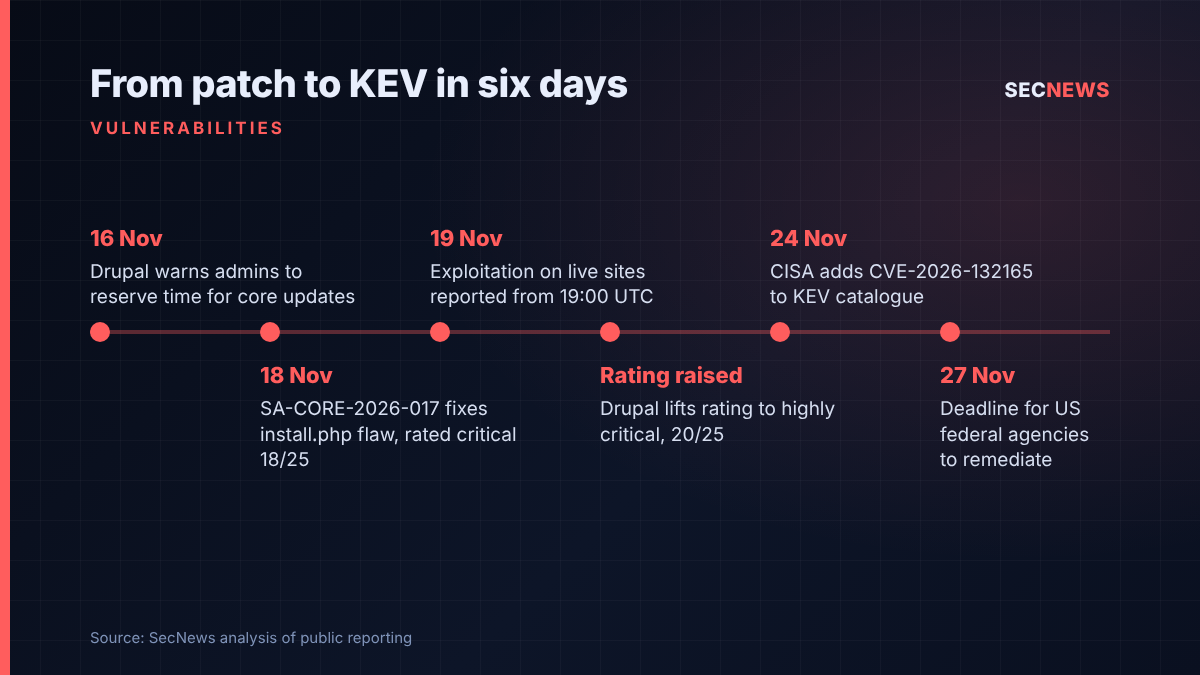
On 18 November the Drupal Security Team released SA-CORE-2026-017, fixing CVE-2026-132165 in Drupal core. The bug sits in the installer, the install.php script that every Drupal codebase carries so that a new site can be set up. Under certain conditions a visitor with no account can use that script to try to reinstall Drupal over the top of a live site, which can end in full site takeover or remote code execution.
At launch the project scored it as critical, 18 out of 25 on its own risk scale, and noted that a proof of concept already existed. It had also warned administrators two days earlier to set time aside, because working exploits could follow within hours or days. That prediction proved accurate. Drupal has since updated the advisory to say it received a report the flaw was “exploited on live sites as early as 2026-11-19 19:00 UTC”, roughly a day after the fix shipped, and has lifted the rating to highly critical (20 out of 25).
The US Cybersecurity and Infrastructure Security Agency (CISA) added CVE-2026-132165 to its Known Exploited Vulnerabilities (KEV) catalogue on 24 November, setting federal civilian agencies a three-day deadline of 27 November. The KEV entry also flags the bug for forensic triage, meaning agencies are expected to look for signs of compromise as well as patch. SecurityWeek reported that no public detail on the attacks or victim numbers was available.
The bug was reported by Anthropic’s OSS Scanner, an automated service that hunts for flaws in open source projects that opt in. What matters more is how quickly attackers turned the fix into intrusions.
The technical picture
The installer is part of core and remains on disk after a site goes live. Drupal’s default .htaccess rules do not deny requests to /core/install.php, so whether it is reachable depends entirely on how each site has been hardened. The Drupal team describes the exploitable configurations as uncommon, and says some, though not all, attack paths fail if the web server account cannot write to settings.php or alter its permissions. CISA’s entry classifies the weakness as CWE-636, a failure to fail securely: the installer should refuse to run against an already installed site, and in the vulnerable cases it does not.
Affected releases are Drupal 10 before 10.6.22, Drupal 11 from 11.0.0 before 11.3.22, and 11.4.x before 11.4.13. The fixes are in 11.4.13, 11.3.22 and 10.6.22. Branches that have already reached end of life (11.2.x and older, 10.5.x and older, plus Drupal 8 and 9) will not receive a patch. According to The Hacker News, security support for Drupal 10 and for 11.3.x also ends in December.
Alongside the installer fix, the same release addressed CVE-2026-132166, a moderately critical gadget chain. It needs administrator rights plus a separate deserialisation bug, so it is secondary, but the same upgrade closes it. Customers of the paid Drupal Steward firewall service are covered against known attack vectors, though Drupal still tells them to upgrade.
Why it matters for UK organisations
Drupal is popular with organisations that run large, content-heavy or multi-site estates: government bodies, universities, research institutions, charities and media groups. In the UK that maps onto local authorities, higher education, arm’s-length public bodies and membership organisations, many of which rely on agencies or small in-house teams to keep sites current.
The figure that worries me most is the long tail. According to The Hacker News, in the week of 8 November about 29 per cent of the sites sending usage data to drupal.org (154,485 out of 528,430) were on branches with no security support. Those sites cannot simply apply the patch; they need an emergency mitigation now and a migration plan after. SecurityWeek counts this as the third Drupal flaw exploited in the wild this year, after an SQL injection bug (CVE-2026-9082) in May and the Commerce Core access bypass (CVE-2026-118539) in October, which suggests attackers are watching Drupal releases closely.
There is a regulatory edge too. A site taken over through a published, actively exploited flaw is hard to defend to the ICO under UK GDPR’s security principle, especially where the site holds form submissions, member accounts or case data. Cyber Essentials expects high and critical fixes within 14 days; for a bug exploited within a day of release, that ceiling is far too generous.
Expert view
When we test web estates, leftover installers, setup wizards and upgrade scripts are a recurring finding. They are built to run once, with high privilege and few checks, then sit on disk for years. This bug is a textbook example of that class: the installer itself is not exotic, but it was never supposed to be reachable on a production site, and most organisations simply never removed or blocked it.
In my experience the sites that get caught are rarely the flagship site. They are the campaign microsite an agency built three years ago, the departmental instance nobody owns, or the staging copy left facing the internet. Asset inventory is the real control here. If you do not know how many Drupal instances you run, start there today.
I would also read the forensic triage flag in the KEV entry as a hint. A day passed between the patch and the first reported exploitation, and nearly a week has passed since. Patching closes the door, but does not tell you whether someone has already walked through it.
What to do now
- Find every Drupal instance. Include agency-hosted, staging and legacy sites, and check hosting contracts for sites run on your behalf (Cyber Essentials: secure configuration and asset scope).
- Upgrade supported sites immediately to 11.4.13, 11.3.22 or 10.6.22 (Cyber Essentials: security update management). Do not wait for the 14-day window.
- Block the installer on every site, patched or not. Drupal’s guidance gives three routes: deny access in your web server config, add an .htaccess block, or delete the file and use Composer scripts so it stays gone.
- Lock down settings.php so the web server account cannot write to it or change its permissions. That shuts off some of the exploit paths.
- Handle end-of-life sites as a separate risk. Block the installer, put them behind a web application firewall, and agree a dated plan to upgrade or retire them (Cyber Essentials: supported software).
- Look for signs of compromise. Review web logs for requests to /core/install.php since 18 November, check for unexpected administrator accounts, changed configuration or new files, and compare code against a known-good copy.
- Brief your suppliers. If an agency manages your sites, ask for written confirmation of version, installer blocking and a log review.
Bottom line
A flaw in a file that should never be reachable on a live site went from patch to real-world exploitation in about a day. Upgrade, block install.php everywhere, and check your logs. Sites on unsupported branches, more than a quarter of those reporting to drupal.org, are the ones attackers will keep coming back to.
Sources
- Drupal.org: Drupal core – Highly critical – Remote code execution – SA-CORE-2026-017
- SecurityWeek: Drupal Flaw Found by Anthropic Scanner Exploited in Attacks
- CISA: Known Exploited Vulnerabilities Catalog (CVE-2026-132165)
- The Hacker News: Drupal Patches Critical Installer Flaw That Could Give Unauthenticated Attackers Control of Sites
- BleepingComputer: Drupal patches critical RCE flaw, warns exploits may surface quickly

One thought on “Drupal installer flaw CVE-2026-132165 exploited, CISA warns”
Comments are closed.