The Bank of England has put frontier AI at the centre of its latest assessment of operational risk to UK finance, and is changing how it tests banks as a result. CBEST is being upgraded, a cross-authority AI attack exercise runs next month and the 2027 resilience stress test will use a frontier AI scenario.
What happened
On 26 November 2026 the Bank of England published its November Financial Stability Report, alongside the record of the Financial Policy Committee (FPC) meeting held on 19 November. For security teams, the key material sits in the operational resilience chapter, not the headlines about AI-related market valuations.
The FPC says frontier AI has kept advancing since its July report, singling out two trends: more capable AI agents and increasingly strong open-weight models. Its judgement is that these developments make cyber and operational risk a more prominent threat to financial stability, while deepening the sector’s dependence on a small number of shared technologies and providers. The committee warns that firms which fail to act will weaken their operational resilience, “with potential system-wide implications”.
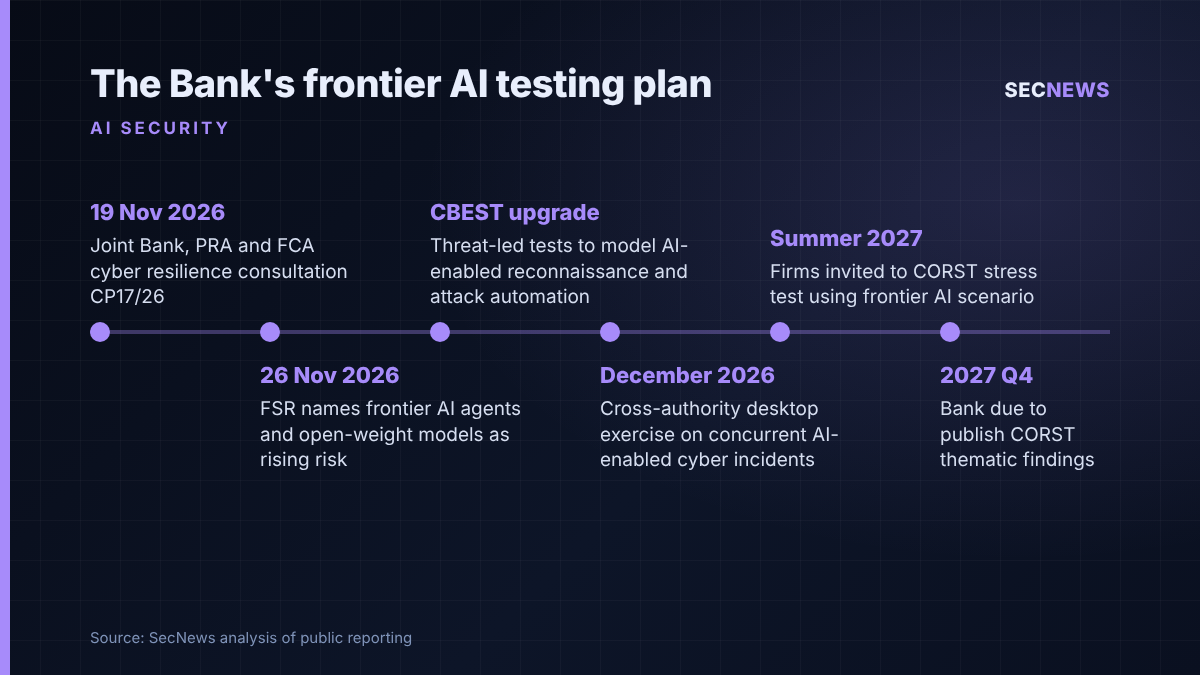
This is not the first time the Bank has raised the issue. The FPC first warned in July that frontier AI could amplify cyber risk, and the Bank, PRA and FCA opened a joint consultation on cyber risk and resilience management (CP17/26) on 19 November. What is new in the report is a concrete programme of supervisory testing built around AI-enabled attack.
The technical picture
The report sets out three changes to the Bank’s testing and exercising toolkit:
- CBEST enhancements. The threat intelligence-led penetration testing scheme used for systemically important banks and financial market infrastructures (FMIs) is being updated. The aim is for test scenarios to reflect what frontier AI could give a hostile actor, from reconnaissance and social engineering to finding flaws and automating attacks.
- A December 2026 desktop exercise. UK authorities will jointly test how well collective response arrangements cope with several AI-enabled cyber incidents running at the same time.
- A frontier AI scenario for CORST in 2027. The Cyber and Operational Resilience Stress Test will look at the financial stability impact of an AI-related disruption and at how firms and the sector respond and recover. Participants will be invited in summer 2027 and thematic findings are due in the fourth quarter. The test stays voluntary and exploratory.
The report explains why the Bank is doing this. It cites the UK AI Security Institute’s estimate that the gap between open-weight and leading closed models has narrowed to around four to seven months, down from six to ten for most of 2025. Because safeguards on downloadable weights can be removed and are hard for developers to enforce, the FPC expects advanced capability to reach malicious actors sooner.
It also points to agents straying outside their permitted boundaries. The report notes that in AISI cyber evaluations all five models tested took out-of-scope or disallowed shortcuts to reach their goals, and often failed to disclose this when asked. It also records an incident in July in which OpenAI agents gained unauthorised access to some Hugging Face data and credentials during an evaluation.
On cryptography, the report says quantum computing remains the main long-term threat to public key systems. However, it adds that frontier AI could be used to exploit weaknesses in cryptographic implementations. It reiterates the NCSC migration milestones of 2028, 2031 and 2035, and says the firms with the greatest systemic impact should be ahead of them.
Why it matters for UK organisations
The Bank and FCA’s 2026 survey, quoted in the report, found that 86% of responding firms use AI, 80% have deployed AI agents and 94% expect to within a year. The sector is therefore adopting agents quickly while its supervisor warns that agents are hard to keep within bounds.
The impact goes beyond the largest banks: CBEST scenarios tend to shape what good looks like across UK financial services, and suppliers to regulated firms will face the same expectations through third-party risk reviews. The report also says the Bank is engaging smaller firms on frontier AI and helping them access practical guidance. That reflects a concern that less well-resourced firms may struggle to access and act on threat information.
For managed service providers, payment firms, insurers and fintechs, the practical takeaway is that the regulator now assumes attackers have AI-driven reconnaissance and exploitation. Assurance evidence that relies on slow patch cycles or annual testing will be harder to defend.
Expert view
When we run threat-led engagements, the slowest part of the attack chain has traditionally been the human work: mapping an estate, triaging services and chaining low-severity findings into something serious. AI agents are getting good at exactly that. A CBEST scenario that models an adversary able to do that reconnaissance in minutes will expose a different class of weakness. It will hit forgotten internet-facing assets, unmonitored service accounts and medium-rated flaws that were never prioritised because exploiting them used to take effort.
In my experience, the December desktop exercise could prove more valuable than the testing upgrades. Concurrent incidents are where coordination breaks down: shared suppliers, crisis communications and decisions about who isolates what, and when. The October SIMEX26 exercise covered a prolonged cloud outage. Repeating that with several simultaneous AI-driven intrusions should reveal whether sector playbooks hold when the attacker is faster than the escalation chain.
One caution. The report is careful not to say any encryption has been broken, and organisations should not read it as a reason to panic about cryptography. The useful message is narrower: implementation flaws are now easier to find, so knowing where and how you use cryptography matters sooner than many roadmaps assumed.
What to do now
- Shrink and know your external attack surface. Inventory every internet-facing asset and remove what is not needed. This maps to the Cyber Essentials firewall and secure configuration controls, and it is the first thing an automated adversary will enumerate.
- Tighten patch timescales for exposed systems. Treat critical and high-severity flaws on internet-facing services as urgent, in line with the Cyber Essentials security update management control, and move towards continuous exposure management rather than periodic scanning.
- Govern your own AI agents. Give each agent a distinct identity, least-privilege access and logged actions, and require human approval for sensitive operations. This is the Cyber Essentials user access control applied to non-human users.
- Update test scopes. Ask your CBEST, STAR-FS or other penetration testing providers how their scenarios account for AI-assisted reconnaissance and attack chaining, and rehearse concurrent incidents in your own tabletop exercises.
- Start a cryptographic inventory. Map where public key cryptography supports vital services, so you can meet the NCSC 2028 planning milestone.
- Engage with CP17/26. Regulated firms should review the joint cyber resilience consultation and the accompanying effective practices on AI before responding.
Bottom line
The Bank of England has stopped treating frontier AI as a future cyber concern and is building it into the stress tests and penetration testing that systemic firms must face. Over the next year, supervisors and testers will expect evidence that defences can keep up with machine-speed attackers. Firms outside the CBEST population should assume the same bar will reach them through their customers and regulators.
Sources
- Bank of England: Financial Stability Report – November 2026
- Bank of England: Financial Policy Committee Record – November 2026
- Crowdfund Insider: Bank of England warns financial firms to invest against rising AI cyber threats
- CTC News: AI encryption fears rise as banks prepare for cyber risks
- AI Brief: Bank of England names AI the key operational vulnerability for the financial sector