The University of Liverpool has confirmed a cyber incident affecting its systems and has made every member of staff and every student reset their password. Leak-site trackers report that the extortion group ScarlettGroup has listed the university on its leak site, but that claim is unverified and the university has not said that any data was taken.
What happened
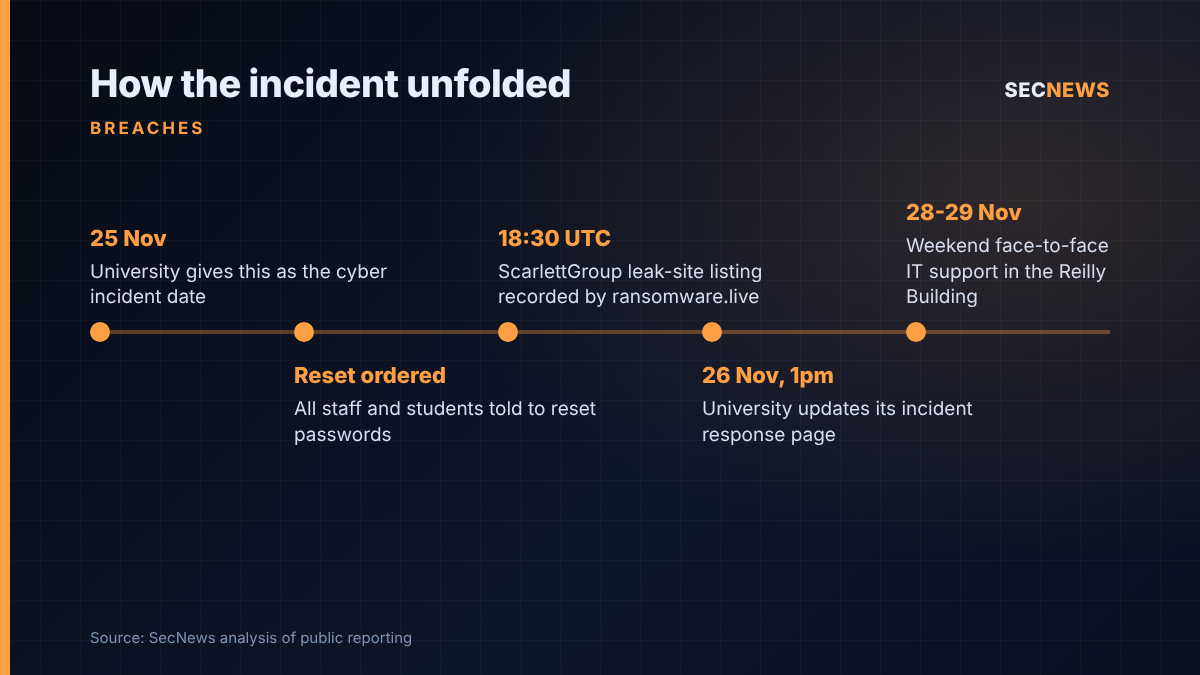
The University of Liverpool, a Russell Group university, has published an incident response page giving 25 November 2026 as the date of the incident. The page says the university “has experienced a cyber incident” and that several internal teams are working with specialist external organisations. Their job is to investigate what happened, assess the impact and protect university systems and data. The page was last updated at 1pm on 26 November. It does not say how attackers got in or whether personal information was involved.
The most visible step so far is a forced password reset. On 25 November the university told all staff and students to change their passwords. It warned that anyone who had not done so could lose access to their computer and applications until they did. Temporary face-to-face IT support is running in the Reilly Building at the Guild of Students, and is open between 10am and 5pm across this weekend, 28 to 29 November, with the IT Service Desk warning of busy lines.
The same evening, ransomware.live recorded a new listing for liverpool.ac.uk on the leak site of ScarlettGroup at about 18:30 UTC. Threat intelligence outlets including HookPhish, DeXpose and QPulse reported the listing on 26 November. DeXpose reports that the group’s listing says it will publish a “full leak” unless someone from the university contacts it. QPulse labels the incident as claimed by the attackers and not confirmed by the organisation. The university’s public statement does not mention ScarlettGroup, a ransom demand or data theft.
The technical picture
The university has released no technical detail, so any account of the intrusion is inference.
An organisation-wide reset on the same day as the stated incident date usually means the responders believe account credentials are in play. That could be stolen passwords, harvested session tokens or a directory service the attackers may have touched. It is a common early containment step when identity compromise is suspected. It also has a cost, as the weekend support queues show.
The ransomware.live entry for liverpool.ac.uk includes infostealer telemetry from Hudson Rock and an exposure summary credited to ParanoidLab. Those figures are not evidence about this incident and should be read with care. As reported by QPulse, they show 535 compromised employees, 774 compromised users and 518 compromised third-party employee credentials linked to the university’s domain. The ParanoidLab summary counts 45,463 exposed passwords and 2,079 cookies, of which 2,258 passwords and seven cookies are rated critical. They are aggregate counts gathered over time, and QPulse notes that its source does not confirm how any intrusion happened.
Still, the numbers show a familiar risk for universities. Large, constantly changing user populations often log in from personal devices the institution does not manage. When an infostealer infects one of those laptops, it can capture saved passwords and live session cookies. A stolen session cookie is a particular worry because it can let an attacker skip a multi-factor authentication prompt that the password alone would trigger. The tracker also lists SaaS services tied to the domain, including Microsoft 365, Atlassian and Zapier, each another place a stolen identity could be used.
Why it matters for UK organisations
UK higher education is a frequent target, and universities are hard to defend. They hold student records, staff HR and payroll data, research data that is sometimes commercially or nationally sensitive, and in many cases clinical or health-related information. Their networks are open by design and their estates have grown faculty by faculty.
The incident also shows a pattern UK responders now see often: an extortion listing that appears within hours of an organisation’s first visible response. The listing creates pressure before the victim has the facts. A university that has not finished scoping an incident cannot say with confidence what was or was not taken, and the criminals know that. UK GDPR gives a controller 72 hours from awareness to notify the ICO of a reportable personal data breach, and making that call while a leak threat hangs over you is one of the hardest judgements in incident response.
Research collaborators, NHS partners and other institutions that share systems with the university all have a stake in what investigators find.
Expert view
In my experience, the first public step an organisation takes tells you more than its first statement does. A forced reset for every account, done the same day, is a sensible and fairly aggressive move. It suggests the responders treated identity as the likely attack path and chose to accept disruption over the risk of an attacker keeping valid credentials.
It is important to keep three things separate: what the university has confirmed (an incident and a credential reset), what a criminal group claims (that it holds data worth leaking), and what infostealer telemetry suggests (that the domain has a large historical credential exposure). Leak-site listings are marketing. Some groups exaggerate or recycle old data; others are exactly as bad as they claim. Until samples appear or the investigation concludes, nobody outside the incident team knows which applies here.
When we test university environments, the weak spots tend to be the same: legacy authentication that bypasses MFA, service accounts nobody owns, and session lifetimes measured in weeks. An infostealer problem turns all three into an open door.
What to do now
- Staff, students and partners of the university: complete the password reset through official university channels only. Expect phishing that uses the incident as cover, including fake reset links and fake IT support calls. Change any reused passwords elsewhere.
- Revoke sessions, not just passwords: any organisation responding to a suspected credential compromise should invalidate active sessions and refresh tokens across its identity provider and SaaS estate. A password change alone does not kill a stolen cookie.
- Close legacy authentication: block protocols and flows that skip MFA, and apply conditional access for unmanaged devices. This sits under the Cyber Essentials user access control requirements.
- Monitor for leaked credentials: check infostealer and breach feeds for your own domains. Treat every hit as a live incident, and reset and investigate the affected accounts.
- Prepare the decision before the countdown: agree in advance who decides on ICO notification and on any contact with an extortion group, and on what evidence. Make sure your offline backups are tested.
- Review third-party and SaaS access: audit connected apps, API tokens and integration accounts such as automation platforms, which are often missed during resets.
Bottom line
The University of Liverpool has confirmed a cyber incident and has ordered a password reset across the whole institution. ScarlettGroup’s leak-site claim and the infostealer figures circulating with it are still unverified. Other UK organisations do not need to wait for the outcome to act on the lesson: stolen credentials and session tokens remain the fastest route into an open, sprawling network, and the time to revoke them is before a leak site lists you.
Sources
- University of Liverpool: Incident response – incident updates and support
- Ransomware.live: Victim liverpool.ac.uk
- HookPhish: liverpool.ac.uk data breach – Scarlettgroup ransomware claim
- DeXpose: ScarlettGroup compromises University of Liverpool
- QPulse: Scarlettgroup ransomware gang claims attack on University of Liverpool