Installers for two popular SoftwareOK utilities, Q-Dir and DesktopOK, were swapped for versions that quietly plant a Python remote access trojan, delivered from the developer’s own website and, according to researchers, its update feature. For defenders the job now is to find every affected copy, remove the persistence and assume the host has been watched.
What happened
On 26 November 2026 AhnLab’s ASEC research team published an analysis showing that several downloads hosted by SoftwareOK itself had been altered. The affected tools are Q-Dir, a four-pane file manager, and DesktopOK, which saves and restores desktop icon layouts. Both are free, so they turn up on admin workstations, jump boxes and staff laptops.
ASEC confirmed altered builds for Q-Dir 12.83.0.0, 12.84.0.0 and 12.85.0.0, and for DesktopOK 12.82.0.0 and 12.85.0.0. It found the bad files by comparing downloads against the SHA-256 values printed on the vendor’s own download pages, and spotted mismatches plus extra code that fetched and ran further components. ASEC also says logs showed malicious files appearing both after fresh downloads and during the built-in update process of copies that were already installed and legitimate.
Two important gaps remain. Nobody has yet explained how the genuine files were replaced, whether through a website compromise, the update channel or something else. ASEC also did not publish the window during which the poisoned builds were served, and warns that people who installed or updated other versions during that period may also be exposed. At the time of writing I could find no public statement from SoftwareOK. No threat actor has been named; ASEC noted Chinese-language comments in the code, which is a weak clue rather than attribution.
The technical picture
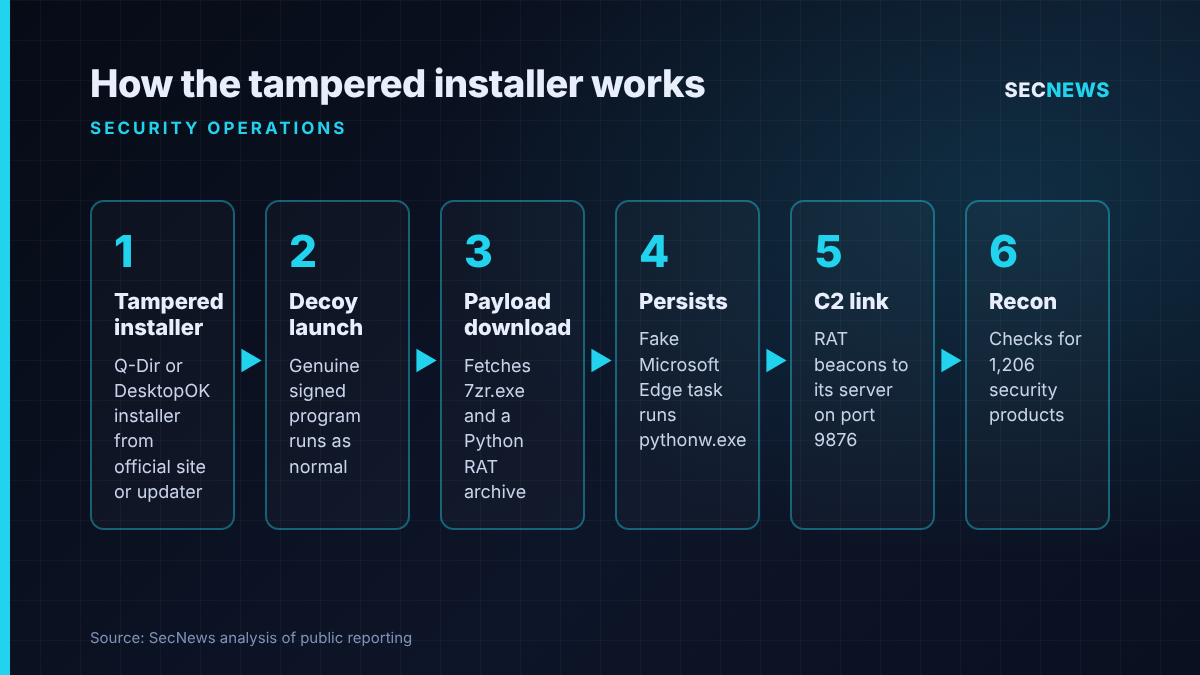
The nasty part is that the victim sees nothing wrong. The modified installer carries the real program as an embedded resource. ASEC says that embedded executable matched the official hash and still carried developer Nenad Hrg’s valid signature. The installer drops it into C:\Users\Public\ and runs it, so the expected window appears and the user carries on.
In the background the installer pulls two files from mail[.]c1a2[.]top: a legitimate copy of the standalone 7-Zip extractor, 7zr.exe, and an archive called dsv2_py39_agent.7z holding a bundled Python runtime and the trojan. Everything is unpacked to C:\ProgramData\Microsoft\DeviceSync\b2, or C:\ProgramData\DeviceSync\b2 as a fallback. Because the interpreter travels with the payload, the host does not need Python installed, which defeats any assumption that “we don’t have Python on Windows clients, so Python malware is not our problem”.
Persistence comes from a scheduled task named \UPnp\MicrosoftEdge_dcntel, which launches pythonw.exe against py_client_dsv2.py. The naming is chosen to blend in with genuine Edge update tasks. The implant talks to 8[.]210[.]69[.]51 on port 9876 and offers the usual operator toolkit: shell commands, arbitrary Python execution, file upload and download, screenshots and system profiling.
The feature that should most interest a SOC is reconnaissance against defenders. The trojan compares running processes with a list of 1,206 names covering Korean and international antivirus and EDR products, and sends the matches home. That tells the operator which estates are well defended and which are worth further effort, so an infected machine with weak or missing telemetry is a likely candidate for follow-on activity.
Why it matters for UK organisations
There are no reported UK victims, and SoftwareOK is not a UK company. The relevance is structural. Many UK organisations, particularly SMEs, schools, councils and MSP-managed estates, let technical staff install small free utilities directly from vendor sites. Those installs often sit outside the software catalogue, are missing from asset inventories and update themselves without change control. When the trusted source is the vendor’s own server, reputation filtering and “download only from the official site” awareness training offer no protection.
The people most likely to run a file manager such as Q-Dir are administrators, developers and support engineers, and their machines hold the most useful credentials and sessions. Screenshots alone can expose password manager entries, remote desktop sessions and customer data. Under UK GDPR, a confirmed infection on a device that handled personal data needs an assessment of whether a reportable breach has occurred, and the 72-hour clock for notifying the ICO starts when you become aware.
The NCSC has long urged organisations to know what runs on their estate and control what can be installed. This incident shows why, even when the program the user sees is properly signed.
Expert view
In my experience the weakest point in most Windows estates is not the operating system but the long tail of handy tools that someone installed years ago and nobody owns. When we test client networks, admin workstations are routinely full of portable utilities, self-updating freeware and scripts with no entry in any inventory. A compromise like this lands squarely in that blind spot.
The detail I would stress to any SOC lead is that a valid signature on the program the user sees proves nothing about the installer that delivered it. Detection here has to be behavioural: an installer spawning a download, a 7-Zip extraction into ProgramData, a new scheduled task impersonating Edge and a Python process making outbound connections to a high, unusual port. None of those steps is exotic, and a properly tuned EDR should see all of them. If yours stayed quiet, treat that as a finding in its own right.
I would also resist the temptation to “fix” it by reinstalling. ASEC warns that uninstalling and reinstalling the application may not remove a trojan that is already installed, because the implant lives independently of the program it rode in on.
What to do now
- Find every copy. Query your EDR, software inventory and file hash telemetry for Q-Dir and DesktopOK, including portable copies in user profiles. Compare installer and binary hashes with the malicious and legitimate values in ASEC’s report (Cyber Essentials: secure configuration and software inventory).
- Hunt the persistence and payload. Look for the \UPnp\MicrosoftEdge_dcntel task, pythonw.exe running py_client_dsv2.py, and files under the two DeviceSync b2 paths. Treat any unexpected Python runtime in ProgramData as suspicious.
- Search network history. Check DNS, proxy and firewall logs as far back as retention allows for mail[.]c1a2[.]top and connections to 8[.]210[.]69[.]51 on port 9876, then block both (Cyber Essentials: firewalls).
- Contain properly. Isolate confirmed hosts, preserve evidence, and reimage rather than clean where you can. Rotate credentials and revoke sessions used on the machine, prioritising administrative and cloud accounts (Cyber Essentials: user access control).
- Assess data exposure. Assume screenshots and system details have left the building. Decide quickly whether personal data was involved and whether the ICO needs notifying.
- Close the gap. Move to allow-listing for executables on admin and privileged devices, stop unmanaged auto-updaters, and route freeware through a packaging process that verifies hashes before release (Cyber Essentials: malware protection and security update management).
Bottom line
This is a supply chain compromise at the smallest scale that still hurts: two free utilities, a handful of builds and a signed program that behaves perfectly while a trojan settles in alongside it. The indicators are concrete and the hunt is quick, so there is no reason to wait for SoftwareOK to explain itself. Check your estate today, reimage anything that matches, and use the exercise to drag your unmanaged freeware into the light.
Sources
- AhnLab ASEC: Software Supply Chain Attack via the Official SoftwareOK Website: Tampering with Q-Dir and DesktopOK Installation Files
- The Hacker News: Hackers Trojanize Official Q-Dir and DesktopOK Downloads to Deliver Remote Access Malware
- Brandefense: Q-Dir and DesktopOK Supply Chain Attack
- Threadlinqs: Software Supply Chain Attack via Official SoftwareOK Website
- TechNewsReel: SoftwareOK Supply Chain Attack Trojanizes Q-Dir and DesktopOK