
HUMAN’s Satori researchers have disrupted BADBOX 3.0, an operation that hid ad fraud and residential proxy software inside cheap Android TV boxes and drove around 40 billion fraudulent bid requests a day at its peak. Its command infrastructure has been cut back, but defenders should treat the proxy side of the operation as an ongoing risk on home and corporate networks.
What happened
On 19 November 2026 HUMAN Security said its Satori research team had disrupted BADBOX 3.0, which it describes as the biggest ad fraud scheme ever made public, judged by bid volume. At its height the scheme accounted for about 40 billion bid requests every day, more than 4% of all connected TV (CTV) traffic HUMAN’s platform saw. HUMAN puts that at over three times the previous record holder, VASTFLUX. BleepingComputer covered the findings on 21 November.
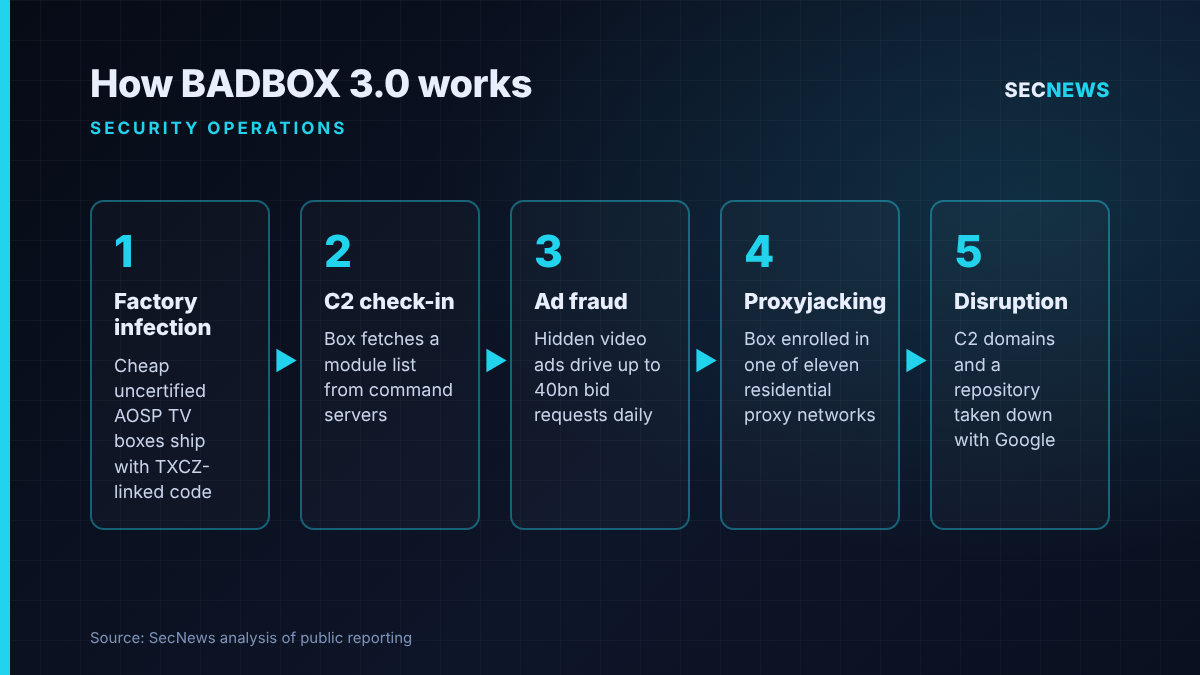
HUMAN took part in a Google-led action earlier this month against a related operation called XCPE, which identified more than a million infected devices in over 200 countries and territories. That action took down several command-and-control (C2) domains used to run parts of BADBOX 3.0. One of the repositories hosting the malware modules was also removed, and HUMAN says its systems now filter the associated fraudulent ad traffic. The researchers expect the operators to adapt, as they have after every previous takedown.
The history explains why. BADBOX was first found in 2023, on a T95 streaming box sold through Amazon, and German authorities warned about it in December 2024. In March 2025 HUMAN and Shadowserver severed over half a million BADBOX 2.0 devices from their controllers, Google pulled 24 related Play Store apps, and Google later sued the operators over more than 10 million infections. Each round slowed the operation without ending it.
The technical picture
The infected hardware is consistent: low-cost phones, tablets and streaming boxes made in mainland China and running the Android Open Source Project. They lack Google’s Play Protect certification and do not run Android TV OS. HUMAN links the BADBOX 3.0 device catalogue to TXCZ, a Chinese electronics manufacturer. The evidence includes matching C2 URL patterns, payloads and ad settings delivered from domains the company owns, a factory-installed launcher, a repository account bearing its name, and module checks for its device build properties.
The architecture is modular. An infected box contacts its C2 server, receives a list of available modules and loads whichever ones the operators choose. Those modules sit on public code-hosting sites, duplicated across further hosts, a public CDN and a GitHub proxy the operators run themselves, so removing one copy achieves little.
There are two kinds of module. The ad fraud modules play video adverts in windows the owner never sees, while the bid requests impersonate legitimate streaming apps. HUMAN also found spoofed server-side ad insertion traffic that needed no infected device at all. The second kind is proxyjacking: the box is quietly enrolled in one of eleven residential proxy networks. HUMAN names ten commercial services (Pawns, Earn, Packet, GaGa Node, HoneyGain, Repocket, Bright, Cashraven, MystNodes and Infatica) plus PXYEDGE, which it assesses to be a rebrand of IpMoYu, the proxy network tied to BADBOX 2.0. PXYEDGE’s domain was registered on 15 March 2026. According to BleepingComputer, the service advertised about 200,000 nodes, while HUMAN’s monitoring saw unique connections peak at around 340,000. Some of the fraudulent ad traffic was itself routed through these proxies to get past anti-abuse filters.
Why it matters for UK organisations
None of the sources gives UK infection figures or names UK victims, so this section is my own professional analysis rather than a reported finding.
The obvious harm is to advertisers, but for defenders the proxy modules are the bigger worry. A residential proxy network sells exit points on ordinary home broadband connections. Traffic sent through an infected box in a living room looks, to a UK bank, retailer or SaaS login page, like a customer on a domestic connection. That is exactly the cover credential stuffing, account takeover and carding campaigns need. Blocking by IP reputation or country does not help much when the source address belongs to a real household.
The second problem is your own estate. Corporate laptops share home networks with whatever cheap streaming box the household bought, and offices and meeting rooms attract unmanaged media players too. An uncertified box on the same flat network as business systems is an untrusted Linux computer with remote module loading. Today it pulls ad fraud and proxy code; tomorrow the operators could push something else.
Expert view
In my experience, the devices that cause trouble on internal tests are rarely the servers. They are the forgotten extras: the projector, the signage player, the media box someone brought in. When we test segmented networks, unmanaged consumer kit sitting on the corporate VLAN comes up again and again, and nobody owns it in the asset register.
The BADBOX story also shows the limits of takedowns. Each disruption has removed infrastructure, and each time the operators have rebuilt with more redundancy: mirrored repositories, a CDN and a self-hosted proxy for payload delivery. The compromise starts at the factory, so the infected population survives the loss of any single C2 domain. Takedowns buy time. They do not clean devices. Defenders should treat this as a supply chain problem that needs procurement and network controls, not just as a threat intelligence feed.
Google says certified devices undergo “rigorous security testing”. The trouble is that bargain buyers rarely check.
What to do now
- Find unmanaged Android devices. Use DHCP, network access control and switch data to identify media players and TV boxes on corporate, guest and meeting room networks. Put them on isolated segments or remove them. This maps to the Cyber Essentials firewalls and secure configuration controls.
- Hunt in DNS and proxy logs. Search for the indicators HUMAN published, including api.drgdj[.]top, file.drgdj[.]top, gh.drgdj[.]top, api.shzhtxcz[.]com and pxyedge[.]com. Also look for traffic to the residential proxy services HUMAN names. A hit on the published domains strongly suggests an infected device; proxy service traffic needs investigating, as some users install those apps knowingly.
- Write procurement rules. Only allow Play Protect certified Android hardware from established brands, bought through approved suppliers. Ban personally sourced streaming boxes on business premises.
- Harden authentication against proxied attacks. Do not rely on geography or IP reputation alone. Use phishing-resistant MFA, credential stuffing detection based on behaviour and velocity, and bot management on customer login pages. This supports the Cyber Essentials user access control requirements.
- Give remote workers clear guidance. Tell home workers to keep work devices on a separate network or guest Wi-Fi away from cheap smart TV hardware.
- Prepare for abuse reports. If your public IP is reported for fraud or scanning, include unmanaged consumer devices in your triage before assuming a server compromise.
Bottom line
BADBOX 3.0 is ad fraud on a record scale, but its residential proxy layer is what should concern SOCs. The infrastructure has been cut back, but the infected hardware remains in homes. UK organisations should find and isolate uncertified Android boxes on their networks, hunt for the published indicators, and assume that some attack traffic will keep arriving from what look like genuine UK broadband customers.
Sources
- HUMAN Security: Satori Threat Intelligence disruption: BADBOX 3.0 hides the largest ad fraud operation ever disclosed inside infected TV boxes
- HUMAN Security: HUMAN Disrupts BADBOX 3.0, an Ad Fraud Operation Running Inside Cheap Consumer TV Boxes
- BleepingComputer: BADBOX botnet returns with record-breaking 40 billion daily ad requests
- MarTech Cube: HUMAN Disrupts BADBOX 3.0 Ad Fraud Operation in TV Boxes