SAP has confirmed it detected suspicious activity and took countermeasures, while saying it has found no evidence so far that customer business data was accessed. German press reports say the trouble sits in the company’s GitHub-based software development environment, which makes this a supply chain question for every UK organisation that runs SAP.
What happened
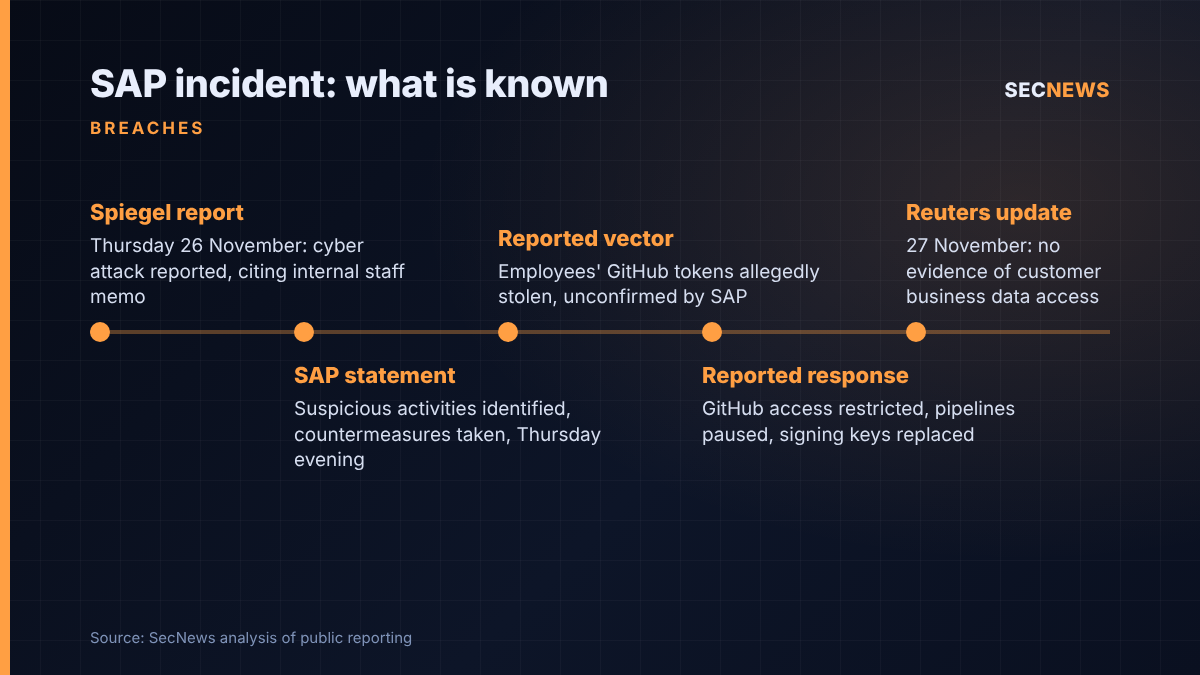
On the evening of Thursday 26 November 2026, SAP issued a short statement saying it had identified “suspicious activities” and had moved quickly to protect customers and keep its services secure. Speaking to Reuters on Friday 27 November, the Walldorf-based software group added that, based on its investigation to date, it had found no evidence of unauthorised access to customer business data. SAP has not said what the activity was, when it was discovered, how the attackers got in or who was behind it.
The statement followed a report by Der Spiegel, which described the incident as a cyber attack and cited an internal memo to staff. According to Der Spiegel, which quoted an insider, attackers stole authentication tokens belonging to SAP employees for GitHub, the Microsoft-owned developer platform SAP uses for product development. Der Spiegel’s sources also suggested the attackers may have used AI agents. SAP has confirmed neither claim.
Handelsblatt, citing sources inside the company, reported that software development is the affected area and that SAP is running the response under the internal name “Project Granite”, involving many teams. The German news agency dpa said it had partly seen an internal message flagging suspicious activity within SAP’s GitHub-based developer and software deployment platform, which asked employees to check whether they needed to take steps such as changing credentials.
The technical picture
The only confirmed facts are SAP’s own. Everything else is press reporting, but it is specific enough to explain why security teams are paying attention.
If the Der Spiegel account is right, the attackers did not need to break SAP’s production cloud at all. A GitHub authentication token, whether a personal access token, an OAuth token or a session credential, acts on behalf of the developer it belongs to. Depending on its scope, it can read private repositories, push commits, open pull requests and, in some set-ups, trigger the automated build and release workflows that sit behind them. Der Spiegel reported that such tokens could let attackers access and alter source code; one secondary report went further and said code was copied and modified, but SAP has not confirmed any of this.
The containment steps reported by Handelsblatt fit that threat model. The paper says SAP restricted access to GitHub, halted automated development processes and replaced signing keys, with the aim of stopping anyone holding stolen credentials from keeping a foothold in systems and source code. Pausing pipelines prevents a compromised account from pushing something through to a build. Rotating signing keys matters because a signature is how downstream systems decide whether a package or update is genuine; if a key might have been reachable, the only safe move is to replace it and re-establish trust.
Note that in April 2026 attackers slipped the Mini Shai-Hulud stealer into a number of SAP-published npm packages. That was a different incident, and there is no public evidence linking the two.
Why it matters for UK organisations
SAP sits underneath finance, payroll, procurement and logistics at many UK enterprises, NHS bodies, universities, councils and central government departments. Most of those organisations never see SAP’s source code. They consume it as patches, transports, cloud updates and add-ons, and they trust it because it arrives signed and through official channels. That trust is precisely what an attack on a vendor’s development environment puts in question.
Nothing so far suggests that tampered SAP code has reached customers, and SAP’s statement points the other way on customer data. But the investigation is live and its scope is not public, so preparation is the right response.
There is also a regulatory angle. The Cyber Security and Resilience Bill, still before Parliament, would extend UK oversight to managed service providers and give regulators more interest in critical suppliers. Boards will be asked how they assess vendor compromise, and an incident at a supplier of this size is a ready-made tabletop scenario. Under UK GDPR, data controllers also remain responsible for assessing any risk to personal data held in third-party systems, whatever the supplier says.
Expert view
In my experience, development platforms are among the least-defended high-value assets in most organisations. When we test them, we routinely find long-lived personal access tokens with far broader scope than the work needs, tokens sitting in local configuration files and CI logs, and build workflows that will happily run whatever lands on a branch. Production gets the attention; the pipeline that produces production often does not.
The reported response looks like a sensible playbook: cut access, stop the pipelines, rotate the signing keys, then work out what was touched. The hard part comes next. Proving that no unauthorised commit made it into a release means reviewing commit history, build provenance and signing records across what could be thousands of repositories. That takes time, so expect SAP to stay cautious until it is done.
I would be careful with the AI agent angle. It may be true, but at this stage it is an unconfirmed claim from unnamed sources, and it does not change the defensive basics. Stolen tokens are dangerous whether a person or a script uses them.
What to do now
- Watch SAP’s official channels. Track SAP security notes and Trust Centre updates and act on any customer guidance the moment it appears. Do not rely on social media summaries.
- Tighten change control on SAP updates. For the next few weeks, apply transports, add-ons and cloud connector updates through your normal test route, verify signatures and checksums, and avoid emergency installs from anything other than official sources.
- Review SAP integration credentials. Inventory the API keys, service users and technical accounts that connect SAP to the rest of your estate, and rotate any that are stale or over-privileged. This maps to the Cyber Essentials user access control requirement.
- Audit your own GitHub estate. Revoke unused personal access tokens, move to short-lived, fine-grained tokens, enforce single sign-on and phishing-resistant MFA, and require approval before workflows run on untrusted changes.
- Protect your signing keys. Keep code signing keys in hardware or managed key services, restrict who can use them, and rehearse how you would rotate them.
- Update your supplier risk register. Record SAP as a vendor under active incident, note what you depend on, and run a short tabletop exercise on a compromised software update.
Bottom line
SAP has confirmed suspicious activity and says it has no evidence that customer business data was accessed; the reports of stolen GitHub tokens, Project Granite and possible AI agent use come from Der Spiegel and Handelsblatt, not from SAP. UK customers do not need to panic, but they should treat this as a live supplier incident: verify what they install, review the credentials that connect them to SAP, and use the moment to harden their own development pipelines.
Sources
- Reuters (via KFGO): SAP flags security incident, says no evidence of unauthorized access to customer data
- Business Standard (Reuters): SAP flags security incident, says no evidence of customer data breach
- Handelsblatt: SAP IT-Sicherheitsvorfall, haben verdächtige Aktivitäten identifiziert
- Tagesspiegel (dpa): Softwarekonzern SAP, haben verdächtige Aktivitäten identifiziert
- Dawan Africa: SAP confirms cyberattack after hackers allegedly used stolen employee tokens to access source code
- The Cyber Sec Guru: SAP GitHub breach explained, stolen tokens, Project Granite