The Department for Work and Pensions has taken online services offline after identifying a cyber incident on its systems, with Universal Credit sign-in reportedly among the casualties. Payments are still going out, but millions of claimants face disruption and a likely wave of scams.
What happened
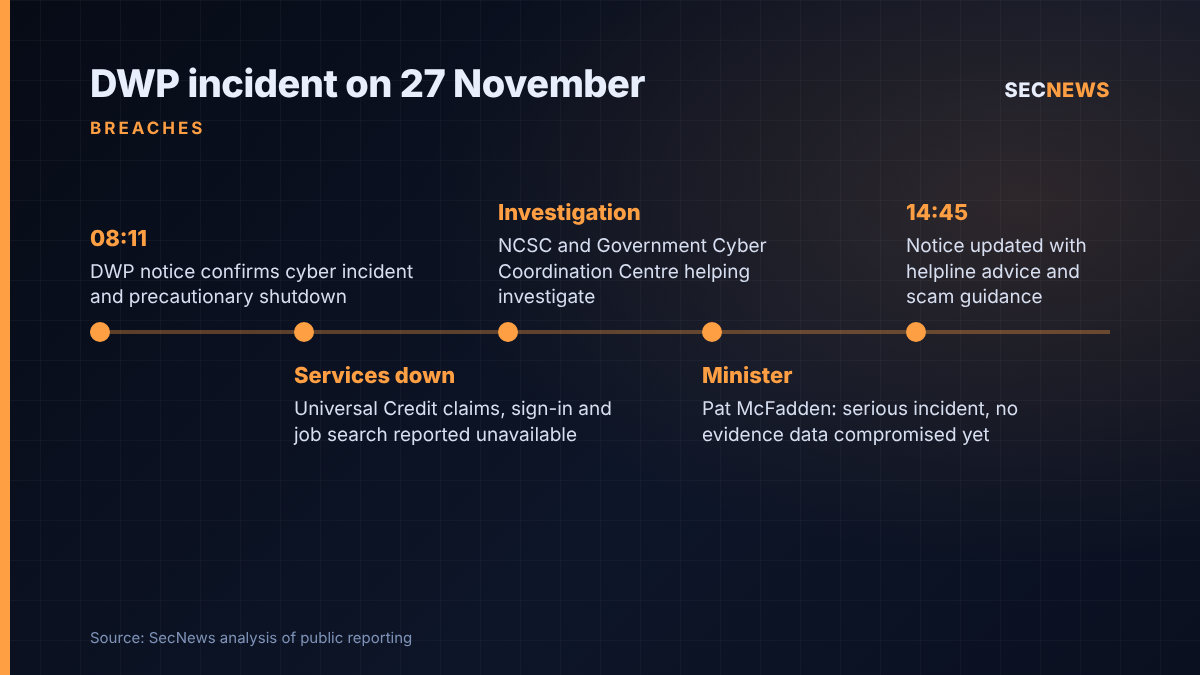
On the morning of Friday 27 November 2026, the Department for Work and Pensions (DWP) posted a brief GOV.UK notice confirming what it called “a cyber incident affecting our systems” and explaining that several online services had been pulled as a precautionary step. The notice, first published at 08:11 and updated at 14:45, says investigators from the National Cyber Security Centre (NCSC) and the Government Cyber Coordination Centre (GC3) are helping the department get to the bottom of it and restore access with minimal disruption.
The DWP has not listed which services are down. According to ITV News, new Universal Credit claims, sign-in to existing accounts and job searching all appeared to be unavailable. Threat intelligence firm SOCRadar went further, saying PIP and State Pension applications and the Tell Us Once service used to report a death were also affected. The department insists routine benefit and pension payments will still arrive on schedule. The afternoon update added that anyone needing help should ring their usual benefit line, where staff will support them.
Work and Pensions Secretary Pat McFadden described it as a “serious cyber incident”, according to The News International, and told reporters there was currently no evidence that personal data had been compromised. The same outlet reported that Downing Street called the situation live and ongoing, and said there was no indication that other government departments had been targeted. Debbie Abrahams, who chairs the Work and Pensions Committee, told ITV News the department had acted swiftly to limit further damage, while calling for the impact on claimants to be examined.
The detail
What we know is narrow. The DWP has confirmed a cyber incident, a precautionary shutdown and the involvement of the NCSC and GC3. It has given no detail on the nature of the incident, on whether data was accessed or taken, how the problem was detected, or when services will come back. No group has claimed responsibility. The Register reported that the department declined to comment beyond its public statement.
That gap matters, and I am not going to fill it with guesswork. A precautionary shutdown tells you that the defenders saw something they did not like and decided that cutting off public-facing access was cheaper than the risk of leaving it open. It does not, on its own, tell you what that something was. SOCRadar noted that Downdetector reports for GOV.UK services began climbing on the evening of 26 November, but whether those problems are connected to the incident is unconfirmed.
The organisational picture is clearer. GC3 coordinates the government’s response to cyber incidents, and The Register notes that the wider Government Cyber Action Plan is led by the Government Cyber Unit under government CISO Bella Powell. Separately, Lloyds and Bank of Scotland app users struggled with logins and transfers that same morning; CybelAngel notes there is no public evidence linking the two.
Why it matters for UK organisations
The DWP is one of the largest digital public services in the country. The News International put its annual spend at roughly £170 billion paid to more than 20 million people. Even with payments protected, losing online access hits people with deadlines: SOCRadar cited a Universal Credit household unable to submit a self-employed income figure and worried about a penalty. Every hour offline pushes more people onto helplines, which is exactly where pressure, mistakes and social engineering thrive.
The second-order risk is fraud. Any high-profile outage at a benefits or banking brand is a gift to scammers, and this one landed on a Friday when many people are paid and many retailers are running Black Friday promotions. Expect texts and emails claiming to be from the DWP or Universal Credit, offering to “verify” accounts, reschedule payments or restore access. The department’s warning that it will never ask for personal information by text or email deserves repeating loudly.
For suppliers and partners connected to DWP systems, including local authorities, housing providers, advice charities and contractors, this is a moment to check your own exposure.
Expert view
In my experience, the decision to pull services quickly is usually the right one, and it is often the one organisations hesitate over longest. Large public bodies carry enormous pressure to stay online, and the instinct is to keep investigating while the front door stays open. Taking the hit early, telling the public plainly that payments are safe and bringing in the NCSC on day one is a response pattern I would rather see than the alternative.
The communication so far has been careful, and that is not a criticism. Saying “no evidence” of data compromise early in an investigation is a statement about what has been found, not a guarantee. Those of us who have worked incident response know the picture on day one is rarely the picture on day ten. Claimants and partners should treat the current position as provisional.
When we test large estates, the hardest part is rarely one system; it is the web of identity, integrations and older platforms around a service used by millions. The real test will be how confidently the DWP restores services, and how clearly it explains what happened.
What to do now
- Warn your customers and staff about DWP-themed phishing. If you serve claimants, pensioners or tenants, send a short note today: the DWP does not ask for bank details or personal information by text or email, and people should go to GOV.UK directly or call their usual benefit line.
- Brief front-line teams. Advice workers, housing officers and contact centre staff will field questions. Give them a simple script and a clear route for reporting suspicious messages, pointing people to the scams and phishing guidance the DWP has now linked from its notice.
- Review any connections to DWP services. If your organisation integrates with or accesses DWP systems, confirm who owns those credentials and be ready to rotate them if asked. This maps to the Cyber Essentials controls on user access control and secure configuration.
- Record impact for affected claimants. Where clients miss a deadline because a service was unavailable, keep a note of times and screenshots so the case can be raised later.
- Test your own shutdown decision. Ask whether your incident plan gives someone the authority to take public services offline quickly, and whether you have pre-approved messages ready for the public, partners and regulators.
Bottom line
The DWP has confirmed a cyber incident serious enough to take key online services offline, but the cause and any data impact remain unknown. Payments continue, the NCSC and GC3 are involved, and the minister says there is no evidence yet of compromised data. For everyone else, the immediate job is protecting claimants from the scams that will follow and checking that your own plan would let you make the same hard call this quickly.
Sources
- GOV.UK (DWP): Temporary disruption to some DWP online services
- The Register: British social security system techies yank services offline following cyber incident
- ITV News: Department for Work and Pensions takes services offline after cyber incident
- SOCRadar: DWP Cyber Incident: Universal Credit and PIP Offline
- CybelAngel: DWP Cyber Incident and Lloyds Outage: What’s Happened So Far?
- The News International: No evidence of data breach in UK DWP cyber incident, pensions minister says