London biometrics specialist iProov will keep supplying the face matching and liveness checks used by GOV.UK One Login under a contract worth up to £45m. The £45m is a ceiling rather than guaranteed spend, and the deal puts one British supplier’s anti-deepfake technology at the front door of many central government services until 2029.
What happened
A contract award notice published on Contracts Finder on 26 November 2026 shows that the Department for Science, Innovation and Technology (DSIT) has appointed iProov Limited to provide what the notice calls a “Genuine Document Checking and Biometric Verification” service. The Government Digital Service (GDS), which runs One Login, made the award as a call-off from an existing framework agreement. Bids closed on 14 May. The award is dated 27 October and the contract runs from 28 October 2026 to 27 October 2029.
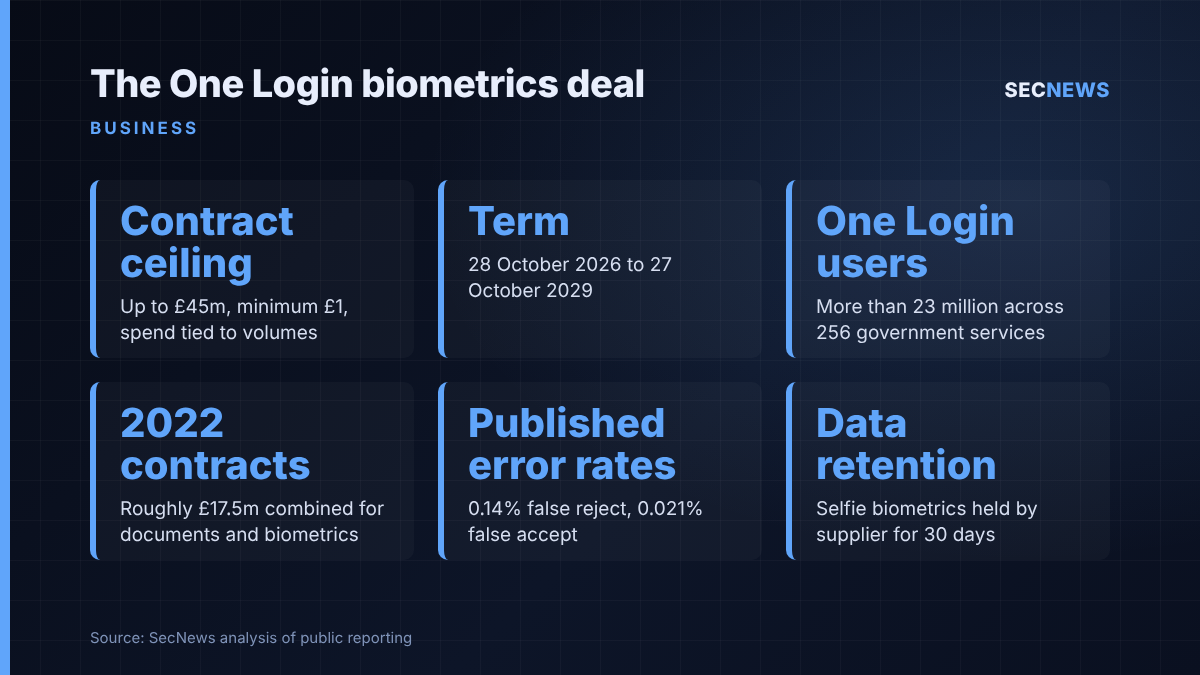
iProov’s announcement frames it as a three-year term plus an optional fourth year. The notice values it at up to £45m, with a stated minimum of just £1, and says actual spend will depend on how many verification transactions go through the system. That makes the headline figure a cap, not a commitment.
iProov names Signicat as a subcontractor for NFC chip-based document reading and orchestration, and Biometric Update reports that Veriff carries out optical document checks. iProov has supported One Login since 2022. Biometric Update reports that its two earlier contracts were worth roughly £11.6m (document checks) and £5.9m (biometrics), so the new ceiling is about two and a half times their combined value.
Founder and chief executive Andrew Bud called protecting the link between people and their digital credentials from deepfakes and state-backed attackers “one of the toughest tasks in cybersecurity”.
The detail
One Login now has more than 23 million users across 256 government services. Those services include HMRC tax accounts, state pension management, HM Land Registry mortgage deeds, basic DBS checks and identity verification for company directors at Companies House. That last one touches every UK company with a director to verify.
In the GOV.UK ID Check app, a user scans the chip in their passport or other photo ID with a phone, then records a short selfie video. The system compares the best frames from that video with the photo held on the chip, and runs a liveness check to confirm a real person is in front of the camera at that moment. Liveness is the control that matters most. It is meant to defeat presentation attacks (a printed photo or a screen held up to the lens) and injection attacks, where synthetic or deepfake imagery is fed straight into the software pipeline and never passes through a real camera at all.
GDS’s published transparency record for the algorithm reports a 0.14% false reject rate and a 0.021% false accept rate. It adds that none of more than 10,000 spoofing attempts in testing got through. It says fairness testing ran across several demographic groups but publishes no per-group figures. Facial images, the biometric profile and estimated age, gender and race markers are kept by the supplier for 30 days. Nobody has to use biometrics: people can answer security questions on the web or prove their identity in person at a Post Office. iProov says an independent lab assessed it against CEN/TS 18099, the European specification for injection attack detection.
The contract comes with some history. In 2025 One Login was briefly removed from the UK digital identity trust framework register after iProov’s own certification lapsed. The government described it as a supply chain issue rather than a change to the product. Biometric Update reports that One Login regained certification in January 2026.
Why it matters for UK organisations
This is a business story with a security core. For the UK identity sector, it is a large, multi-year public contract won by a London company that earns most of its revenue abroad, and a reference customer rivals will struggle to match. For buyers, it is a reminder of how much of the state’s digital front door now sits on a short supplier chain: one prime and two named subcontractors, one of which, Veriff, faces US class action claims over a separate data incident affecting another customer, according to Tech Times. Those claims are allegations, and nothing reported links them to One Login.
The fraud backdrop explains why government keeps paying for this. ONS figures put fraud against adults in England and Wales at 4.5 million incidents in the twelve months to June 2026, an 11% rise, while Cifas attributes 59% of cases filed to its National Fraud Database between January and June to identity fraud. Any firm that onboards customers or staff remotely faces the same attackers and deepfake tooling.
The certification lapse is the lesson not to skip: one expired supplier certificate knocked a national service off a trust register. Under the Cyber Security and Resilience Bill, and in normal third-party risk management, that kind of dependency is exactly what boards will be asked to evidence.
Expert view
When we test identity journeys, the camera is rarely the weak point. What matters is whether the app checks the passport chip’s digital signature properly, whether the server trusts what the client tells it, and whether anyone notices thousands of near-identical attempts from one device farm. Liveness detection that meets an injection standard is a real step forward, but it only protects the parts of the pipeline it can see.
In my experience, the most dangerous phrase in a supplier contract is “certified until”. Certifications expire, subcontractors change and volumes swing. A £1 minimum shows GDS kept its commercial flexibility; private buyers should demand the same, plus contractual notice of any certification change.
Finally, publishing error rates without a demographic breakdown is better than publishing nothing, but it is not the full picture. Any organisation using face matching should expect the ICO and its own customers to ask for that breakdown.
What to do now
- Map your identity verification suppliers. List every prime and subcontractor behind remote onboarding, and record each certification they rely on and its expiry date.
- Ask about injection attacks specifically. Ask vendors for independent test results against CEN/TS 18099 or similar, not just presentation attack figures.
- Check chip verification. Make sure passport and ID chip signatures are validated on the server side, and include this in penetration test scope.
- Keep a non-biometric route. Offer an alternative for people who cannot or will not use face matching, and monitor it closely, because attackers go for the weakest option.
- Build in commercial flexibility. Prefer volume-based pricing, exit clauses and notification duties for certification or ownership changes.
- Cover the basics. Use Cyber Essentials controls (secure configuration, access control and patch management) on the admin consoles and APIs that sit behind your verification flow.
Bottom line
The iProov award extends a British supplier’s hold on the most important identity checkpoint in UK public services, but the real story is the dependency it creates. The value is flexible, the supply chain is short and the certification record has already slipped once. Organisations that rely on remote identity checks should treat this contract as a template for the questions to ask their own suppliers.
Sources
- Contracts Finder: Genuine Document Checking and Biometric Verification (award notice)
- GOV.UK: Algorithmic transparency record, GOV.UK One Login liveness and likeness checks
- Biometric Update: GOV.UK One Login keeps iProov biometrics, liveness in deal worth up to £45M
- Intelligent CISO: iProov secures £45 million UK Government biometric identity verification contract
- ID Tech: iProov Wins £45M GOV.UK One Login Biometric Verification Contract
- Tech Times: UK Scraps Digital ID but Keeps One Login Selfie Checks: iProov Wins Up to $59 Million Contract
- The Paypers: iProov secures GOV.UK One Login contract worth up to GBP 45 million