The UK’s National Cyber Action Plan has been pushed back again, with anonymous sources telling The Record that officials now hope to publish on 9 December. For organisations waiting on government direction before committing budget, the lesson is to stop waiting.
What happened
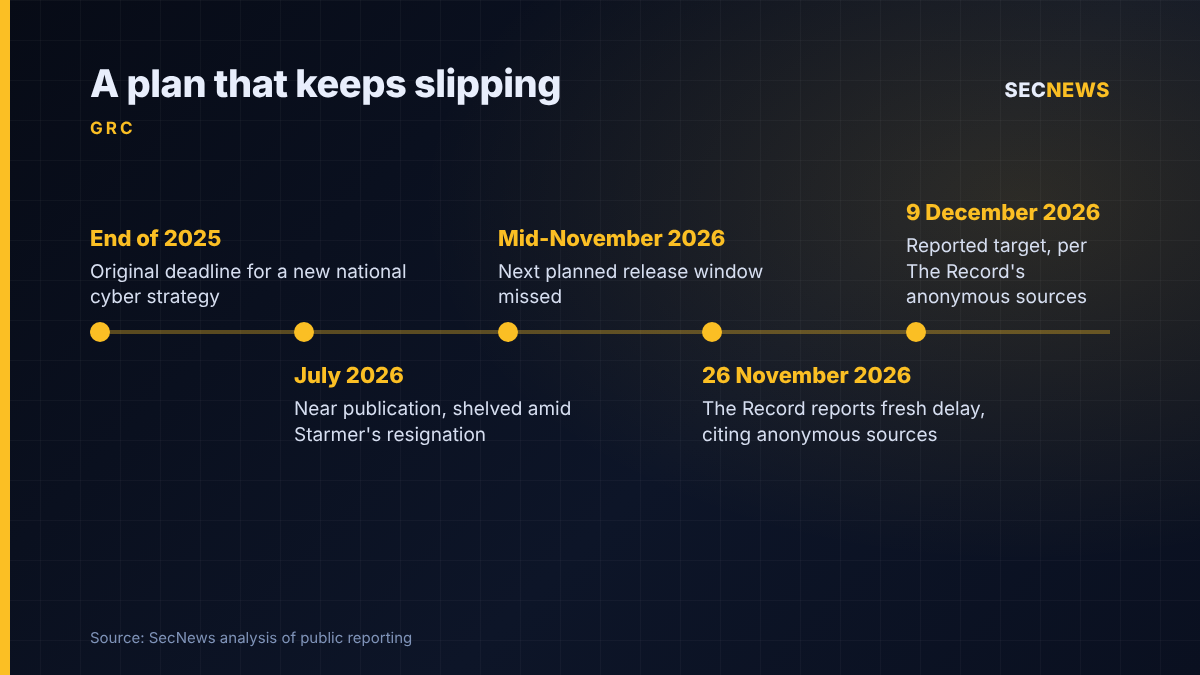
On 26 November 2026, The Record (Recorded Future News) reported that the government had missed its own mid-November target for publishing the National Cyber Action Plan. According to several sources who spoke to the publication anonymously, the new aim is 9 December. A government spokesperson would not discuss timing, saying only that ministers are still committed to releasing the document. Given the plan’s history, treat that as a target, not a promise.
The plan has a long record of slipping. It was originally expected by the end of 2025 as a successor national cyber strategy, then rebranded as an action plan. The Record says it was close to release in July 2026 before being shelved amid the upheaval surrounding Keir Starmer’s resignation. Mid-November was the next window, and that has now passed too.
The news landed in a busy fortnight for UK cyber policy. Earlier this month a House of Lords committee accused ministers of complacency about catastrophic risks, cyber attacks among them, and on 24 November MPs rejected two Lords amendments to the Cyber Security and Resilience Bill, which is still waiting for its final parliamentary stages. Liberal Democrat peer Baroness Northover told The Record that the repeated delay was “unacceptable at a time of significant and escalating risk”.
The detail
The contents of the plan remain officially undisclosed. The Record’s sources say it will be organised around three pillars, Threat, Growth and Resilience, and that the implementation schedule, rather than the headline document, is where the substance will sit. The thinking may echo NCSC chief executive Richard Horne’s June RUSI lecture, which split cyberspace into near, mid and far spaces, with government partnering providers of privately owned cloud, technology and telecoms infrastructure in the middle layer.
Several building blocks are already public. The autumn Budget and follow-up announcements set out money for the AI Security Institute (£120m over four years, according to The Record), £40m for a National Agentic Security Unit, plus £70m for an NCSC centre called the National Exposure and Real-Time Vulnerability (NERV) Centre and £60m for the first phase of a national Cyber Shield. GOV.UK has also announced a Cyber Essentials First Step Fund giving eligible small firms 75% off first-time certification, and a supplier grant of up to £7m.
The voluntary Cyber Resilience Pledge, which asks signatories to treat cyber security as a board-level responsibility and to manage supply chain risk, is described by the government as a central pillar of the plan. Over 230 organisations had signed it by early November. The Record also reports that a consultation on where liability for cyber breaches should fall is expected next year, which could be significant for software vendors.
Around the plan sits a queue of unfinished legislation. The Cyber Security and Resilience Bill must clear the Lords again and gain Royal Assent before the end of 29 April 2027 or it lapses, and The Record says enforcement is unlikely before 2028. The ransomware proposals (mandatory reporting for every victim, licensing of any extortion payment and a payment ban for critical infrastructure operators) still need a legislative vehicle, as does Computer Misuse Act reform, both expected in a National Security Bill next year.
Why it matters for UK organisations
A national plan does not change anyone’s legal obligations on the day it is published. What it does is set direction: which sectors government will lean on, what it expects boards to own, and where future regulation and procurement requirements are heading. Each slip leaves security leaders justifying spend against unwritten expectations.
The practical effect is felt most in the supply chain. Large buyers, especially in the public sector, are already asking suppliers for Cyber Essentials and evidence of board oversight, and the pledge and supplier grant show that government intends to push those expectations down through contracts. Suppliers that wait for the final document risk being asked at the next tender for evidence they cannot yet produce.
There is also a credibility problem: when the strategy, the bill and the ransomware reforms all run late, ministers find it harder to demand urgency from private boards. The threat, meanwhile, keeps growing: on 24 November the NCSC reported a marked rise in AI-assisted attacks on UK organisations since September.
Expert view
In my experience, the organisations that struggle most when new regulation arrives are not the ones with immature tooling. They are the ones that treated strategy documents as a starting gun and did nothing until it fired. The controls that keep coming up in our tests, unpatched internet-facing systems, weak identity management, flat networks and poorly managed third-party access, are not going to change because of a December publication date.
The direction of travel is already clear enough to plan against. Board accountability, supply chain assurance, faster patching of exposed systems and incident reporting appear in every relevant government announcement this year and in the resilience bill itself. A December plan will most likely confirm those themes and attach timelines.
I would also caution against reading too much into the three-pillar framing until the implementation schedule is visible. The real test is whether named owners, dates and funding sit behind each commitment. The liability consultation deserves close attention from anyone who ships software, because it could shift risk on to vendors in a way the current voluntary code does not.
What to do now
- Put cyber risk on the board agenda now. Assign a named director, agree a risk appetite and review the Cyber Governance Code of Practice. Consider whether signing the Cyber Resilience Pledge suits your organisation.
- Close the Cyber Essentials basics. Check firewalls and secure configuration on internet-facing assets, apply critical and high-risk patches within 14 days, enforce MFA through user access control, and confirm malware protection is current. If you are an eligible SME, look at the First Step Fund before it runs out.
- Map your supply chain. Identify which suppliers, including subcontractors, could disrupt critical services, and write ongoing security obligations into contracts rather than checking only at tender stage.
- Prepare for incident reporting. The resilience bill and the ransomware proposals both point to tighter reporting deadlines. Test that your incident response plan can identify, escalate and report a significant incident within 24 hours.
- Software vendors: review the Software Security Code of Practice. Get ahead of any liability consultation by evidencing secure development and vulnerability handling.
- Track 9 December, but do not plan around it. Have someone review the plan and its implementation schedule on release, then update your roadmap.
Bottom line
A further delay to the National Cyber Action Plan is frustrating, but it is not a reason to pause. The government’s priorities are already visible in the funding, the pledge and the resilience bill, and attackers are not waiting for a publication date. Organisations that build board accountability, supply chain assurance and basic hygiene now will find the plan, whenever it arrives, largely confirms work they have already done.
Sources
- The Record: UK’s long-awaited National Cyber Action Plan delayed until December
- GOV.UK: New Government-backed cyber security protections could save UK businesses thousands
- The Record: British government ‘complacent’ on cyber threats from hostile states, peers warn
- Cyber Security and Resilience Bill: Status and Timeline
- NCSC: Familiar weaknesses, exploited faster: defending against agentic cyber attacks