One researcher scanned every public model on Hugging Face and reports finding five GGUF models whose chat templates push users, or AI agents with shell access, into running malware. The models had been downloaded 2,428 times by 27 November and Hugging Face had disabled access to all five when we checked on 29 November.
What happened
On 26 November an independent researcher who publishes as Düzgün (@Root0ne) scanned all 3,273,389 public model repositories on Hugging Face, the main hub for open-weight AI models. The write-up went out on the Malspark blog on 27 November. It reports five malicious models in the GGUF format, which is what most people use to run large language models locally with tools such as llama.cpp, LM Studio and Ollama.
The researcher attributes them to two accounts. Mir2k published two “uncensored” builds, a Qwen3.5 9B derivative and Inkling-2-Mini, each carrying a Windows remote access trojan the researcher calls “ollie” appended to the file. Timdedid published three identical copies of a small Qwen3 model pitched at security users, plus an Ollama mirror.
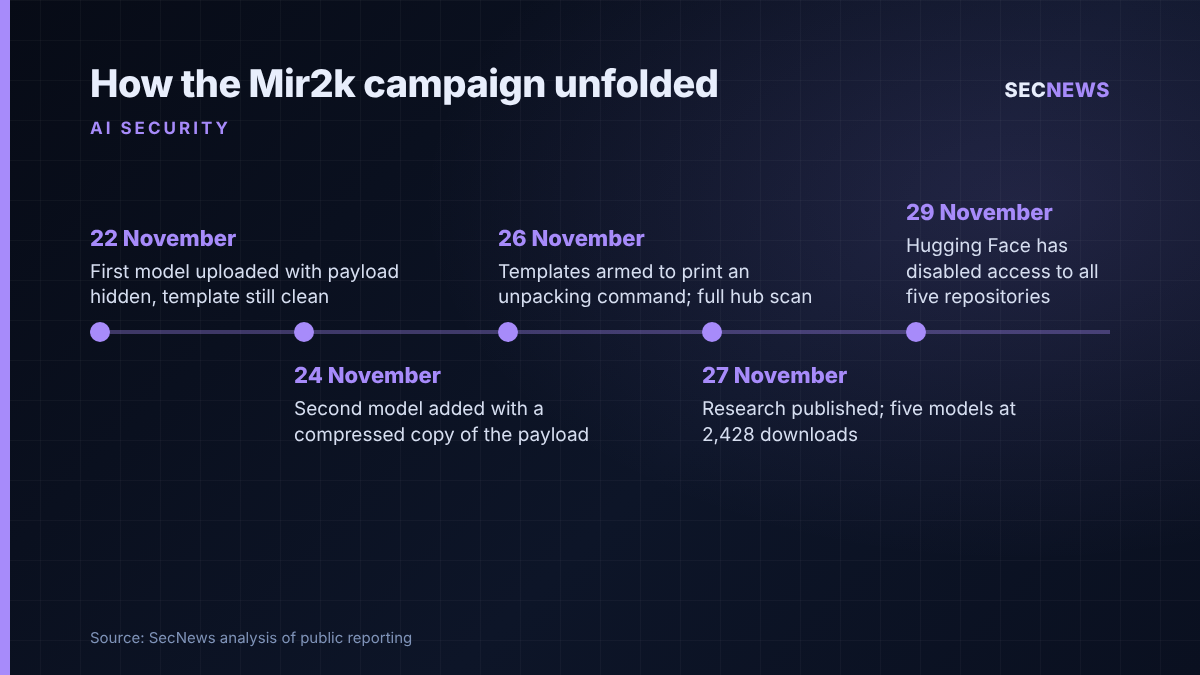
Downloads reached 2,428 by 27 November, up from 1,502 a day earlier, mostly on the Mir2k models. Downloads are not infections, as both follow-up analyses stress, and the researcher notes that Hugging Face counts downloads rather than people. By 29 November Hugging Face had disabled all five repositories for breaching its content policy, though we have seen no wider statement. The timdedid Ollama mirror page still loaded.
All of the core findings come from this one researcher. Spectrum Security and Mallory have published threat summaries, but both build on the Malspark post rather than separate investigations, so the malware analysis and attribution remain unconfirmed by anyone else.
The technical picture
Every GGUF file embeds a chat template, a small Jinja2 program that formats each conversation before the model reads it. Users never see its output, making it an ideal hiding place for instructions.
In the Mir2k models, the researcher says, the template told the model to open every answer with one line of PowerShell. Run by the user, that line extracts the program hidden beyond the model weights and launches it. Loaders only read the regions the GGUF header describes, so trailing data changes nothing about the model and triggers no warning. The second Mir2k file also compressed its payload, stripping the signatures scanners look for.
The timing stands out. Repository history shows the files went up on 22 and 24 November with benign templates and the payload already embedded; the templates were armed on 26 November and revised nine hours later. Earlier downloads hold the payload without the trigger. Mir2k also created twelve empty repositories named after anticipated releases such as DeepSeek-V4, apparently to catch people hunting for new models.
Static analysis describes a capable commodity implant: sandbox checks, persistence via scheduled tasks and watchdogs, Tor-based command and control, browser password theft, Phantom and MetaMask wallet targeting, keylogging, screen and webcam capture, and idle-time Monero mining. A coding error breaks its User Account Control bypass.
Timdedid’s models target agents instead of people. When a particular phrase appears in a prompt, the template injects a fake system directive ordering any agent with a shell tool to fetch and execute a script from a remote site. That second stage was not recovered, so its purpose is unknown.
The idea is not new: the write-up credits Pillar Security with demonstrating template instructions in 2025, and Splunk research published in February 2026 examined about 156,000 GGUF files, judging poisoning plausible but unseen. What is new is use in the wild, paired with an embedded payload. In the researcher’s tests, antivirus and pickle scanners flagged nothing.
Why it matters for UK organisations
Local models are common in British development, data science and security teams, often run on laptops to keep sensitive data away from cloud providers. That sound privacy choice puts unvetted files on endpoints holding source code, cloud credentials and browser sessions. The “uncensored” and “cyber” labels appeal to exactly the technically curious users who tend to have elevated access.
The agent angle matters more. Organisations are increasingly giving coding agents shell access, and this week the NCSC warned that attackers are adopting agentic AI frameworks of their own. A model that can quietly instruct its own agent to fetch and run a script turns a model download into a supply chain compromise with no exploit needed. Under UK GDPR, credentials or personal data taken from a developer’s machine would be a reportable incident like any other, and “it came from a model file” will not change the ICO’s view of whether controls were appropriate.
Expert view
In my experience, most organisations that have a software supply chain policy at all apply it to packages and containers, and treat model weights as data. This research is a useful prompt to stop doing that. A GGUF file is closer to an installer than to a spreadsheet: it carries executable logic in its template and can carry arbitrary bytes beyond the weights.
I would also caution against overreacting to the download figure. Running the Mir2k payload still needed a human to copy and run a command the model printed. The timdedid approach worries me more, because an agent working on its own will not find anything odd. When we test agentic deployments, the weakest point is rarely the model. It is the breadth of tools and permissions the agent is given, combined with nobody reviewing what it actually runs.
The single-source caveat is real. The analysis is detailed and the indicators are published, but Hugging Face disabling the repositories does not confirm the analysis. Until it or another research team does, treat the specifics as the researcher’s findings rather than settled fact.
What to do now
- Check for exposure. Search endpoints and model caches for files from the Mir2k and timdedid accounts, and hunt using the researcher’s published indicators and YARA rules. Treat any machine that ran the printed command as compromised and rotate its credentials.
- Gate model intake. Bring models in through an internal registry, scan them there (the researcher’s open-source gguf-radar is one option) and block direct downloads to developer laptops where you can. This is the Cyber Essentials secure configuration and malware protection controls applied to a new file type.
- Override embedded templates. For tool-enabled use, load a reviewed template file rather than the one shipped inside the model.
- Constrain agents. Remove shell tools that agents do not need, require approval for command execution and log every tool call so it can be matched against endpoint telemetry. This maps to the user access control principle of least privilege.
- Update awareness training. Tell staff that a command suggested by a model is untrusted input, just like a command in an unsolicited email.
Bottom line
If this research holds up, it shows attackers have moved from proof of concept to live use: model files on the biggest public hub carrying hidden instructions and, in one campaign, the malware itself. The numbers are small and the findings need independent confirmation. Even so, the lesson for UK organisations is clear: treat community models as untrusted code and keep a tight limit on what your agents are allowed to run.
Sources
- Malspark: GGUF LLM Models with Hidden Malware on Hugging Face Reached 2400+ Victims
- Spectrum Security: Poisoned GGUF template unpacks hidden RAT
- Mallory: Five Poisoned GGUF Models on Hugging Face Steered Users and Agents Toward Malware
- Splunk: Trust at Inference Time: Investigating GGUF Model Templates at Scale
- Hugging Face: Mir2k/Huihui-Qwen3.5-9B-abliterated-GGUF repository page