Check Point Research has named a new Iran-nexus espionage cluster, Volant Manticore, that hides the commands for its first-stage backdoor in the public IPFS network. Its main targets are in Cyprus and Saudi Arabia, but the methods it uses are ones UK defenders and red teams should be ready for.
What happened
On 24 November 2026 Check Point Research (CPR) published its analysis of a group it calls Volant Manticore, which no one had documented before. CPR is highly confident the group has an Iran nexus. With medium confidence, it ties the group, at least in its origins, to Iran’s Ministry of Intelligence and Security (MOIS). Its working theory is that the operators used to be part of MuddyWater, the long-running MOIS-linked espionage group, and have since broken away to work as their own cluster.
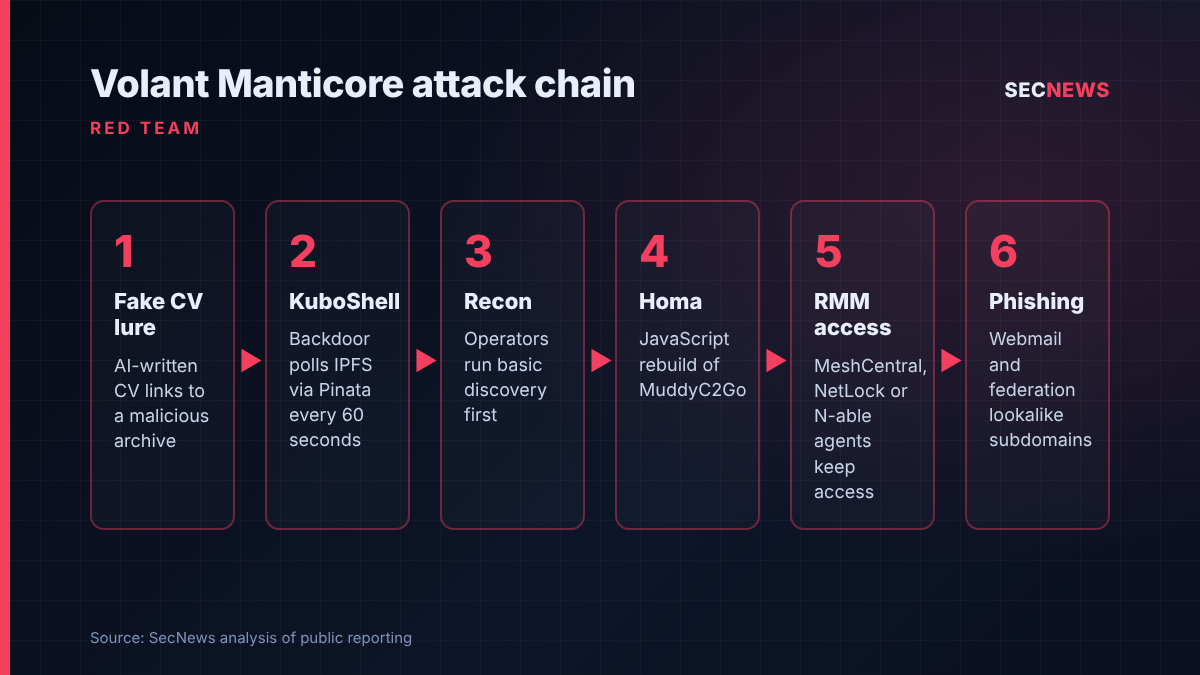
The investigation began in July 2026 with one sample: a fake CV that CPR believes was sent to a Cyprus-based airline whose business centres on flights between Cyprus and Israel. Working back from that sample, the researchers found activity going back to September 2025. That includes a macro-laden Word lure titled “MilitaryHeritageProposal.doc”, uploaded from Cyprus in January 2026 and probably aimed at a Cypriot government body. CPR thinks this may be the first Iranian group to treat Cyprus as a primary espionage target, with telecoms operators, airlines and critical infrastructure at the top of its list.
In late September 2026 the group abruptly turned to Saudi Arabia, with noisier, healthcare-themed phishing, at least once sent from a private hospital’s mailbox that CPR believes was taken over using leaked credentials. The researchers tie the pivot to the escalating Saudi conflict with the Houthis.
The technical picture
The new implant, KuboShell, takes its name from Kubo, the reference IPFS implementation. Instead of talking to an attacker server, this Windows backdoor exchanges small files over the InterPlanetary File System, which addresses data by content hash, using the commercial pinning service Pinata. Victims are keyed by MAC address, and the implant checks for new instructions every minute, running them through hidden PowerShell.
From the operator command history, CPR concludes that KuboShell is a lightweight “guardrail” used to size up a machine before anything more capable is installed. Operators occasionally typed framework commands into the wrong console, which hints at a larger modular toolkit.
That toolkit, which CPR calls the Homa Framework, runs as a PowerShell stager, a PowerShell loader and a JavaScript backdoor. The last stage is a JavaScript rewrite of MuddyWater’s retired MuddyC2Go client using the same server protocol, which CPR reads as a small team recycling familiar code just enough to dodge existing detections.
Legitimate tooling does much of the rest. The group has installed MeshCentral, then NetLock RMM, and in some samples N-able RMM for persistence, and set up webmail, Exchange and federation-themed subdomains alongside a GoPhish server, which CPR says suggest credential phishing. The operators’ own virtual machines showed tooling tested against antivirus products and Fortinet SSL VPN adapters, which CPR says may indicate VPN access into victim networks.
Why it matters for UK organisations
The report names no UK victim, and the targeting is regional. CPR does stress Cyprus’s role in Western military activity and its deepening defence and energy ties with Israel and Greece, so UK firms with operations or partners on the island or in the Gulf should read it as relevant intelligence.
The wider lesson is the tradecraft, all of which works on UK networks. First, the AI-generated job applicant: a CV is one of the few attachments staff are expected to open from strangers, and generative AI makes a convincing persona cheap. In my experience, recruitment teams are rarely included in phishing simulations and often have looser download habits than the rest of the business.
Second, command and control over decentralised storage. IPFS gateways and pinning APIs can blend into permitted SaaS traffic, and domain-reputation blocklists will not flag them the way they flag a beacon to a freshly registered VPS. Third, RMM abuse: signed, trusted remote management agents give an intruder persistence that looks like routine IT administration, particularly where a managed service provider already runs one.
Expert view
What I value here is the view of the operators’ habits: test environments, mistyped commands, leftover debug strings in the Saudi samples and a rushed infrastructure move on 11 October. This is a small team under pressure, not a polished state programme, yet its simple methods would still land in plenty of organisations.
When we run adversary simulation work, the useful question is not “would we spot this malware?” but “would we notice a new remote access path at all?”. A hidden PowerShell process polling an external storage service every minute, followed by a fresh RMM install, should trip alerts in a mature estate. In many mid-sized organisations it would not, because nobody has defined approved RMM tools or baselined workstation egress.
CPR also warns that folding Volant Manticore into MuddyWater could create blind spots, so intelligence teams should keep the new label and its confidence levels distinct and hunt on behaviour.
What to do now
- Control remote management software. Keep an approved list of RMM products and tenants, block unapproved agents by application control, and alert when any new RMM service is installed. This maps to the Cyber Essentials secure configuration and malware protection controls.
- Restrict and log decentralised storage traffic. Find out whether workstations need to reach IPFS gateways or pinning APIs at all. If they do not, block them at the proxy or DNS layer and investigate any hosts already making regular, scheduled requests to them.
- Harden recruitment workflows. Bring HR and recruitment staff into phishing exercises, open CV attachments in isolated viewers, and treat “download the full CV” links to file-sharing sites as suspicious.
- Lock down Office macros and PowerShell. Block macros in files from the internet, turn on PowerShell script block logging, and watch for hidden PowerShell windows started by user applications.
- Remove standard users’ local admin rights. KuboShell asks for elevation through a UAC prompt. Users who cannot approve that prompt break the chain early, which is the Cyber Essentials user access control requirement in practice.
- Protect identity and VPN access. Enforce phishing-resistant MFA on webmail, federation and SSL VPN portals, and check sign-ins for odd locations and devices.
- Take in the indicators. CPR’s report lists domains, IP addresses and file names. Load them into your SIEM and EDR, and search historical logs as well as watching for new activity.
Bottom line
Volant Manticore is a small, regionally focused Iranian team, not a global menace. Its toolkit is a concise lesson in how cheap evasion has become: an AI-written job applicant, a backdoor that gets its orders from a public peer-to-peer network, and trusted remote management software for persistence. UK organisations that can’t currently see a new RMM agent or an unexpected IPFS beacon should fix that now, whoever turns out to be using those techniques.