Attackers used five unauthenticated Mitel MiCollab flaws as zero-days and went from a conferencing server to a domain controller in about half an hour. Patching now closes the door, but it will not tell you whether someone has already walked through it.
What happened
Mitel’s advisory MISA-2026-0012, issued on 16 November 2026, fixed five vulnerabilities in the Audio, Web and Video Conferencing (AWV) component of MiCollab, its unified communications platform. It said nothing about attacks in the wild, and a 24 November revision only updated the CVE numbers.
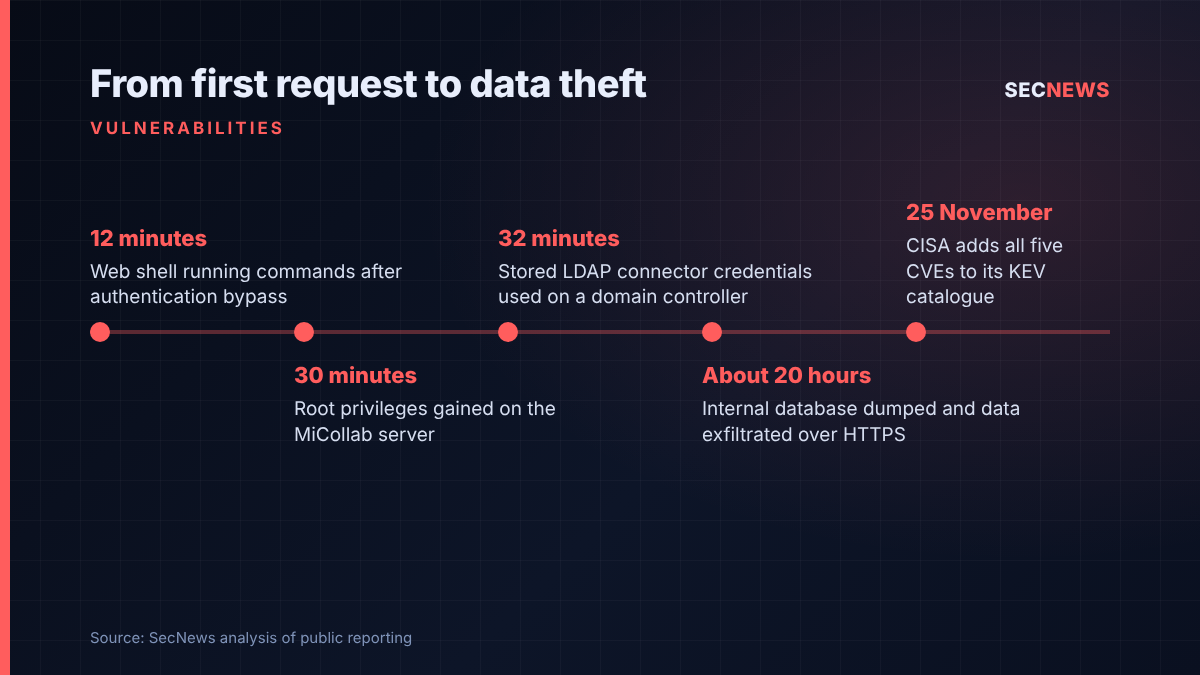
The picture changed this week. Accenture’s APEX Labs has published a threat intelligence report concluding, with high confidence, that an unknown threat actor was exploiting the flaws before the advisory existed. At one victim, web shell activity began before 23:00 UTC on 15 November, the day before Mitel went public. On 25 November CISA added all five CVEs to its Known Exploited Vulnerabilities (KEV) catalogue. US federal agencies must fix four of them by 28 November and the fifth by 9 December. SecurityWeek reported Accenture’s findings on 26 November.
A second organisation’s server had held a persistent HTTPS link to the same attacker machine since 9 November, though Accenture could not tell how it was breached: it ran an older 10.0-series release open to earlier Mitel flaws too. No known group has been linked to the activity. Accenture believes the pattern points to an extortion operation and expects more exploitation now the details are public.
The technical picture
All five bugs, CVE-2026-133275, CVE-2026-133303, CVE-2026-133311, CVE-2026-133323 and CVE-2026-133324, can be reached without credentials. Mitel describes them as an arbitrary file upload, an XML injection, unauthorised access to sensitive information, a blind command injection and an authentication bypass. The command injection scores a maximum 10.0 on CVSS 3.1 and the XML injection scores 9.0. Mitel warns that chaining them raises the impact, which is exactly what happened. MiCollab 10.3 (10.3.0.18) and earlier are affected. The fix is a patch applied on top of 10.3.0.18, described in Mitel knowledge base article KB000129195.
The intrusion timeline Accenture describes is the part that should worry defenders. The attacker:
- identified the MiCollab version and bypassed authentication on AWV
- uploaded files and was running commands through a web shell 12 minutes after the first request
- had root on the server within 30 minutes
- used the directory credentials MiCollab keeps for its LDAP connector to sign in to a domain controller after 32 minutes
The attacker then enumerated the directory, Kerberoasted service accounts and harvested passwords from file shares. About 20 hours in, they dumped an internal database with custom Java tooling and moved the data out in hundreds of short HTTPS uploads, partly via a backup server.
Two further findings matter for incident response. The exploitation traffic went through an internet-facing reverse proxy, so the proxy offered no protection. The attacker also scrubbed its own activity from MiCollab’s local logs, so a clean-looking log proves nothing.
Accenture also says the attacker’s server talked to two unnamed commercial AI API services during the campaign, including a restart in the same second as the authentication bypass request. It assesses that AI-assisted tooling probably drove parts of the intrusion, but admits it cannot say exactly how the services were used.
Why it matters for UK organisations
MiCollab is the kind of platform that sits quietly in many organisations that standardised on Mitel telephony years ago. It is usually published to the internet so that remote staff and external guests can join conferences. It is also wired into Active Directory. That combination of public exposure and a privileged directory credential is what turned a conferencing bug into an enterprise breach here.
There is a governance angle too. If MiCollab is your way in, the attack described here ends in bulk data theft from internal databases. That makes it a personal data breach, and the 72-hour clock for reporting to the ICO starts when you become aware of it. Organisations falling under the NIS Regulations, and the wider scope proposed in the Cyber Security and Resilience Bill, should treat telephony platforms as in scope for their asset and vulnerability management, not as something the comms team or a reseller looks after. Where a Mitel partner manages the platform, confirm today who is actually applying the patch.
Expert view
When we test unified communications platforms, they nearly always turn out to be among the least scrutinised internet-facing systems in the estate. Nobody wants the phones down for maintenance, so patching slips, and the directory service account is often over-privileged. This campaign punishes all of those habits at once.
The detail for any board is the timing. Thirty-two minutes from first request to a working domain account leaves no room for a weekly patch cycle or a ticket waiting for the telephony supplier. In my experience, the organisations that come through this sort of event well have already decided that a compromised edge appliance means a compromised directory, and they respond on that basis. Accenture makes the same point: a confirmed MiCollab breach should be handled as a potential Active Directory compromise, not a single-server clean-up.
On the AI element, keep a sense of proportion. Accenture’s evidence is timing from sampled telemetry. What made this attack work was unauthenticated bugs, an exposed service and an over-trusted connector account, and the fixes are the same whoever, or whatever, is typing.
What to do now
- Find every MiCollab instance. Include ones run by partners or sitting behind a MiVoice Border Gateway. Anything on 10.3.0.18 or earlier that faces the internet should be presumed exposed. (Cyber Essentials: secure configuration, asset inventory.)
- Take forensic images before you patch. Patching or rebuilding can destroy the evidence you need to know whether you were hit.
- Apply the MISA-2026-0012 patch via KB000129195, after moving to 10.3.0.18 if needed. Clear any backlog of older Mitel fixes such as MISA-2026-0006 at the same time. (Cyber Essentials: security update management, critical fixes within 14 days. KEV-listed flaws warrant much faster action.)
- Restrict external access to AWV until the fix is in, and do not count on a reverse proxy to protect it. (Cyber Essentials: firewalls.)
- Hunt using upstream data. Compare proxy, WAF and gateway logs against MiCollab’s own logs, look for system logs that have suddenly shrunk, and search network telemetry for the indicators Accenture has published.
- Watch and reset the LDAP connector account. Alert on it authenticating to many domain controllers or requesting bursts of RC4 service tickets. If compromise is suspected, rotate it, every Kerberoastable service account and any admin, SIP and share passwords the server could reach. (Cyber Essentials: user access control.)
- Cut the connector’s privileges to read-only directory lookups, and watch for unusual outbound traffic from telephony hosts.
Bottom line
This was a zero-day campaign against a platform that is internet-facing by design and trusted by the directory, and it reached the crown jewels in under a day. Patch MiCollab now, but image it first and hunt as if you had already been breached. A server patched today may have been compromised a fortnight ago.
Sources
- Accenture APEX Labs: When patch day comes too late: MiCollab flaws exploited before disclosure
- Mitel: Product Security Advisory MISA-2026-0012
- SecurityWeek: Mitel MiCollab Zero-Days Exploited in Suspected AI-Assisted Attacks
- The Factum: Unknown actors exploited five Mitel MiCollab flaws as zero-days and stole business data