St James’s Place, the FTSE 100 wealth manager with close to a million clients, has confirmed a cyber security incident dating from late October, according to press reports. It is the third UK wealth firm reported to have been hit this autumn, and the company has yet to say whose data was taken or how much.
What happened
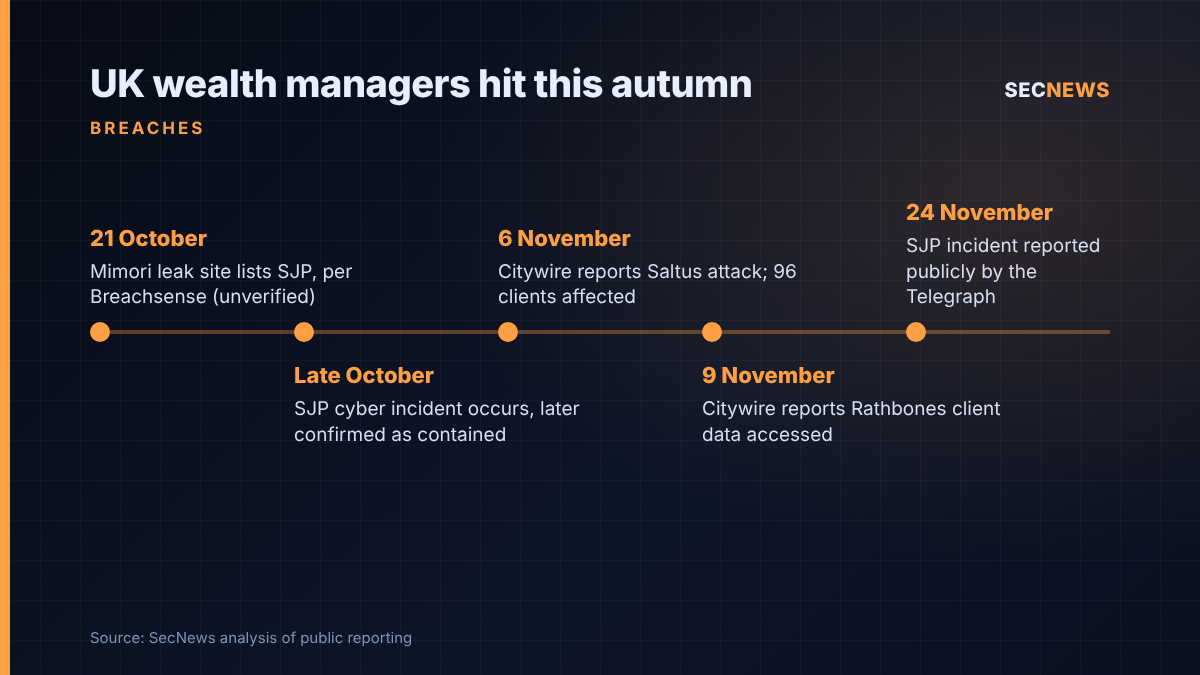
St James’s Place (SJP) has acknowledged a cyber security incident that took place towards the end of October 2026. The confirmation surfaced publicly this week: the Telegraph reported it on 24 November, and SSBCrack News credits Citywire with first breaking the story.
According to those reports, SJP says the incident has been contained, its core systems were not touched and clients have been able to reach their accounts as normal. BozokMedia quotes a spokesperson as saying the incident “did not impact our operations”. The firm also says it has told the relevant regulators and has been in contact with the individuals affected.
What SJP has not said matters just as much. It has given no figure for the number of clients involved, no description of the categories of personal data concerned and no explanation of how the intruder got in. secnews.co.uk was unable to read the Telegraph or Citywire reports directly, so the detail here comes from outlets summarising them, and we will update if SJP publishes its own statement.
The disclosure lands after similar reports about two other British wealth managers. Citywire reported on 6 November that Saltus had suffered an attack, and on 9 November that client data at Rathbones had been accessed by an unauthorised party during the first week of the month. Both stories, as summarised by the consultancy CyPro, rest largely on Citywire’s own reporting.
The technical picture
Very little technical detail is public, and it would be wrong to fill the gap with guesswork. The one external data point is a listing on an extortion group’s leak site. The threat monitoring service Breachsense records that a group calling itself Mimori posted SJP as a victim on 21 October 2026. Breachsense is explicit that the claim comes from the criminals and has not been verified, and SJP has not publicly attributed the incident to anyone. SSBCrack News adds, without naming its sources, that analysts believe Mimori is run by Russian speakers.
Mimori is a newcomer. Breachsense first saw it in October and lists only three named victims, all posted on the same day: SJP, the UK industrial software company Aveva and the Canadian firm OpenText. The leak site says nothing about the volume or sensitivity of any data held.
Breachsense’s page on SJP also shows the wider exposure that any large brand carries. It counts more than 700 addresses on the sjp.co.uk domain in third-party breach data and 139 sjp.co.uk logins harvested by infostealer malware from 58 infected machines, the latest dated 22 November. The service stresses that these could belong to staff or customers and are not necessarily linked to the extortion claim.
Saltus offers the only other technical clue in this cluster. According to reports of its statement, the attackers went after several of its websites but only succeeded against one small forms service outside its core platform, which it has now shut down for good. Saltus says 96 clients were affected, no client portal accounts were reached and money held with regulated custodians was not affected.
Why it matters for UK organisations
Wealth managers hold an unusually rich mix of data: identity documents, addresses, income, pension and investment holdings, family details and adviser correspondence. Even where no money moves, that data is valuable for targeted fraud, impersonation of advisers and convincing pension or investment scams. For clients, the lack of detail from SJP makes it harder to judge whether they need to take protective steps.
The regulatory backdrop is tightening. Reports citing Financial Conduct Authority figures say reported cyber incidents in October were 52% above the previous peak, recorded in May 2025. Last week the FCA, the Bank of England and the Prudential Regulation Authority set out joint proposals on how firms should govern, detect and recover from cyber attacks, while a Bank of England and FCA survey suggests 88% of financial firms expect AI-enabled attacks to have a moderate or high impact on the risks they face within two years. Katharine Braddick, a deputy governor at the Bank, has described cyber attacks as becoming “more frequent, complex and dangerous”.
For the wider market, the pattern is familiar from UK retail: when one firm in a sector is hit, its peers are often already being probed. Advice networks, discretionary managers and their suppliers should assume they are on the same list.
Expert view
The SJP disclosure is a reminder that “contained” and “no operational impact” describe availability, not confidentiality. A firm can keep every system running and still have lost a meaningful volume of client data.
In my experience, the weak point in financial services is rarely the core platform. It is the periphery: a marketing form, a document upload portal, a legacy integration or a third-party web service that nobody has reviewed in years. The Saltus account fits that shape exactly. When we test firms like this, the real external attack surface usually outgrows the asset register.
The infostealer figures deserve attention too. Stolen session cookies and saved passwords from personal or unmanaged devices bypass a lot of perimeter controls, and adviser networks with self-employed partners using their own equipment are especially exposed. I would also caution against treating a leak-site listing as either proof or noise. It is a lead to investigate, nothing more, until the victim or investigators confirm what was taken.
Finally, transparency has a security function. Clients who know what categories of data were exposed can spot follow-on phishing far more easily. Silence leaves them guessing, and criminals exploit that uncertainty.
What to do now
- Map the periphery. Build a full inventory of internet-facing services, including forms, portals and vendor-hosted pages, and retire anything without a clear owner. This supports the Cyber Essentials firewalls and secure configuration controls.
- Hunt for stolen credentials. Monitor breach and infostealer sources for your domains, force resets and revoke sessions where staff or partner credentials appear, and require phishing-resistant MFA for remote and adviser access (Cyber Essentials user access control).
- Control unmanaged devices. Restrict access to client data from personal machines, or enforce device health checks and malware protection before access is granted.
- Prepare client communications. Warn clients that criminals may impersonate advisers following publicised incidents, and give them a reliable way to verify contact.
- Test recovery and reporting. Rehearse incident response against the new FCA and Bank of England expectations, including ICO notification within 72 hours where personal data is at risk.
Bottom line
SJP has confirmed an incident but very little else, and the only claim of responsibility comes from an unverified criminal listing. With Rathbones and Saltus also reported hit, UK wealth managers should treat this as a sector-wide warning, close off forgotten web services and stolen logins, and be ready to tell clients clearly what has happened if they are next.
Sources
- SSBCrack News: St James’s Place Hit by Cyberattack as Hackers Target Wealth Managers
- BozokMedia: St James’s Place Confirms Cybersecurity Incident Affecting Wealth Management Services
- QUE.com: Keio, Ipsos and St. James’s Place breach round-up
- Breachsense: St. James’s Place Data Breach in 2026
- Breachsense: Mimori Ransomware: Victims and Activity
- CyPro: Client Data Reportedly Accessed in Rathbones Cyber Attack
- CyPro: Saltus Cyber Attack Reported To Expose Client Data