Troy Hunt has published an AI-assisted review of eight and a half years of breach warnings he sent to 73 organisations, and the hardest step was often just finding someone to tell. For UK organisations, it is a timely reminder that a vulnerability disclosure route is part of incident response, not a nice extra.
What happened
On 23 November 2026, Have I Been Pwned (HIBP) founder Troy Hunt published a long post on how organisations react when an outsider tells them their customers’ data is circulating. He did not write most of it himself. Hunt gave Anthropic’s Claude access to the mailbox he has used for breach notifications since early 2018 and asked it to analyse what happened after his first contact. The review covers the standard notification email he sent to 73 organisations between March 2018 and November 2026, plus other conversations that started through website contact forms. The Register covered the analysis on 24 November.
The company names are left out on purpose. The findings are blunt. In many cases, getting an organisation to admit a breach was harder than getting hold of the stolen data. Hunt sums up the recurring tone as standoffish, delayed and lawyer-led, with corporate interests repeatedly put ahead of customers.
Not every case went badly. A small transport app replied within hours and had already published a statement. A booking platform admitted it had been wrong to doubt him and emailed every affected customer within roughly a week.
The detail
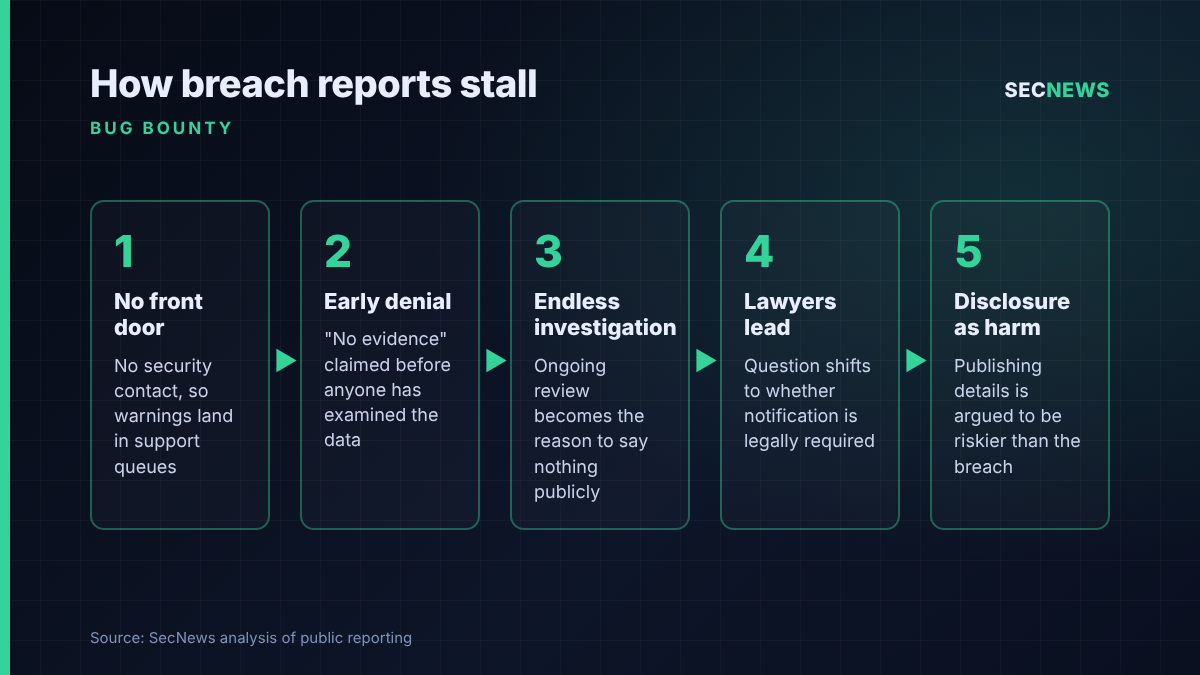
The analysis describes a sequence of failures that most people who have reported a security issue will recognise.
- No front door. Many organisations had no visible security contact. Hunt’s notices went to support desks, returns departments, generic info addresses and contact forms. In some cases he resent the first email, and in others he chased people on LinkedIn, Facebook and X. One hardware maker’s thread passed through six teams before reaching legal.
- Logged as a support ticket. Several warnings were filed as routine customer queries. In one case Hunt received three automated surveys asking him to rate the support he had received.
- Denial before analysis. A common first reply was that there was no evidence of compromise, often sent before the organisation had seen the data. One firm repeated that claim three weeks later, then confirmed an exposed database server once it actually received the records.
- Investigations with no end. Once the data was accepted as real, “we’re investigating” became a reason to say nothing in public, sometimes for months.
- Lawyers take the lead. In the most serious cases, outside counsel or a general counsel replied instead of the security team. The question then became whether notification was legally required, not whether customers needed to know.
- Disclosure framed as the harm. One law firm argued that publishing details would point criminals to the file, even though it had already been shared on a large forum.
The post also notes a limit of HIBP itself. Hunt can only email his own subscribers. In one healthcare-adjacent case, around 1,300 subscribers sat among almost 500,000 affected addresses, leaving everyone else dependent on the company. The report concludes that each excuse for silence “sounds reasonable on its own”, but together they leave victims to find out last.
Why it matters for UK organisations
Hunt’s sample is international and anonymised, but the pattern still matters here, for two reasons.
First, the starting point of every failed thread was the lack of a security contact. That is a vulnerability disclosure problem, and the UK already has tools for it. The NCSC publishes a vulnerability disclosure toolkit. The security.txt standard (RFC 9116) gives researchers a predictable place to find a contact. Makers of consumer connectable products sold in the UK are required under the product security regime to publish a way to report vulnerabilities.
Second, the UK GDPR does not let organisations wait out an investigation. A notifiable personal data breach must normally be reported to the ICO within 72 hours of the controller becoming aware of it. Where the risk to individuals is high, they must be told without undue delay. The clock is not paused while lawyers debate thresholds. Leaving a credible report backed by sample data in a ticket queue is a governance failure, not just a courtesy failure.
Expert view
None of this surprises anyone who has spent time on the reporting side of the fence. In my experience, the technical work of confirming an issue is usually the quick part. The slow part is finding a human with the authority to act, then getting past the instinct to treat the person reporting it as the threat. Hunt’s write-up is valuable because it puts numbers and repeated patterns behind what researchers usually describe anecdotally.
When we run incident response exercises with clients, an external researcher or journalist contacting the support desk with leaked data is one of the most useful scenarios to test, because it exposes routing problems quickly. Front-line agents rarely know who to escalate to, and days can pass before security sees the report.
I would also push back on the legal-first approach. Counsel has a real role, but the best responses in Hunt’s mailbox came from people who treated the report as help, shared what they knew early and updated it later.
There is a lesson for bug bounty and VDP owners too. A programme that only accepts in-scope technical findings through a platform can still miss the most important report of the year, the one saying your data is already for sale. Make sure the policy explains how to report suspected breaches, not just bugs.
What to do now
- Publish a security contact. Add a security.txt file to your main domains, pointing to a monitored mailbox or form and to your disclosure policy.
- Adopt a simple disclosure policy. Use the NCSC toolkit as a template. State what you accept, how fast you will acknowledge it and how you will treat reporters acting in good faith.
- Fix support desk routing. Give customer service a short script and an escalation path for any message mentioning a breach, leaked data or a vulnerability. Such messages should never be closed as ordinary tickets.
- Examine evidence before you deny anything. Ask for a sample, validate it against your own records, and only then form a position.
- Write the 72-hour decision into your incident plan. Name who decides on ICO notification and who drafts customer communications, and practise both in exercises.
- Close the detection gap. Under Cyber Essentials, secure configuration and access control address many of the exposed servers and forgotten test systems in Hunt’s examples. Make sure internet-facing databases and test environments are inventoried and locked down.
Bottom line
In every thread Hunt describes, the data was already circulating; the real question was whether its owners would ever hear about it. For UK organisations, the fix is cheap: a published contact, a disclosure policy, a support desk that knows when to escalate, and a leadership team willing to say what it knows before it knows everything.