London Gatwick has confirmed that AutoPay, the third-party system that automatically charges drivers for using its drop-off zones, was accessed without authorisation, exposing customers’ personal, vehicle and payment records. AutoPay has been switched off, affected customers have been emailed and the ICO has been told.
What happened
On the afternoon of Tuesday 24 November 2026, Gatwick Airport said it was investigating a data breach affecting the payment system used for its drop-off charges. According to the airport, the incident was reported to it by Times24 UK Limited, the company that operates the drop-off zones on Gatwick’s behalf. Times24 told the airport it had experienced unauthorised access to AutoPay, the third-party service that recognises registered vehicles and takes the drop-off fee automatically.
A Gatwick spokesperson said the investigation was ongoing, that some customer information was affected and that those people had been contacted. The ICO has been informed and AutoPay disabled as a precaution. Drop-off zones remain open with alternative payment options, and flights and car parks are unaffected.
Not yet disclosed: how many customers are affected, when the access began, how long it lasted and how the attacker got in. We have seen no public statement from Times24 and no claim of responsibility. Early headlines warning bank details may have been stolen go beyond what the airport has confirmed, which is partial card data in a minority of cases.
The technical picture
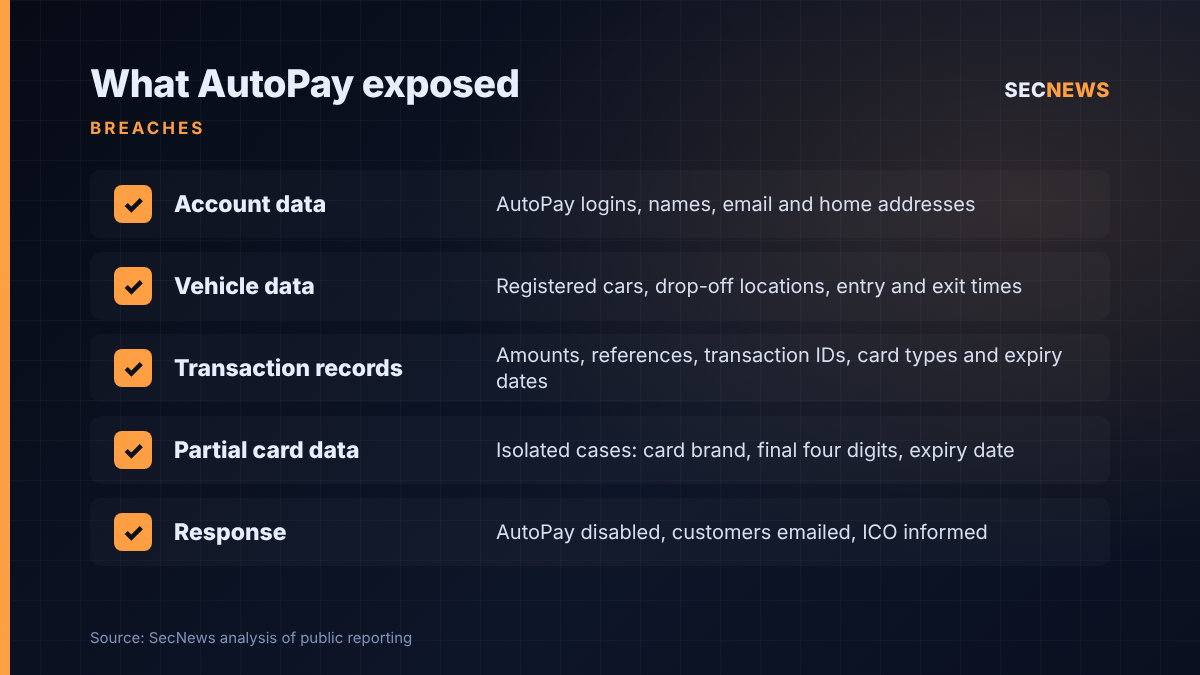
The airport’s statement and customer email, as reported by the BBC, list four groups of data.
- Account data: AutoPay login credentials, names, email addresses and home addresses.
- Vehicle data: details of the cars registered to the account, plus drop-off locations and the times vehicles entered and left the zone.
- Transaction records: payment amounts, transaction status, payment references, transaction IDs, card types and expiry dates.
- Partial card data: in what Gatwick calls “isolated cases”, the card brand, final four card digits and expiry date.
What has not been said matters just as much. Nothing so far suggests that full card numbers or security codes were exposed, and the airport has described the payment exposure as partial. Partial card details cannot be used on their own to buy anything, but they help a scam call or email sound convincingly like it comes from the airport or a bank.
The exposure of login credentials is the more pressing issue. Anyone who reused their AutoPay password elsewhere should assume that account is at risk, since the airport has not said how passwords were stored. The vehicle entry and exit times also deserve attention. Paired with a home address, a record of when someone drove to an airport tells you roughly when they were travelling and when their home may have been empty.
Drop-off charging links number plate recognition to stored payment details, and the point of AutoPay is that drivers sign up once and forget about it. That convenience leaves a lot of personal data with a supplier most passengers have never heard of.
Why it matters for UK organisations
This is another case of a well-known UK brand having to own a breach that happened in a supplier’s system. For customers, the brand is the organisation they dealt with, whoever ran the software, and any organisation outsourcing parking, ticketing, payments or booking faces the same position when a supplier is compromised.
The regulatory side is clear. Under UK GDPR, an organisation must report a personal data breach to the ICO within 72 hours of becoming aware of it, unless it is unlikely to result in a risk to people’s rights and freedoms. It must tell the people affected without undue delay where the risk is high. Here, home addresses, travel times, credentials and partial card details are held together. That combination points towards the higher-risk end, and notifying customers directly was the right call. The split of controller and processor roles between Gatwick, Times24 and the AutoPay provider will shape the ICO’s questions about security and contracts.
Parking, drop-off and enforcement services across UK airports, hospitals, rail stations and retail parks are run by a fairly small group of operators and software platforms. They hold number plates, addresses and payment tokens for large numbers of drivers, yet rarely get the security scrutiny given to payment and identity systems.
Expert view
When we test this kind of system, the weak points are rarely the payment gateway itself. Card handling is usually outsourced to a PCI DSS-certified processor, and that part tends to stand up. The problems sit around it: the customer self-service portal, the operator’s back-office application, the API that links number plate cameras to accounts, and the support staff who can look up any record. Portals often lack multi-factor authentication, and back-office tools are often internet-facing with single-factor logins. An attacker in either can usually see everything the operator sees, which resembles the dataset described here.
In my experience, the larger governance gap is fourth-party risk. The airport contracts with an operator, and the operator licenses a platform from someone else. Assurance questionnaires usually stop at the first link in that chain. A client may know its operator holds ISO 27001, yet not know where the data is hosted or who administers it.
Gatwick deserves some credit. It disabled AutoPay, notified customers and issued a plain statement listing the data types. The open questions are about detection and data minimisation: how long was the attacker present, and how much vehicle movement history does a drop-off system really need to keep?
What to do now
If you are a Gatwick AutoPay customer:
- Change the password on any other account where you used the same one as for AutoPay, and turn on multi-factor authentication wherever it is offered.
- Be wary of calls, texts and emails that mention Gatwick, drop-off charges, refunds or your card ending in particular digits. Contact the airport or your bank through numbers you look up yourself.
- Watch card statements and report anything odd to your bank and Action Fraud.
If your organisation outsources a customer-facing service:
- Map your suppliers’ suppliers. For each outsourced service that holds customer data, record who hosts it, who administers it and which software platform it runs on.
- Write security terms into contracts. Require multi-factor authentication on all administrative and customer-facing logins (the Cyber Essentials user access control), plus logging, notification of incidents within hours rather than days, and the right to audit.
- Minimise and age off data. Agree retention limits for operational data such as vehicle movement history, and check that they are actually applied.
- Test the surrounding systems. Commission testing of the portals and APIs around the payment flow, not just the payment page. Make sure supplier systems are covered by secure configuration and patch management (Cyber Essentials controls).
- Rehearse a joint response. Agree in advance who notifies the ICO and customers, and who can switch off an integration.
Bottom line
The Gatwick AutoPay breach does not involve full card numbers. It does involve a combination of credentials, home addresses, travel times and partial card details that is valuable to fraudsters and burglars. The airport has responded openly, but the lesson is that low-profile services like drop-off charging are payment and identity systems and deserve the same scrutiny.