Turnitin, whose plagiarism and AI-writing checks are built into coursework submission at many UK universities, says it has found unauthorised activity on some of its customer-facing systems. The company has not yet said whether student work or personal data was touched, so institutions should prepare now rather than wait for the answer.
What happened
On 23 November 2026, Turnitin chief executive Chris Caren published a letter to customers on the company’s help centre. In it, he said the company had detected unauthorised activity on some of its customer-facing systems. The firm says it has invoked its incident response plan, opened an investigation with outside cyber security specialists, and informed law enforcement and cyber regulators. It has not named which regulators, or in which countries.
The letter is short and carefully worded. Turnitin states that its services remain fully operational and safe to use, and that the systems involved do not collect government identity credentials or institutional financial information. Beyond that, very little is on the record. The company has not said which systems were affected, when the intrusion began, when it was spotted, how the attacker got in, whether any data was viewed or taken, or how many institutions or individuals could be affected. It says it is still watching for further unauthorised activity and will share more information as circumstances warrant.
BleepingComputer, which reported the disclosure on 24 November, said a Turnitin representative told it there were no further details to share. Both BleepingComputer and BreachNews noted that Turnitin’s public status page listed no November incidents, and that no ransomware or extortion group had claimed responsibility at the time of writing. As of the morning of 25 November, the letter carried no visible update.
The detail
Turnitin is one of the largest education technology suppliers in the world. Its own figures, quoted by the outlets covering the incident, put its reach at more than 16,000 institutions in 185 countries and territories, serving tens of millions of students.
That matters because of what a typical Turnitin account holds. As BreachNews points out, the platform processes student names, institutional email addresses, course and module details, the submitted work itself, and grades and tutor feedback. The CEO’s letter addresses none of those categories. Excluding passport-style ID and payment data is helpful, but those were never the main assets here. For most universities the sensitive material is the coursework repository and the identity data wrapped around it.
The phrase “customer-facing systems” is also worth reading closely. It can cover anything from a marketing site or support portal to the submission and feedback interfaces students and staff use every day. Until Turnitin narrows that down, defenders should assume the broader reading.
There is a second, less obvious exposure. Turnitin rarely works alone: in most deployments it is plugged into the institution’s virtual learning environment, such as Moodle, Blackboard or Canvas, through LTI integrations and API keys. Edtech suppliers have been prominent targets recently, including Instructure in a breach claimed by ShinyHunters, and integration trust relationships are an obvious prize. If any integration secrets or tokens sat on the affected systems, the risk extends beyond Turnitin itself.
Why it matters for UK organisations
Turnitin has been a fixture of UK higher education assessment for years, which is why Times Higher Education described the service as once-ubiquitous when reporting on universities reconsidering their contracts in October. Newcastle University and the University of Westminster have said they will stop using it, following Southampton. Aberdeen is reviewing its use, and Cambridge has said it will not accept licence changes that affect data privacy or intellectual property. At least some of those decisions reflected concern over how student submissions might be processed for AI purposes. A security incident lands directly on top of that debate.
From a UK GDPR point of view, the university is normally the controller of student data and Turnitin acts as its processor. A processor is required to tell its controllers about a personal data breach without undue delay, and the controller then has 72 hours from becoming aware of a reportable breach to notify the Information Commissioner’s Office. A generic letter on a help centre is not the same as a specific notification to each customer, so data protection officers should be asking Turnitin directly whether their institution’s data is in scope and recording the answer, or the lack of one, in their breach log.
There is also a reputational and practical angle. Students are a heavily targeted population for phishing, and an incident at a well-known assessment platform is ideal cover for fake “resubmit your assignment” or “verify your Turnitin account” emails, whether or not any data was actually taken.
Expert view
In my experience, the early silence after a disclosure like this is normal rather than sinister. Firms are often still working out scope with their responders. But it leaves customers in an uncomfortable position, and the burden of acting shifts to them.
When we test university environments, the third-party integrations are routinely the weakest documented part of the estate. LTI keys get created once, shared between teams, and never rotated. Service accounts for plagiarism checking and proctoring tools frequently have broader access than anyone remembers granting. A supplier incident is the moment to find out what you actually have connected, and what each connection can do.
I would also caution against reading too much into the absence of a ransomware claim. Some groups wait days before listing victims, and others never list at all. Equally, nothing published so far shows that student data was taken. The honest position today is that we do not know, and planning should reflect that uncertainty.
What to do now
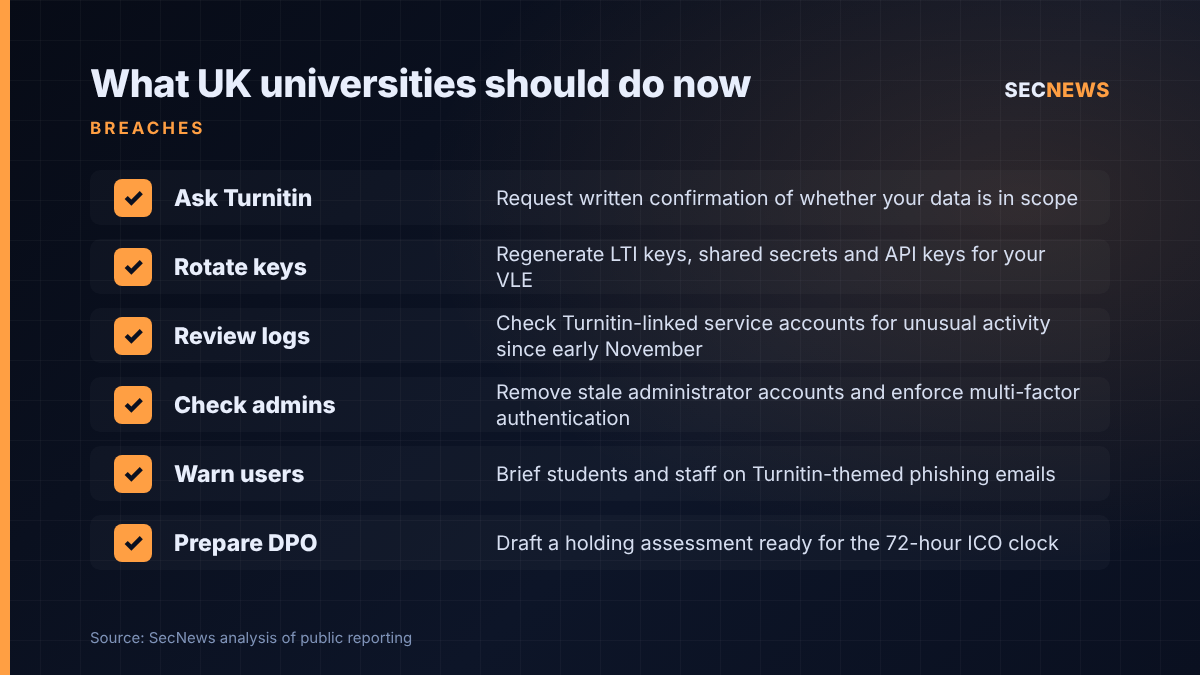
- Open a formal line to Turnitin. Ask, in writing, whether your tenant, users or submissions are within scope, and request indicators of compromise and timelines as they become available. Log the request for UK GDPR accountability.
- Rotate integration secrets. Regenerate LTI consumer keys, shared secrets and API keys used to connect Turnitin to your VLE and any student record systems. This maps to the Cyber Essentials secure configuration and user access control themes.
- Review integration logs. Look for unusual calls from Turnitin-linked service accounts, unexpected grade or submission changes, and access outside normal patterns since early November.
- Check admin accounts. Confirm who holds Turnitin administrator rights, remove stale accounts, and make sure multi-factor authentication is enforced wherever single sign-on is not used.
- Warn students and staff about phishing. Tell them Turnitin access will only ever come through your normal VLE or portal, and that they should not follow links in unexpected account emails.
- Prepare your DPO. Draft a holding assessment so that, if Turnitin confirms personal data exposure, the 72-hour ICO clock does not catch you unprepared.
Bottom line
Turnitin has confirmed an intrusion but almost nothing else, and the questions that matter to UK universities, about coursework, student identities and integration credentials, remain unanswered. Institutions should not wait for the forensic report: rotate the keys, check the logs, brief students on phishing and press the supplier for a clear statement of scope.
Sources
- Turnitin: Letter from Turnitin CEO Chris Caren to customers on 23 November 2026
- BleepingComputer (republished by We Fix PC): Turnitin discloses cyberattack affecting customer-facing systems
- BreachNews: Turnitin confirms cyberattack on customer-facing systems
- Times Higher Education via Inside Higher Ed: More U.K. universities end Turnitin contracts