WHMCS has fixed three flaws in its hosting billing platform, including a shopping cart SQL injection that requires no login and can expose customer records and admin password hashes. Self-hosted installations must be updated by hand, and one fix also needs some manual clean-up.
What happened
On 23 November 2026, WHMCS published three security advisories for its billing, provisioning and support automation software. Many web hosting companies, domain resellers and managed service providers use it to run the customer-facing side of their businesses. All three were found by a researcher known as alakazamspooon and reported via the vendor’s disclosure programme.
The most serious flaw for internet-facing installations is CVE-2026-82981, an input validation weakness in the shopping cart. According to the vendor, an unauthenticated user could use it to pull data out of the WHMCS database. That includes clients’ personal details, support information and administrator account records with their password hashes. The Hacker News and Computing.net both put it at 8.7 under CVSS 4.0.
The other two flaws need a logged-in client account. CVE-2026-82979, scored 7.1, is a second SQL injection, this time in the Client Area. CVE-2026-93700 concerns how email campaigns handle client-supplied data. Rated 9.0 on the older CVSS 3.1 scale, it scores highest of the three: the vendor says a client could potentially read configuration files holding database credentials and execute code on the host.
WHMCS has not reported any exploitation of the three bugs.
The technical picture
Each advisory lists a different set of affected versions. As the vendor states them:
- CVE-2026-82981 (shopping cart, unauthenticated): WHMCS 9.0.0 and later, specifically all 9.1.x builds before 9.1.2 and all 9.0.x builds before 9.0.10. Fixed in 9.1.2 and 9.0.10, though The Hacker News noted that 9.1.2 was not yet on the 9.1 release notes page when it reported. The vendor does not list the 8.x line as affected by this flaw.
- CVE-2026-82979 (Client Area, authenticated): WHMCS 8.13.x and later, covering 9.1.x before 9.1.2, 9.0.x before 9.0.10 and 8.13.x before 8.13.8. Exploiting it needs a client account that holds the View & Manage Contacts permission.
- CVE-2026-93700 (email campaigns, authenticated): WHMCS 8.0.0 and later, covering 9.1.x before 9.1.2, 9.0.x before 9.0.10 and all 8.x builds before 8.13.8. The vendor says fixes exist only for supported versions, so anyone on 8.0.0 or later must move to 8.13.8, 9.0.10 or 9.1.2.
Two practical points stand out. First, CVE-2026-82981 sits in the cart, which hosting businesses deliberately expose to the public internet so prospective customers can buy services. No credentials are needed, so any attacker who can reach the order page can attempt it. Second, the authenticated flaws are less reassuring than they sound: many hosts let anyone open a client account with little more than an email address.
The email campaign advisory goes further than “update now”. Administrators must remove all scheduled and in-progress campaigns (Utilities, Email Campaigns) and empty the template cache from the System Cleanup page. WHMCS has not explained why. My reading is that campaign content already stored or cached could still carry a malicious payload after patching, so the clean-up is not optional.
WHMCS Cloud customers receive updates automatically, but self-hosted deployments must be updated by their own administrators. Computing.net also reports that the 9.0 line requires PHP 8.2 or higher with a matching ionCube Loader, and that the 9.0 line is expected to reach end of life on 31 December 2026.
Why it matters for UK organisations
WHMCS is often the system of record for a hosting firm’s whole customer base. It typically holds contact details, billing histories and support tickets. UK hosting companies, domain resellers, web design agencies that resell hosting, and MSPs that bill through WHMCS should treat an exposed, unpatched installation as a potential personal data breach waiting to happen.
If customer data is taken, the UK GDPR obligations apply. Organisations must assess the risk and, where it is likely to affect individuals’ rights and freedoms, report to the ICO within 72 hours of becoming aware. Support tickets deserve particular attention. In my experience customers paste things there they should not, including passwords and server details. A database dump from a billing platform can therefore hand an attacker a route into the downstream infrastructure it manages.
Admin password hashes are the other worry. A hash is not a working password, but weak or reused administrator passwords can be cracked offline. A WHMCS administrator usually controls provisioning modules connected to cPanel, Plesk, registrar and payment gateway accounts. UK small businesses whose websites and email sit with an affected provider inherit that risk without ever seeing the billing system.
Expert view
Billing and client portals are among the most under-tested assets I come across. They tend to be bought rather than built, so teams assume the vendor has it covered. They are also heavily customised and often fall outside the agreed scope of the main penetration test. When we do get to test them, the order process and client-registration flows are usually where things go wrong, because they are designed to accept input from strangers.
This is also at least the third set of WHMCS security fixes this year. According to both outlets, the vendor fixed a Client Area authorisation issue on 12 May and a pre-authentication code execution bug on 3 September. That is not unusual for a large PHP application, but it means providers need a fast, dependable update routine for this platform rather than a quarterly catch-up.
I would not read too much into the lack of reported exploitation. Detailed advisories naming the vulnerable component give attackers a clear place to start comparing builds. Pre-authentication SQL injection in widely deployed commercial software has historically attracted opportunistic scanning soon after disclosure.
What to do now
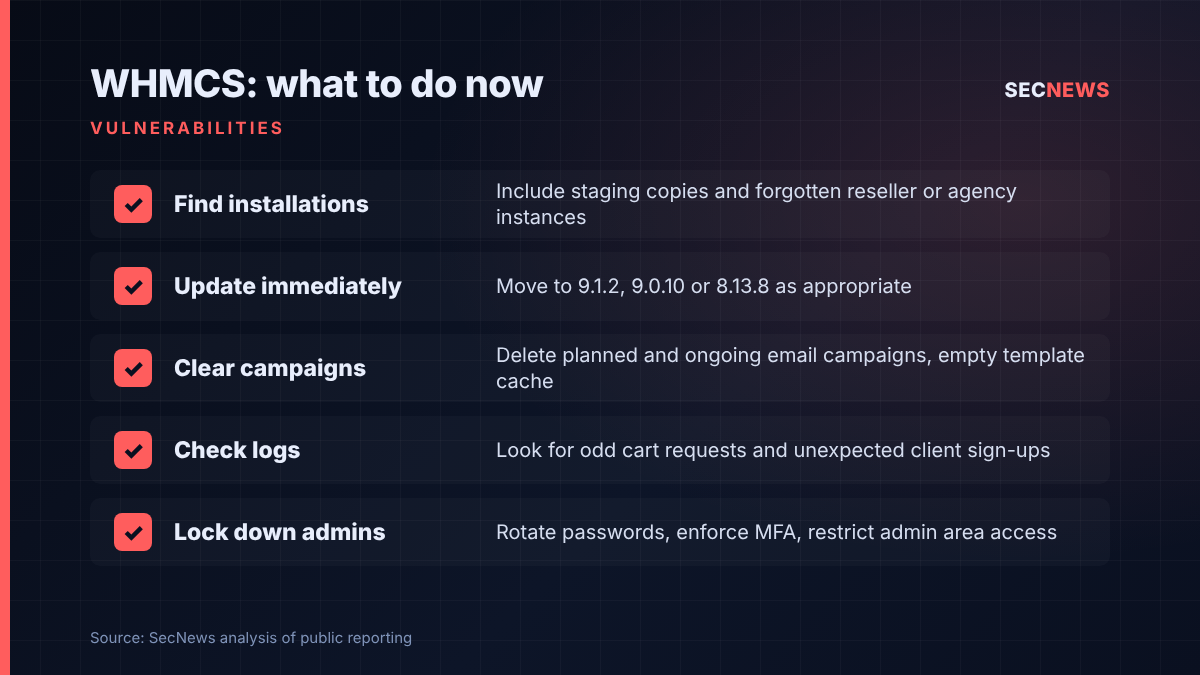
- Find every installation. Include staging copies, old reseller instances and anything an agency set up years ago and forgot.
- Update self-hosted installations immediately to 9.1.2, 9.0.10 or 8.13.8 as appropriate. Anything on 8.0 to 8.12 has no fix and must be upgraded. Cyber Essentials expects high and critical updates within 14 days of release. For an internet-facing order page, aim for days, not weeks.
- Complete the email campaign clean-up. Delete planned and ongoing campaigns and empty the template cache, as the vendor instructs, then rebuild legitimate campaigns from known-good content.
- Look for signs of abuse. Check web and WAF logs for odd requests to cart and order pages, unexpected client sign-ups and recent email campaign changes.
- Protect administrator accounts. Rotate admin passwords, enforce multi-factor authentication and restrict the admin area by IP address or VPN, in line with Cyber Essentials user access control and secure configuration.
- Review client account controls. Limit who holds the View & Manage Contacts permission, and consider verification or rate limiting on new sign-ups.
- Rotate secrets if in doubt. If there is any sign of compromise, rotate database credentials, API keys and the provisioning module credentials stored in WHMCS, and assess ICO reporting duties.
Bottom line
An unauthenticated route into a hosting provider’s customer database is serious, even without evidence of attacks so far. Self-hosted WHMCS operators should patch now, finish the email campaign steps the vendor sets out, and treat the billing platform as the critical, internet-facing system it is.
Sources
- WHMCS: CVE-2026-82981 – WHMCS Security Update 2026-11-23
- WHMCS: CVE-2026-82979 – WHMCS Security Update 2026-11-23
- WHMCS: CVE-2026-93700 – WHMCS Security Update 2026-11-23
- The Hacker News: WHMCS SQL Injection Could Expose Customer Data and Admin Password Hashes without Login
- Computing.net: WHMCS Patches Three Security Flaws as 9.0 Support Nears Its End