Australian brake controller maker Elecbrakes has told owners to update firmware after researchers showed any nearby Bluetooth device could operate trailer brakes. The fix took seven weeks to arrive, but the published disclosure took six months, and that timeline is a lesson for every UK organisation that runs a vulnerability disclosure programme.
What happened
On 23 November 2026, Elecbrakes posted a security notice asking owners of its EB2 and VM1 trailer brake controllers to make sure they were running the firmware it shipped on 6 July. Owners of the older ELBC model were told it cannot take that update. Instead, they should keep the unit actively connected to their phone or remote whenever they tow. The notice came four days after Patrick Forck and Jeremy McCarthy of Element Digital, a consultancy in Hobart, published their research alongside CISA advisory ICSA-26-323-02 on 19 November.
On unpatched units, anyone in Bluetooth range could apply or release the brakes, or change how hard they bite, without pairing or authenticating. The more useful part of the story, though, is the researchers’ account of how coordination went: a vendor that moved fast on the engineering, then went quiet once the patch was out.
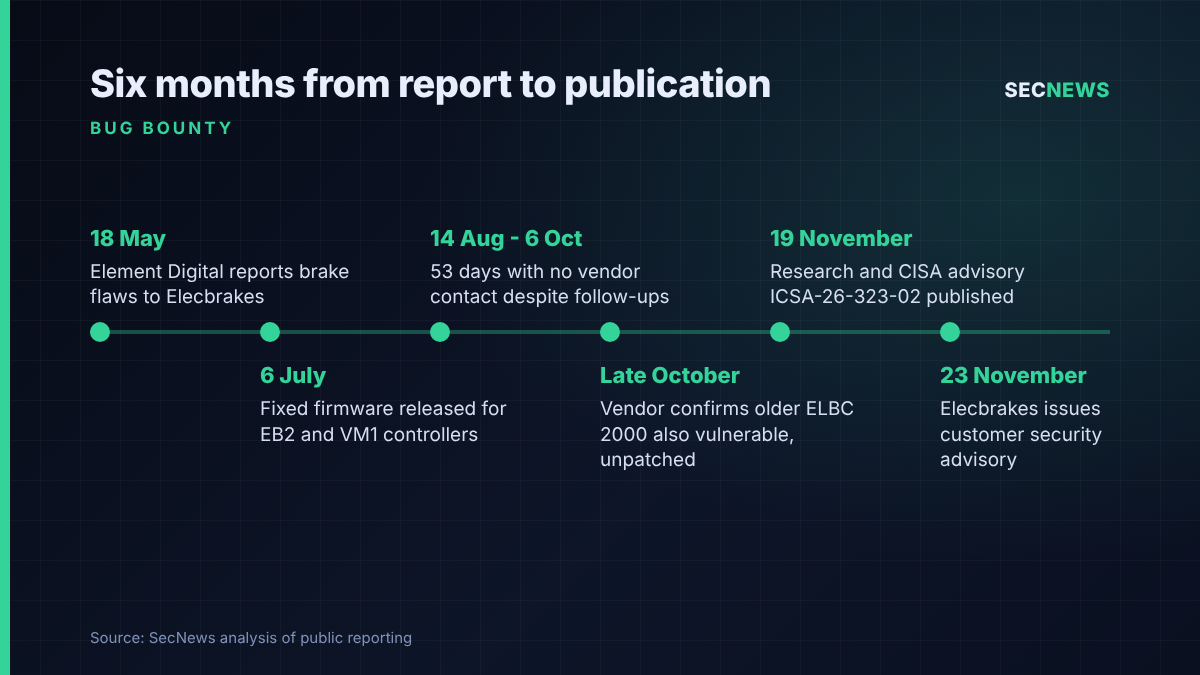
Forck stumbled on it when his in-car remote silently linked to a stranger’s trailer. The pair reported their findings to Elecbrakes on 18 May. The vendor acknowledged and validated them on 29 May and released fixed firmware and a new app on 6 July.
The detail
Three CVEs were assigned. CVE-2026-96805 covers missing authentication on the brake control function and CVE-2026-125273 covers the lack of replay protection. Both are scored 9.6. Elecbrakes argued for 8.2 on the second but later accepted the researchers’ case. CVE-2026-124281, rated 6.1, concerns the firmware update channel. The patched design puts brake control behind a bonded, encrypted connection, and first-time pairing needs a physical brake-pedal sequence.
The process is where things slowed down. The researchers filed with CISA’s industrial control systems team on 3 July, three days before the fix shipped. CISA’s 45-day policy then ruled out an advisory before 25 August. Elecbrakes joined the case in CISA’s VINCE coordination platform on 4 August, about a month after CISA had the report. On 14 August both sides settled on a 15 November disclosure date. From 14 August to 6 October there was no vendor contact at all, 53 days in which follow-ups from the researchers and from CISA went unanswered. The silence ended the day after the researchers rang their usual contact’s mobile and emailed a director and the company’s general inbox.
While this was going on, Forck spotted an older ELBC 2000 on a trailer near his home. Elecbrakes had left that model out of its own assessment. It confirmed only at the end of October that the ELBC 2000 was vulnerable too. Its co-founder, Craig de Leon, told iTnews: “The vulnerability affects all Elecbrakes brake controllers”.
Updates are started by the owner, so take-up has been partial. The vendor puts it at roughly 60 to 70 per cent of the controllers that connect each day. Elecbrakes says it knows of no exploitation, damage or injury.
Why it matters for UK organisations
Elecbrakes sells into Australia and New Zealand, so few UK caravanners will be directly affected. The way the disclosure played out is the part that applies here. Under the Product Security and Telecommunications Infrastructure regime, whose regulations took effect on 29 April 2024, manufacturers of consumer connectable products sold in the UK must publish how to report vulnerabilities. That means at least one contact point and when the reporter can expect an acknowledgement and status updates. The Office for Product Safety and Standards enforces it, and penalties go up to £10 million or 4 per cent of worldwide revenue.
A published contact address satisfies the letter of that rule. This case shows how little an address is worth if one person sits behind it and stops replying. A UK maker that promised updates and then went silent for 53 days would struggle to show it honoured its own published commitments.
The same applies beyond consumer products. The NCSC’s Vulnerability Disclosure Toolkit asks organisations to acknowledge reports promptly, keep the finder updated while a fix is in progress and confirm when it is complete. Any VDP, on a bounty platform or a plain inbox, is only as dependable as the people behind it.
Expert view
The researchers put it neatly: “Coordination is only as fast as the least motivated participant”. In my experience the pattern is familiar. Engineering teams treat a credible report as a defect and fix it quickly. Once the fix ships, the case passes to product, legal or marketing, and nobody owns the disclosure date. After that, each week of delay protects the vendor’s reputation, not its customers.
The missed ELBC 2000 worries me more than the silence. When we test, the first question is always what else shares the vulnerable code or design. A vendor that scopes remediation only to the models named in the report, and does not search its own product history, will keep being caught out by finders who look harder than it does.
The researchers are candid about their own part too: they say they went to CISA late and wish they had pinned down a written publication date while the patch was still in progress. Sound advice for anyone reporting to a smaller vendor.
It is also worth noting that the reverse engineering was largely AI-assisted, by two infrastructure specialists rather than developers. More capable finders means slow coordination will be tested more often.
What to do now
- Give your VDP more than one owner. Route reports to a shared mailbox or platform queue with at least two named people and a manager to escalate to. Publish it in security.txt, as the NCSC advises.
- Keep your promised timelines after the patch ships. Track the case to the agreed publication date, and treat any update you promised the finder as a deliverable, not a courtesy.
- Agree the disclosure date in writing early. Vendor or finder, fix the date before release, while everyone is engaged.
- Scope variants across your whole product line. Check legacy and discontinued models that share code or protocols. This links to Cyber Essentials security update management: you cannot patch what you have not listed.
- Check your PSTI statements of compliance. If you make, import or distribute connectable consumer products, confirm that your published reporting contact, acknowledgement times and support period reflect what your team can actually deliver.
- Plan for updates that owners have to start themselves. If customers must trigger the update, budget for repeated in-app prompts and direct contact, and be honest in advisories about how many devices are still unpatched.
Bottom line
Elecbrakes got the hard part right: it reproduced the flaw, did not argue about whether it was real, and shipped a meaningful redesign in seven weeks. It then let the disclosure drift, missed a product and left researchers chasing a single contact. For UK organisations, having a VDP is no longer the test. The test is whether anyone is still answering after the patch has shipped.
Sources
- Element Digital: Brake check – trailer brakes over Bluetooth
- Elecbrakes: Security update for Elecbrakes brake controllers
- The Register: Bluetooth brakes are broken as researchers find anyone can control them
- iTnews: Hackers can slam on Bluetooth-connected trailer brakes, researchers find
- SecurityWeek: Elecbrakes Bluetooth vulnerabilities expose trailers to forced braking
- Cooley: UK Product Security and Telecommunications Infrastructure Act
- NCSC: The NCSC’s Vulnerability Disclosure Toolkit