Leeds-based managed security provider SEP2 has sold a majority stake to FPE Capital, the first investment from the growth investor’s Fund IV. For the hundreds of UK organisations that hand their monitoring to a mid-sized MSSP, it is a reminder that a change of ownership at your SOC deserves its own risk review.
What happened
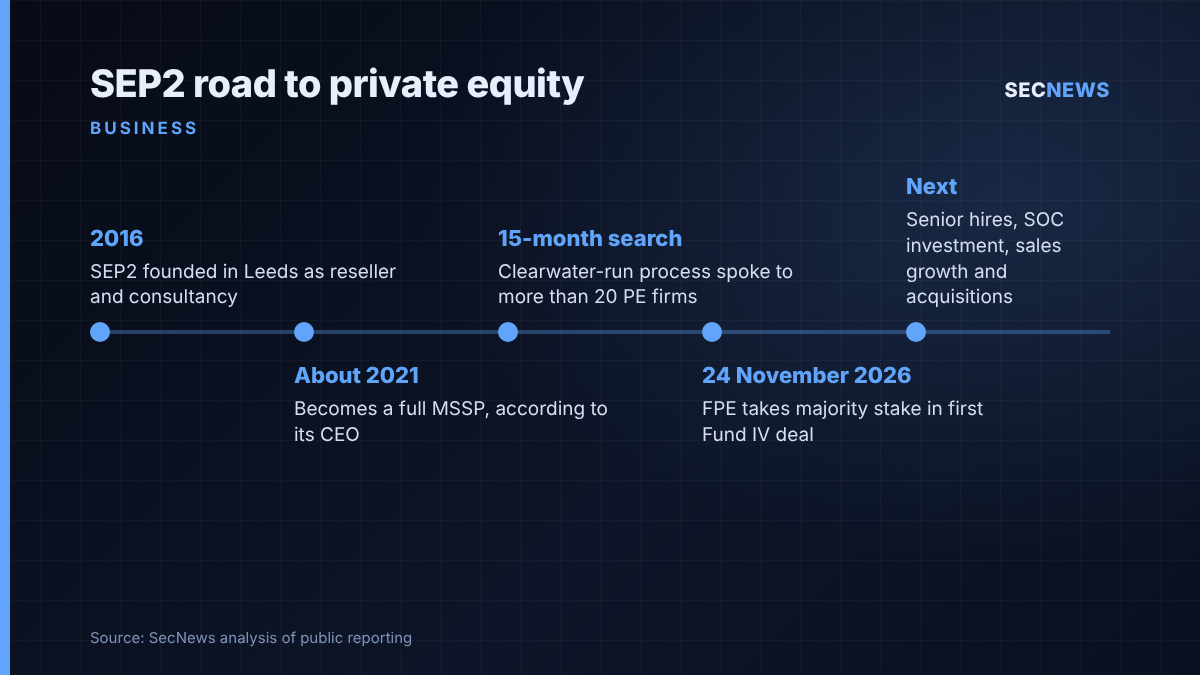
On 24 November 2026, FPE Capital confirmed it had invested in SEP2, a managed security services provider (MSSP) headquartered in Leeds. The deal is the first from FPE Fund IV. According to IT Channel Oxygen, which interviewed SEP2’s chief executive, FPE now holds a majority of the shares. Neither side has disclosed the price, the size of the stake or SEP2’s revenue.
SEP2 was founded in 2016 and says it employs more than 100 people. From its CREST-accredited Leeds SOC it provides round-the-clock monitoring to more than 300 businesses. This is its first institutional backing. The company says the money will go on senior hires, further investment in its services and SOC, a larger sales operation and acquisitions. Chief executive Paul Starr has set out a blunt ambition: to become “the number one MSSP in the UK”.
FPE partners Chris Kay and Sam Greenberg led the investment. BDO, Squire Patton Boggs, Rothschild & Co, Kernel and AJ Gallagher acted for FPE; Clearwater, Freeths and Claritas acted for SEP2’s owners.
The detail
The background to the deal is more interesting than the press release. Starr told IT Channel Oxygen that SEP2 spoke to more than 20 private equity firms over a 15-month search run by Clearwater. He and his co-founders, Tim Ward and Mike Goodwin, ruled out selling to a larger rival early on. Their reasoning was that a trade buyer would impose its own strategy. The founders are staying on, keeping their board seats and their operating roles.
FPE targets founder-led, lower mid-market companies in software, data and services across the UK and Ireland. It has been here before: it backed identity and security specialist Intragen and sold it to Nomios in October 2025. Fund IV also has public money behind it. In June the British Business Bank agreed to put £40m into the fund as a cornerstone investor, citing a funding gap for lower mid-market companies.
SEP2 began as a reseller and consultancy and became a full MSSP about five years ago. Its pitch is a deliberate counterweight to the many UK providers built around Microsoft Sentinel. It runs a sovereign SOC on Google’s security stack and keeps its vendor list short, with Google and Check Point, alongside Wiz, among its main partners. Starr says 62% of SEP2’s customers use no other Google services. He presents this as a sign that buyers are choosing the detection platform on its own merits rather than following an existing cloud relationship. He also says that 2026 has brought larger enterprise wins, so the company’s target customer is moving up from its traditional mid-market base.
Why it matters for UK organisations
By the standards of a year of multi-billion vendor mergers this is a modest deal, but it is a clear example of how the UK managed services market is consolidating. Private equity likes MSSPs because monitoring contracts recur, and because there are still many independent providers with a few hundred customers each that can be bought and combined. Acquisitions are an explicit part of SEP2’s plan, so the provider some UK firms use today may soon be part of a larger group, or may be absorbing other providers itself.
For customers, that is not automatically a bad thing. New money can pay for more analysts, better tooling and longer opening hours on the escalation desk. But a buy-and-build strategy also brings integration work, platform migrations, changes to staff incentives and pressure on margins. All of these can affect the service a customer actually receives.
Regulation adds to the stakes. The Cyber Security and Resilience Bill is designed to bring managed service providers into the UK’s NIS regime. Boards are also being told more and more often that outsourcing a function does not outsource accountability for it. If your MSSP holds privileged access to your estate, its ownership, financial stability and staff turnover are part of your attack surface and your resilience planning.
Expert view
In my experience, a managed SOC is only as good as the analysts on shift and the access they hold. When we test organisations that outsource detection, the weak points are rarely the SIEM itself. They are the provider’s standing accounts, shared administrative credentials and onboarding scripts that nobody has reviewed since the contract was signed. A change of ownership is the right moment to ask those questions, because the provider is about to change things on its side anyway.
The Google-versus-Microsoft angle is worth taking seriously, and not as a matter of vendor loyalty. Where a detection platform runs, and who can see the data, has become a procurement question for public sector bodies and regulated firms. A provider that sells a sovereign SOC should be able to say exactly where logs are stored, who at the provider and its subprocessors can read them, and what happens to them when the contract ends. If it cannot answer clearly, the word sovereign is marketing.
I would also not read the founders’ decision to stay as a guarantee of continuity. It helps. But growth targets agreed with an investor change priorities, and the analysts who know your environment are exactly the people a competitor will try to hire away during a period of change.
What to do now
If SEP2, or any MSSP likely to be caught up in sector consolidation, monitors your environment:
- Read the change of control clause. Check whether your contract lets you renegotiate or exit after a change of ownership or a merger, and what notice you are owed.
- Audit the provider’s access (Cyber Essentials: user access control). List every account, API key and agent the MSSP holds. Remove anything unused, enforce MFA and least privilege, and ask to be told when an analyst who has access to your systems leaves.
- Pin down data location and handling. Get written confirmation of where telemetry is stored, which subprocessors can reach it, and how it will be exported or deleted if the platform changes after an acquisition.
- Re-baseline the service levels. Record current triage and escalation times now, so you can show evidence if service slips during integration.
- Test the escalation path. Run a short exercise or a purple team test to confirm that alerts still reach the right people at 3am, and that the provider’s runbooks for your estate are current.
- Keep your own logs and patching in-house (Cyber Essentials: security update management). Outsourced detection does not replace your own patching or a copy of critical logs that you control.
Bottom line
FPE’s backing gives a growing Leeds MSSP the capital to hire, buy competitors and compete for enterprise contracts. It also adds another private equity-backed buyer to UK managed security. Customers should treat the news as a prompt rather than a problem: check the contract, the access the provider holds and where your data lives, while the provider is still focused on keeping you.
Sources
- SecurityBrief UK: FPE backs SEP2 in first Fund IV cyber security deal
- IT Channel Oxygen: ‘We’ve got a lot to give’ – SEP2 CEO on FPE investment
- ScotlandIS: FPE Capital backs UK cybersecurity firm SEP2 with first Fund IV deal
- CRN UK: SEP2 targets UK MSSP top spot after FPE investment
- Private Equity International: FPE Capital backs UK cybersecurity firm SEP2 with first Fund IV deal
- The Intermediary: British Business Bank commits £40m to FPE Capital