The Commons has thrown out the two changes peers forced on the government’s flagship cyber law: a statutory register of hostile foreign powers and an annual review of the whole NIS regime. Ministers have offered a sector-scope commitment in return, and the Bill now goes back to the Lords with the clock running to April 2027.
What happened
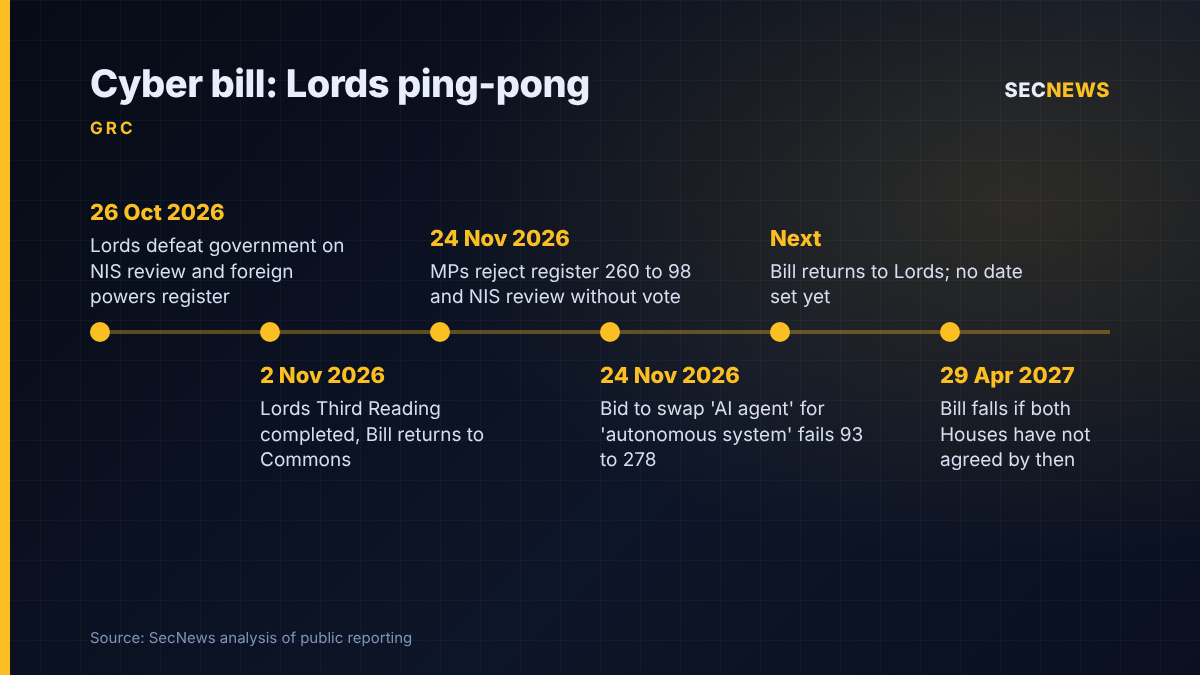
On the evening of Tuesday 24 November 2026, MPs debated the Lords amendments to the Cyber Security and Resilience (Network and Information Systems) Bill, the legislation that will replace and extend the NIS Regulations 2018. The other 110 Lords amendments, many of them the government’s own, were agreed without a vote. The two defeats ministers suffered in the Lords on 26 October did not survive.
Lords amendment 108, tabled by Viscount Camrose, would have obliged ministers to set up and maintain a register of foreign powers judged to threaten the UK’s critical network and information systems. MPs disagreed with it by 260 votes to 98. Lords amendment 107, which would have required a sweeping review of how the whole NIS framework is working, a year after the Act passes, was rejected without a division.
A third vote concerned the government’s new power covering loss of control of an AI agent (Lords amendment 33). Shadow minister Dr Ben Spencer tried to replace “artificial intelligence agent” with “autonomous system”, arguing that the law should target the harm rather than one technology. That was defeated by 93 votes to 278.
The Bill goes back to peers, who may give way, insist or propose a compromise. No date has been set. If both Houses have not agreed a text by the close of 29 April 2027, it falls.
The detail
Ian Murray, the minister who took the Bill through the Commons on the night, gave three reasons for turning down the annual review. First, a post-implementation review is already built into the Bill, and Lords amendment 42 shortens that cycle from five years to three. Second, the government will add its own amendment when the Bill reaches the Lords again. It will oblige ministers to report to Parliament within a year on which further activities should be classed as essential, including whether more critical national infrastructure services should come into scope. Third, Murray promised that advanced manufacturing, electoral infrastructure and political parties would be considered within two years of the Act passing.
On the foreign powers register, the government argued that a fixed list would mislead. Murray said state, state-affiliated and criminal activity often overlap, and actors work through proxies and front companies. In his words, “A blunt register risks undermining dynamism.” Ministers prefer case-by-case judgements informed by the intelligence community, the approach Parliament took in the Telecommunications (Security) Act 2021.
The AI provision drew the most technical debate. The new clause gives the Secretary of State functions where an AI agent slipping out of its operator’s oversight or control has caused, or may have caused, a compromise of a regulated system. Both terms are expected to be defined later, through regulations and consultation. According to the independent guide at cybersecurityandresiliencebill.com, those regulations may include inspectors, powers of entry, testing and financial penalties. Select committee chair Dame Chi Onwurah asked how long the definitions would take, and why responsibility seemed to fall on buyers of AI rather than sellers.
Other changes now agreed include restricting overseas information sharing by NIS regulators to Five Eyes partners, EEA countries and Switzerland. Data centres lose mandatory near-miss reporting in favour of a voluntary scheme open to all regulated organisations.
Why it matters for UK organisations
The structure of the Bill is now largely settled; the remaining dispute concerns two amendments that do not touch operators’ core obligations. The duties that will matter most are unchanged: medium and large managed service providers, qualifying data centres and large load controllers come into scope, regulators can designate critical suppliers, and incidents must be notified to the regulator within 24 hours, followed by a full report within 72.
The Commons votes also make the timetable clearer. If the Lords accept the Commons position, Royal Assent could follow quickly. Commencement still runs on regulations. The guide’s analysis of clause 69 says the main duties, including registration, incident reporting and penalties, start on dates the Secretary of State will set after consultation. The same tracker puts the maximum penalty for the most serious failures at £17 million or 4% of worldwide turnover, whichever is higher.
The new commitment on scope deserves attention. A statement within a year on which further essential activities should be covered means sectors outside NIS today should not assume they will stay outside. Advanced manufacturers in particular were named on the floor of the House.
Expert view
I have some sympathy with both sides on the foreign powers register. In my experience, clients do ask for a clear list of suppliers and jurisdictions to avoid, and a register would have given procurement teams something firm to point to. But the minister is right that attribution is messy. Some of the most damaging intrusions we see come through a managed provider, a cloud tenancy or a contractor’s laptop, and none of those would show up on a list of countries.
The fight over the AI clause matters more for practitioners. Spencer and his Conservative colleagues have a point. When we test industrial environments, we find automated control logic that can cause exactly the “loss of control” harm the clause describes, with no machine learning involved. Writing the law around one technology means it will need amending again. The definitions will come through consultation, which is where security teams should speak up.
What worries me more is the gap between Royal Assent and the duties actually applying. Organisations that wait for commencement regulations before mapping their scope will find themselves rushing a registration, a reporting process and supplier contracts all at once.
What to do now
- Confirm whether you are in scope. Managed service providers, data centre operators and anyone likely to be designated a critical supplier should get a written view now, not after Royal Assent.
- Rehearse the 24-hour and 72-hour reporting cycle. Run a tabletop exercise that ends with a draft regulator notification and a customer notice.
- Inventory your AI agents. Record what each agent can reach, what credentials it holds and how you would stop it from outside its own runtime.
- Review supplier contracts. Write in notification duties, log retention and cooperation with investigations, and require Cyber Essentials (ideally Plus) to be maintained for the life of the contract, not just at tender.
- Get the basics right first. Secure configuration, user access control, malware protection, security update management and firewalls, the five Cyber Essentials controls, are still what decide most incident reviews.
- Respond to the consultations. Definitions of “AI agent”, reporting thresholds and the scope statement will all be consulted on.
Bottom line
The Commons has kept the Bill the government wanted and offered a compromise on scope rather than an annual review. Unless peers dig in, the UK’s updated NIS regime is close to law, with the details to follow in regulations. Organisations likely to be covered should treat 2027 as preparation time, not a grace period.
Sources
- Hansard: Cyber Security and Resilience (Network and Information Systems) Bill, Consideration of Lords amendments, 24 November 2026
- UK Parliament: Division 136, Motion to disagree with Lords Amendment 108
- UK Parliament: Division 137, Amendment (a) to Lords Amendment 33
- CSRB guide: Cyber Security and Resilience Bill Status and Timeline
- Cloud Security Alliance: UK Cyber Resilience Bill: AI-Agent Incident Powers for Deployers
- Hansard Society: Parliament Matters Bulletin, 23-27 November