A fake take-home coding test aimed at Windows .NET developers leaned on 13 booby-trapped NuGet packages that ran their payload when the project was built or run. The campaign has been running since July, survived several takedowns by republishing under fresh names, and turns the routine job interview into an initial access vector.
What happened
Researchers at software supply chain firm Socket published an analysis on 23 November 2026 of 13 malicious NuGet packages, spread across 28 versions, that were built to compromise developers working on Windows desktop applications. Most of them pretend to be harmless user interface components: button controls for WinUI 3 and WPF, with names such as WinUI.Button, WinUI3IconButton, StyledAppButton and SetButtonColor.
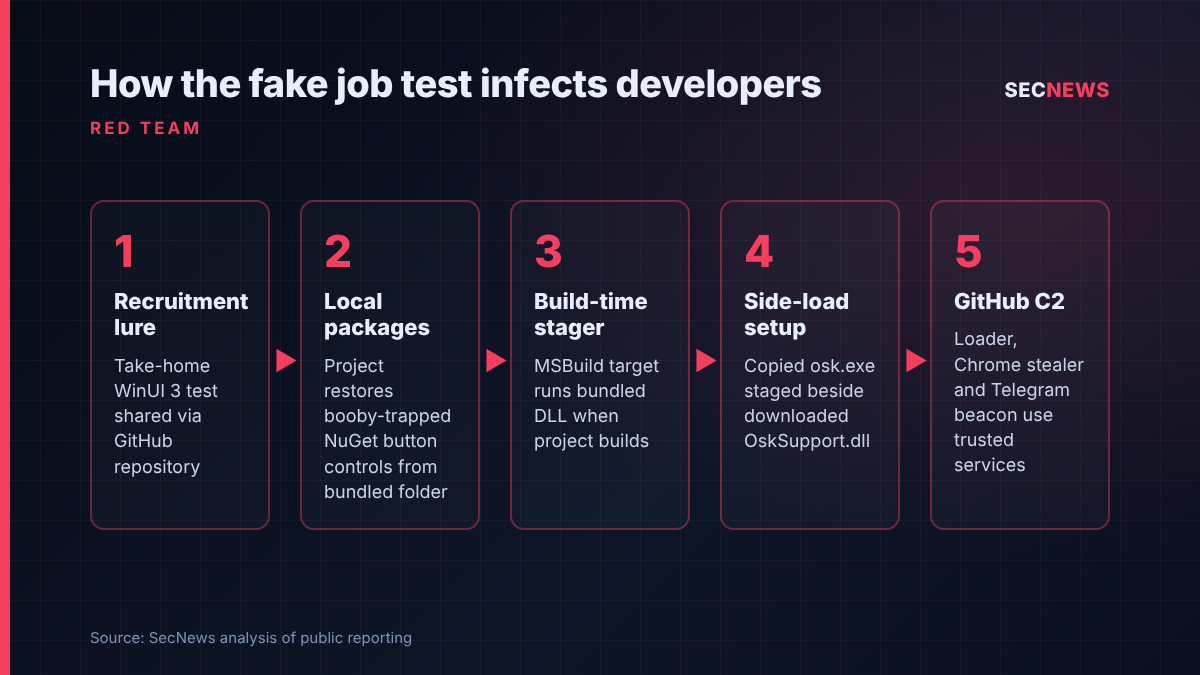
Delivery relied on a recruitment lure. The latest version, the stevenleedig-ux/WinUI3_Home_Assessment repository on GitHub (set up on 4 November), presented candidates with a “Mini File Vault & Tracker” exercise to complete in a few hours. The project was configured to restore packages from a local folder bundled in the repository, and its README told candidates not to modify the supplied FileButton control, which happened to be the component carrying one of the malicious triggers.
The same persona surfaced on LaborX, a Web3 freelance marketplace. On 7 November a client account opened two days earlier advertised a C# WPF “Crypto Wallet Analyzer” job worth between $8,500 and $10,000. According to The Hacker News, the operator’s X profile claims a Miami base, while X’s own account information places it in Korea.
NuGet’s public removal log shows Web3TotalButton taken down as malware on 27 October, and VS_Builder.MSBuildAnalyzer and VS_Builder.WinUI3Controls on 2 November. The same build logic returned under a HappyOne publisher name two days later and was deleted on 6 November. When Socket published, 12 of the 13 had gone, with WinUI.Button 1.0.0 still listed; The Hacker News now reports all 13 have been removed.
The technical picture
What sets this campaign apart is where the code runs: not when the application starts, but inside the build itself.
The analyser package (first VS_Builder.MSBuildAnalyzer, then HappyOne.MSBuildAnalyzer) contains an MSBuild targets file that executes a bundled DLL after compilation. Socket found the target declares an output file that is never produced, so MSBuild never considers it up to date and repeats it on every build. Error handling is set so that any failure in this step is swallowed and the build still succeeds, leaving the developer with no visible sign that anything ran. The stager fetches a file from GitHub into a folder under the user’s local application data, places a copy of the Windows On-Screen Keyboard (osk.exe) beside it, and relies on DLL side-loading when a companion control later launches that copy. Socket says it did not test whether this side-loading step works on current Windows builds.
A separate package, WinUI.Button, takes a blunter route. Its constructor starts a background task that uses a GitHub access token embedded in the package to pull down an executable, saves it to the temporary folder as Launcher.exe and runs it.
Socket tied the NuGet activity to a wider cluster. Six npm packages published in July, including axios-test-one and fs-extra-core, plus fake repositories impersonating the popular Axios JavaScript library, delivered a loader that uses GitHub as a two-way command and control channel, a Chrome profile stealer that uploads harvested data back to GitHub, and a payload that reports host details to a Telegram bot. A newer build of that loader turned up on 13 November inside a trojanised “Crypto Wallet Analyzer” app. Staging, control and exfiltration all ran over GitHub, GitHub Pages and the Telegram Bot API – traffic that blends into normal developer activity.
Attribution is open. Socket points to similarities with North Korean recruitment lures such as Contagious Interview and to an Iranian-linked cluster, but Kush Pandya, the Socket researcher behind the analysis, said the team found “no indicator or code shared” with known Contagious Interview campaigns.
Why it matters for UK organisations
The UK has a large community of contract and freelance developers, many building Windows line-of-business software. A contractor between engagements who completes a take-home test on the same laptop they use for client work is exactly the person this lure is designed to catch. A compromised developer workstation hands the attacker its reach: repositories, publishing credentials, cloud consoles, signing keys and SaaS sessions.
The crypto theme suggests financial motivation, but any actor wanting a foothold inside a software supplier could reuse the approach. Hiring processes are also a blind spot: security teams rarely see what candidates are asked to download, often on unmanaged personal devices.
Expert view
When we run social engineering exercises against development teams, the coding test pretext is one of the most dependable we have, because it asks the target to do the very thing they do all day: clone, restore, build. Nobody reads a targets file inside a NuGet package before pressing F5. That is the real lesson here. The trust boundary in .NET is not the moment you run your application; it is the moment you restore and compile someone else’s project.
I also want to highlight the operator’s resilience. Takedowns on 27 October, 2 November and 6 November slowed the campaign but did not end it, because the logic was simply republished under new names within days. Registry removal is cleanup, not defence. In my experience, organisations that rely on public feeds without any source mapping or internal proxy have no way to stop a fresh, unknown package arriving on a developer’s machine.
Finally, with GitHub and Telegram carrying the command and control, domain blocklists offer little; detection has to be behavioural, on the endpoint.
What to do now
- Treat recruitment code as untrusted. Tell developers and contractors to open take-home tests and client “starter projects” only in disposable virtual machines with no saved credentials, tokens or VPN access.
- Control package sources. Use NuGet package source mapping and an internal feed or proxy, and flag repositories that add local package folders or commit .nupkg files. This sits squarely within Cyber Essentials secure configuration.
- Review build-time execution. Add checks for packages that ship build targets containing Exec tasks, particularly those that suppress errors or declare outputs that never appear.
- Hunt on endpoints. Socket recommends alerting on osk.exe running, or OskSupport.dll being written, outside the System32 directory, on dotnet.exe launched by MSBuild with a DLL from a NuGet package folder, and on Launcher.exe in the temporary folder. Watch for Telegram Bot API traffic from build hosts.
- Respond decisively. If a machine built one of these projects, isolate and reimage it, then rotate GitHub, NuGet, cloud and browser-stored credentials from a clean device.
- Limit privilege. Developer accounts should not hold standing admin rights or long-lived publishing tokens, in line with Cyber Essentials user access control and malware protection requirements.
Bottom line
This campaign shows that compiling a project can be as dangerous as running one. A convincing job offer and a silent build step were enough to run code on developer machines without exploiting any vulnerability. UK organisations that employ or contract .NET developers should treat external projects as hostile until proven otherwise, and should lock down where their builds pull packages from.
Sources
- Socket: 13 Malicious NuGet Packages Target .NET Developers With Fake Job Assessments
- The Hacker News: 13 Malicious NuGet Packages Turn Fake .NET Job Assessments Into Malware Delivery Traps
- NuGet Gallery: Removed packages log
- Junglewise: Fake job assessments hide malicious NuGet packages that run when .NET developers build