Zodia Custody, the institutional crypto custodian Standard Chartered is buying outright, says an intruder got hold of business contact details for some clients and staff this week. No funds have moved, according to the firm, but the leaked names and work emails are just what a fraudster needs to impersonate a bank-backed custodian.
What happened
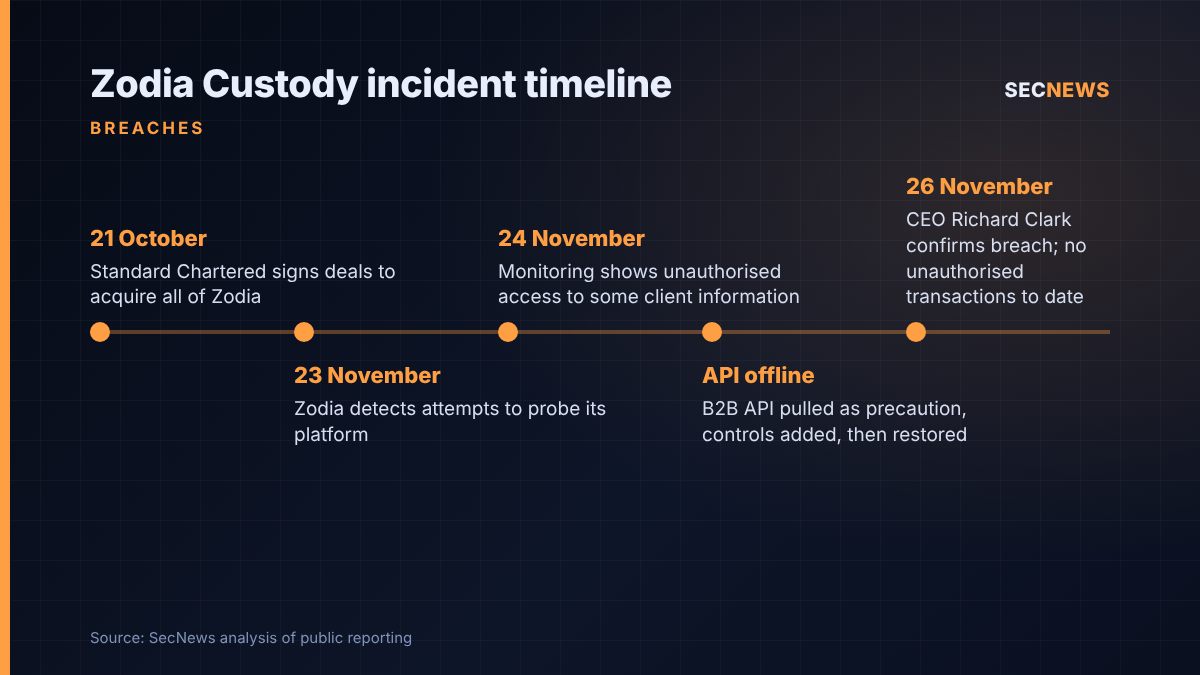
Zodia Custody, set up in 2020 by Standard Chartered and Northern Trust, holds digital assets for banks, asset managers and hedge funds. It has confirmed a security incident affecting some client and employee information. Chief executive Richard Clark disclosed it on Thursday 26 November 2026 in an emailed statement, which crypto.news says was sent to Reuters. I was unable to retrieve Reuters’ own report, so the details below come from trade coverage that quotes or summarises his statement.
The reports agree on the basics. Zodia spotted attempts to probe its platform on Monday 23 November. Startup Fortune’s account of the statement says monitoring showed the next day that an unauthorised party had reached some client information. By that account, the exposed material was organisation details already in the public domain, plus work names and emails for a handful of clients and staff. Zodia pulled its business-to-business (B2B) API as a precaution, added further controls and later brought it back. It says it has told affected clients and the relevant regulators.
The key line is about money. Startup Fortune quotes Clark as saying the investigation had found no unauthorised transactions “to date”. No source reports any loss of client assets.
The timing is awkward. On 21 October, Standard Chartered signed definitive agreements, via its Standard Chartered I H Limited subsidiary, to take full ownership of Zodia. The regulated custody entities in Singapore, Hong Kong, Australia, the UAE and Luxembourg will join the bank’s Securities Services division, while software and services are spun out as Zodia Solutions under SC Ventures. Standard Chartered’s shares rose 2.6% in London on Thursday, crypto.news reported, so the market does not seem worried.
The technical picture
Much is still unknown. Zodia has not disclosed the entry route, the culprit, how long access lasted, how many people are affected or what it changed. The statement is silent on keys, API credentials and wallet infrastructure, and silence is not an all-clear.
The API detail tells us the most. A business-to-business API is how institutional clients’ own systems send instructions to a custodian, so taking it offline after spotting probes suggests Zodia saw that interface as the likely route in. When we test financial platforms, the client-facing API layer is often less mature than the core behind it: partner endpoints, legacy versions and responses that return more data than the caller needs are common findings. That fits the leak described here, which is directory-style information rather than balances or keys. It is still a guess until Zodia publishes a root cause.
Zodia’s public material describes segregated client wallets, keys held offline or in hardware security modules, approvals from several independent people before assets can leave, and a multi-party computation option that spreads signing material across separate environments. The Cryptonomist and Startup Fortune also note its ISO 27001 certification. Those controls protect the assets. They do not stop a customer directory or contact table from being read, and that is what appears to have been exposed.
Why it matters for UK organisations
Zodia is UK-based, and its parent company in the restructuring is Zodia Custody UK. The buyer is a London-headquartered bank, so this is a British financial services incident even though most of the regulated custody entities sit abroad. UK fund managers, family offices and corporate treasuries that hold digital assets through Zodia, or are thinking about it, should treat this as a live supplier incident.
The real risk is what comes next. Leaked names and work emails, together with the knowledge that someone deals with a bank-owned custodian, make very convincing phishing. Add an ownership change and the pretexts write themselves: a new legal entity, revised settlement instructions, fresh KYC paperwork, updated API onboarding. Messages like that will look routine during the Standard Chartered integration, which is exactly why criminals will send them. Startup Fortune recalls that, in September, attackers inside email provider Brevo pushed a bogus alert to roughly 347,000 Trezor subscribers, with no wallet access needed.
For UK firms there is a data protection side too. Business contact details for named people are still personal data under UK GDPR. Any UK client whose own staff appear in the leaked records should decide whether it needs to log the incident internally and tell those staff, even though the breach happened at a supplier.
Expert view
On the facts available, this looks like a contained, low-sensitivity exposure, handled by taking the suspect interface offline. Detecting the probing and suspending the API before any reported loss is better than many incidents I have seen, where the client tells the provider before the provider notices.
Still, “limited” is a word the victim chose early in an investigation. Note Clark’s “to date”. Several questions will decide whether this stays minor. Did the attacker get any API tokens or client key material? Were the maker-checker approval steps tested during the access window? Was the API covered by Zodia’s most recent assurance reports? If the answers are dull, clients can move on. If they are not given, institutional customers should keep asking. Custodians sell trust, and a bank buying one takes on the duty to explain properly what went wrong.
For anyone running client APIs in financial services, the wider lesson is that “harmless” directory data is the raw material for the next attack, not a low-risk afterthought.
What to do now
- Warn finance and operations teams today. Treat any unexpected message about Zodia account changes, new entities, wallet addresses or settlement details as suspect. Check it by calling a number you already hold, never one in the message.
- Ask Zodia for written answers. Ask whether API credentials or keys need rotating, which of your users were in the exposed data, and whether approval workflows ran as normal between 23 and 26 November.
- Rotate your own API credentials anyway if your systems connect to Zodia’s B2B API, and review recent API activity and audit logs for anything unfamiliar.
- Tighten email defences. Look out for lookalike domains, enforce DMARC checks on inbound mail, and flag external senders. This matches the Cyber Essentials secure configuration and malware protection controls.
- Review access controls on your own client APIs. Check what directory or organisation data each endpoint returns and to whom, in line with Cyber Essentials user access control.
- Record your assessment under UK GDPR if your staff’s details may be in the dataset, and keep a note of the decision.
Bottom line
No crypto has been reported stolen and the leaked data was not highly sensitive, but contact details from a bank-owned custodian halfway through a takeover are a ready-made phishing kit. UK clients should assume impersonation attempts are coming, verify every change request out of band, and push Zodia for a full root cause once its investigation is finished.
Sources
- crypto.news: Standard Chartered-backed Zodia Custody hit by client data breach
- Startup Fortune: Standard Chartered’s Zodia Custody says an intruder reached client contact data
- The Cryptonomist: Zodia Custody Standard Chartered security breach reported
- Political.org: Standard Chartered’s crypto custody unit Zodia Custody hit by security breach