Two research teams reported overlapping GeoServer remote code execution chains months ago, the project shipped quiet fixes from mid-October, and attackers started probing within about two days of the advisories going public. The case is a sharp lesson in how the gap between a silent patch and full disclosure now works for researchers, maintainers and anyone running a vulnerability disclosure programme.
What happened
GeoServer, the open source Java server that many public bodies and utilities use to publish map data, has disclosed serious flaws that chain into unauthenticated code execution on a default installation. How they were disclosed matters more than the bugs.
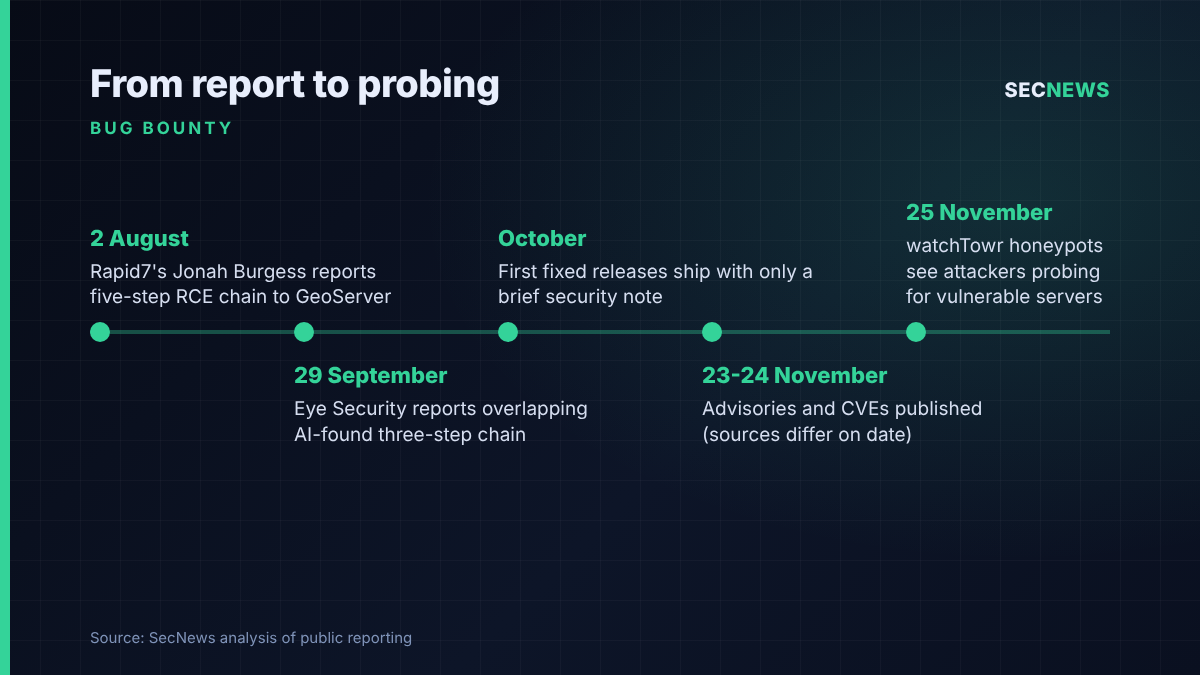
According to The Hacker News, Rapid7 senior security researcher Jonah Burgess, known online as CryptoCat, reported a five-step chain to the project on 2 August 2026. Separately, Dutch firm Eye Security says it reported its own three-step chain on 29 September, having used AI models to find the bugs. CSO Online reports that two more researchers, McCaulay and Quikko, share credit for some of the bugs.
GeoServer released fixed versions (3.0.2 and 2.28.6, plus 2.27.7 for the older, unsupported branch) during October and early November. Eye Security says the 19 October release carried only a short note promising details at the start of November. In the end the advisories and CVE identifiers arrived later than that. Eye Security and Burgess’s own timeline put the publication on 23 November, while The Hacker News, after updating its story, gives 24 November. Either way, watchTowr told reporters that its honeypots saw attackers from several IP addresses checking for vulnerable servers early on 25 November, which is why the window is being described as roughly two days.
The technical picture
The chains share a common middle. One flaw, CVE-2026-120705, lets an unauthenticated request inject XML into a Web Feature Service stored query and read files the GeoServer process can access, including the user store and security configuration. Those files give up the administrator’s password digest and the key used to sign “remember me” cookies, which in many installations is still the default value. CVE-2026-129245 covers that predictable key, and with both values an attacker can forge an administrator session without cracking any password.
From there the routes diverge. Burgess’s chain adds CVE-2026-129244 (an error message that leaks the data directory path), CVE-2026-129243 (a service-name trick that sidesteps admin-only rules) and CVE-2026-129242 (deserialisation in the JDBC user service) to reach command execution. Eye Security instead abuses administrator control of a JDBC connection, tracked as CVE-2026-120704, to load native code on both Linux and Windows. Burgess has published a technical write-up and proof-of-concept code. Eye Security counts more than 3,000 GeoServer instances reachable from the internet.
So far watchTowr has reported validation probes, not confirmed code execution. Probing is usually the step before something worse.
Why it matters for UK organisations
GeoServer is exactly the sort of product that sits quietly in a local authority planning portal, an environmental data service or a utility’s asset map, often deployed years ago by a contractor and rarely revisited. Assume nobody reads its release notes unless that is someone’s job.
The disclosure pattern matters just as much. A fix that ships with only a vague “security release” note relies on administrators upgrading on trust. Many UK organisations patch on a monthly cycle and prioritise by CVE severity, so a release without CVEs or detail can easily slip down the queue. When the advisories finally land, the attacker and the defender read them at the same moment, but only one of them has already been waiting for weeks.
For anyone running a vulnerability disclosure programme along NCSC lines, it shows what researchers face on the other side of the inbox.
Expert view
The most honest part of this story is Eye Security’s own account of its dilemma. Once it learned another researcher had reported overlapping bugs, it had to choose between going public and waiting for the project. It waited, but said it “wasn’t an easy decision”, warning that a capable attacker with good models could diff the official patch to find the same flaws. Instead it nudged users to upgrade through private channels and LinkedIn without publishing details. It also blamed part of the delay on an overloaded CVE assignment process.
In my experience, the old assumption behind a quiet fix was that reverse engineering a patch took real skill and time, so a few weeks of silence bought defenders a head start. That assumption is weakening. When several independent teams, at least one of them using AI, converge on the same bugs within weeks, the chance that a criminal group has also found them is no longer remote. Google Project Zero made the same point this month when it scrapped its post-patch soak period.
None of this means researchers should drop proof-of-concept code the day a patch appears. Burgess and Eye Security both followed the coordinated route, and the maintainers fixed every reported issue. The weak point was the long, quiet stretch between fix and advisory, with users given little reason to act. For an open source project juggling several reporters and a slow CVE queue, that is understandable. But it is a process gap, and VDP owners everywhere should recognise it in their own workflows.
When we review clients’ disclosure processes, the same gaps recur: no agreed timeline, no plan for duplicate reports, and release notes written to avoid alarm rather than drive action.
What to do now
- Find every GeoServer instance. Check internet-facing estates, supplier-hosted portals and forgotten test servers. This is the asset inventory discipline behind Cyber Essentials, and shadow geospatial servers are a common blind spot.
- Upgrade to 3.0.2, 2.28.6 or 2.27.7. Treat it as a critical update under the Cyber Essentials security update management control, which expects high and critical fixes within 14 days. Here, faster is better.
- Clean up after patching. The upgrade generates a new remember-me key and invalidates existing remember-me sessions. Clustered deployments need a shared key, and because the data directory may already have been read, change administrator passwords.
- Hunt for traces. GeoServer advises checking the stored query folders for queries no legitimate user created. Where you cannot patch at once, block requests with a slash in the service name, remove the remember-me filter and restrict access to the host.
- Fix your own disclosure process. If you run a VDP or bug bounty, publish a target timeline, decide in advance how you handle duplicate reporters, and make security release notes say plainly when users must upgrade, even before full details are public.
- Talk to your suppliers. Ask contractors hosting your map services which version they run.
Bottom line
GeoServer did fix these flaws, and the researchers behaved responsibly. Even so, attackers were probing within about two days of the advisories, after weeks in which the patches existed but few users knew why they mattered. Once several teams, some using AI, can find the same bugs, a silent patch only protects users who install it without being told why. Researchers, maintainers and VDP owners should plan on the assumption that the window between fix and full disclosure is unsafe.
Sources
- Eye Security: Unauthenticated remote code execution vulnerability in GeoServer
- CryptoCat’s Blog: GeoServer Pre-Authentication RCE via WFS and HSQLDB
- CSO Online: New GeoServer RCE exploit chain seen in the wild two days after disclosure
- SecurityWeek: Two Newly Disclosed GeoServer Vulnerabilities Under Attack
- The Hacker News: Hackers Exploit Two GeoServer Flaws as Researchers Warn of Unauthenticated RCE Chains
- Infosecurity Magazine: Google Project Zero to Cut Disclosure Deadline to 30 Days by 2028