Specialist insurer CFC’s claims records show November is the worst month of the year for ransomware against retailers, hospitality and leisure businesses. With Black Friday arriving today, the figures land on a sector where many smaller firms still hold no cyber insurance at all.
What happened
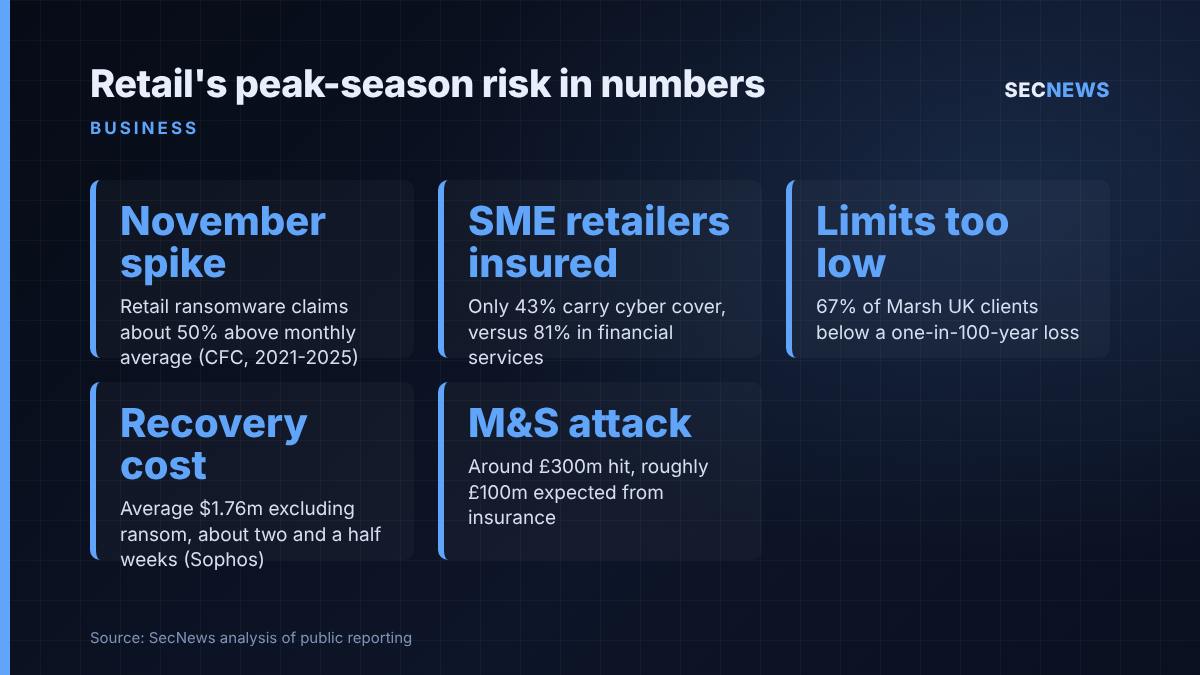
On 25 November 2026 Reuters reported new figures from CFC, the London-based specialist insurer and managing general agent. They come from the company’s own claims book. Between 2021 and 2025, ransomware incidents involving retail, leisure and hospitality customers ran at roughly 50% above the monthly average in November. Insurance Business and The Next Web covered the same data between 24 and 26 November.
This is a separate thing from CFC’s earlier Cyber Insurance Disconnect Survey of SMEs and from Brit’s recent work on why small firms buy cover. Those studies asked businesses what they think and what they purchase. This one is a count of claims that were actually filed, broken down by month, and it shows a seasonal spike that lines up with peak trading.
CFC set the spike against its existing finding that only 43% of small and mid-sized retailers carry cyber insurance. That is one of the lowest rates of any sector it measures. Reuters reported the comparable figures as 81% for financial services and 71% for technology firms. Lindsey Maher, CFC’s head of global cyber development, told Reuters that Black Friday should be “treated as a resilience exercise as much as a revenue opportunity”.
The detail
Commentary from brokers and carriers in the coverage gives a mixed picture of how the market is responding. Aon’s David Molony told Reuters that retailers do not normally buy extra cover just for a busy weekend. Instead, he said, they put their effort into testing and hardening systems before it. Beazley says the number of exposed vulnerabilities it tracks has risen to nearly six times last year’s level. Its staff also note that the AI tools speeding up attacks are helping defenders too.
Insurance Business UK added findings from Marsh’s Retail Pulse 2026 survey of 350 UK retail executives. According to that report, 95% admit to significant cyber exposure. It also says that 67% of Marsh’s UK clients buy limits that would fall short of a one-in-100-year loss. Insurance Business also quoted Maher as estimating that standalone cyber cover reaches only about 10% to 15% of UK SMEs, against 30% to 40% in the US.
Recent costs show why limits matter. Marks & Spencer put the hit from its 2025 ransomware attack at about £300m. Reports say insurance should recover around £100m of that. Insurance Business says the Co-op had no dedicated cyber policy when it was attacked. The Next Web cited an estimate of £1.9bn for the wider economic cost of the Jaguar Land Rover incident. Sophos, as cited by Insurance Business, puts the average cost for a retailer to recover from ransomware at $1.76m, not counting any ransom, with recovery taking about two and a half weeks.
The money at stake over the weekend is large. Reuters reported PwC’s forecast of about £235 per UK shopper, the highest Black Friday spend since 2022. Insurance Business put the total at £6.6bn.
Why it matters for UK organisations
The spike follows the shape of the attackers’ business model. Ransomware crews get paid by causing disruption, and an outage costs a retailer most when tills, websites and fulfilment are under full load. November also brings peak change: temporary staff, rushed releases, pop-up integrations and promotional microsites.
For UK boards the uncomfortable sum is simple. Take a 50% seasonal rise in claims, add a sector where fewer than half of smaller firms are insured, and add limits that Marsh says are often too low even for those who are. The likely result is that much of the next big retail loss will be uninsured. Suppliers carry part of this risk too. Many SME retailers share a few ecommerce, payment and logistics platforms, so one compromised provider can hit dozens of shops at once.
There is also a pricing point. Broker Lockton’s Q4 2026 market update says cyber premiums are still falling after more than three years of reductions, though the declines may be easing, so for many firms cover is cheaper now than it has been for some time. A business that dropped or skipped its policy in the hard market of 2021 to 2023 may find the numbers look quite different today.
Expert view
When we test retail environments in the run-up to peak, the problems are rarely exotic. We find helpdesk processes that will reset a password for anyone who sounds stressed enough. Temporary accounts get created in October and are still live in March. Third-party support connections have no MFA, and admin interfaces sit on the internet because a marketing tool needed them. Holiday pressure makes all of it worse, because people approve exceptions to keep sales flowing.
I agree with Molony that buying a weekend of extra cover is not the answer. The more useful question for a board is whether the policy you already hold matches how you really make money. If a quarter of your annual revenue comes in five weeks, a business interruption limit worked out on an average month will not cover you. Your waiting period and indemnity period need checking against that peak as well. Insurers also ask harder questions after a claim than at inception, so optimistic MFA and backup answers will catch up with you.
Insurance Business repeated a government figure that organisations certified to Cyber Essentials are 92% less likely to make a cyber insurance claim. In my experience the five controls do remove most of the cheap routes in. They will not stop a determined crew, but they make you a costlier target than the shop next door.
What to do now
- Lock down access for the peak: enforce MFA on every admin, remote access and supplier account. Disable temporary and seasonal accounts on a fixed date (Cyber Essentials: user access control).
- Harden the helpdesk: require call-back or in-person verification before password and MFA resets, especially for privileged staff.
- Patch internet-facing kit first: prioritise VPNs, firewalls, ecommerce platforms and remote management tools within the 14-day window (Cyber Essentials: security update management).
- Prove you can restore: keep offline or immutable backups of order, stock and payment systems, and run a timed restore test now, not in January.
- Rehearse a weekend outage: agree who decides to take systems offline, how you will trade manually and who calls the insurer’s incident line.
- Review the policy against peak revenue: check business interruption limits, waiting periods, supplier dependency cover and whether ransomware sub-limits apply.
- Sign up to NCSC Early Warning: it is free and flags known compromises and exposed services on your networks.
Bottom line
CFC’s claims data puts numbers on what retail security teams have long suspected: November is open season for ransomware. Many UK retailers still have no insurance, or too little, and that makes resilience a commercial matter, not just a technical one. Firms that tighten access, test their restores and check their policy against peak revenue before this weekend will be in a much stronger position than those that hope the quiet holds.
Sources
- Reuters (via WHTC): Retailers face rising AI cyberattack threat ahead of Black Friday, many uninsured
- Insurance Business UK: Black Friday ransomware spike exposes retail’s cyber insurance gap
- The Next Web: Retailers face more AI-driven cyberattacks ahead of Black Friday
- Insurance Business: Retail ranks among least-insured sectors as ransomware attacks peak
- Lockton: Cyber insurance market update Q4 2026