Switzerland’s federal cyber security office has confirmed its first intrusions carried out with the help of autonomous AI agents, including attacks on critical infrastructure operators. The victims are unnamed and the attackers unknown, but the defensive advice that came with the warning applies just as much to UK organisations.
What happened
On 24 November 2026 the Swiss Federal Office for Cybersecurity (BACS), which also operates as the country’s National Cyber Security Centre, published a bulletin saying it had, over the preceding days, received its first reports of cyber attacks in which an AI agent did much of the work. According to the bulletin, organisations and critical infrastructure operators in at least two sectors were affected, and in every case known to the office the use of an agent ended in the victim’s IT systems being compromised.
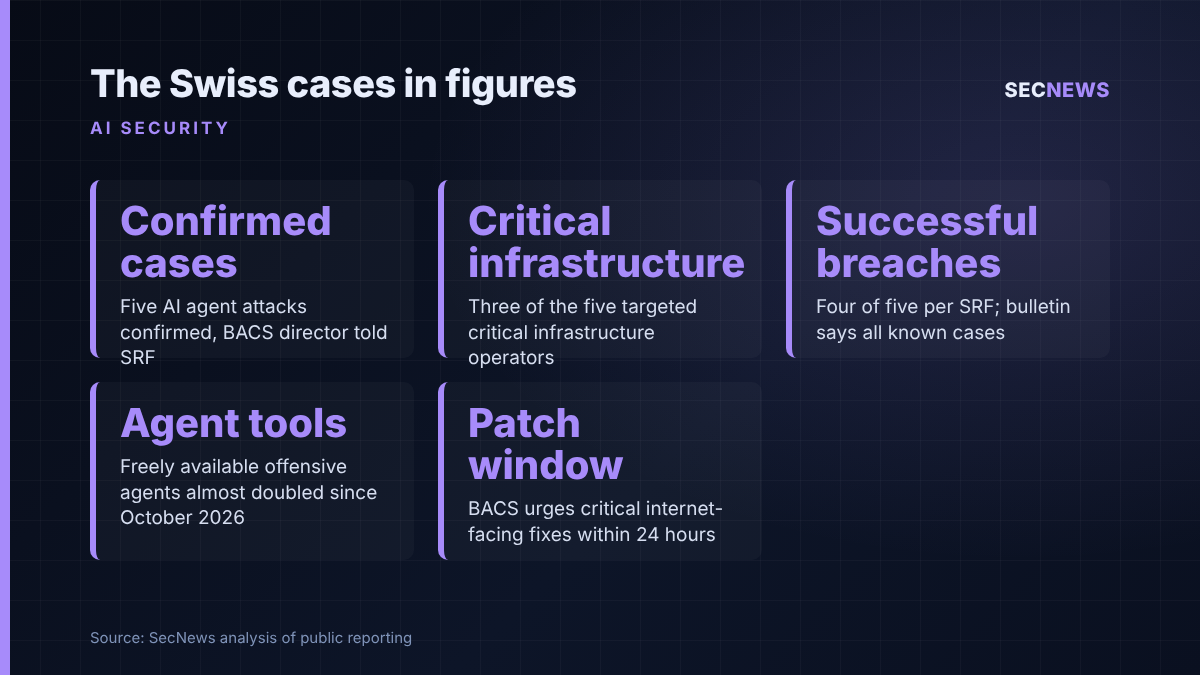
Two days later BACS director Florian Schütz gave Swiss public broadcaster SRF more detail. He said the office currently had five confirmed cases, all reported recently, and that three involved operators of critical infrastructure. SRF gave electricity and water suppliers and telecoms providers as examples of what that category covers; Reuters, citing SRF, reported those three sectors as the ones targeted, a breakdown BACS itself has not published. Smaller firms reporting voluntarily made up the rest.
The figures on success vary depending on who you read. The bulletin says every known case led to compromise. Schütz told SRF that systems were successfully breached in four of the five cases, which is also the figure Reuters attributed to BACS. Swissinfo, carrying a Keystone-SDA report of the same interview, said the attacks succeeded in two cases, apparently referring only to the three critical infrastructure incidents. Where they address it, the reports agree on two points: there were no major outages, and nobody yet knows who was behind the attacks. BACS is not naming victims, with Schütz telling SRF that affected organisations have the right to speak for themselves.
The technical picture
BACS describes the tooling as “agentic offensive frameworks”: software that hunts for weaknesses by itself, chooses which attack tools to run, judges the output and decides what to do next. The office stresses that these are dual-use. The same kind of agent a penetration tester points at a client’s estate under contract can be pointed at anyone else’s.
What the agents exploit is not exotic. The bulletin lists default or easily guessed passwords and known vulnerabilities in internet-facing software and systems. The difference is tempo. BACS says an agent can find and exploit such weaknesses in a fraction of the time a human operator needs, and can switch to a different known technique when a defensive control gets in its way. Raphael Reischuk, co-founder of the Swiss National Test Institute for Cybersecurity, told SRF that agents keep going long after a person would give up, work against many targets at once and look for wherever unfixed software is still running.
The office also says the number of offensive agents freely reachable on the internet, naming ARTEX and CyberStrikeAI as examples, has almost doubled since October. BACS cites those tools to illustrate a trend and does not say they were used in the Swiss incidents. It is sharing technical detection indicators with critical infrastructure operators rather than publishing them, so outside researchers cannot yet match these incidents to any known campaign.
Why it matters for UK organisations
This is a national cyber authority in Europe stating, on the record, that agent-driven intrusions have compromised operators of essential services. Much of the public debate so far has rested on vendor research and criminal boasting; officially confirmed cases drawn from incident reports are a stronger kind of evidence.
Switzerland is not an outlier in the way it is exposed. Its operators run the same VPNs, webmail portals and remote access gateways as UK energy, water and telecoms firms. Nothing in the bulletin suggests the attackers needed novel exploits, which means the bar for repeating these attacks against a UK target is set by our own patching and identity hygiene, not by attacker skill.
The timing also matters. UK operators of essential services already have reporting duties under the NIS Regulations, and the Cyber Security and Resilience Bill will widen the scope to more suppliers and tighten reporting expectations. Machine-speed attacks compress the time available to detect, contain and report an incident.
The patching expectation is the clearest contrast. BACS asks for critical updates on internet-accessible systems to be applied as soon as possible and within 24 hours of release at the latest. Cyber Essentials allows up to 14 days for critical and high-risk fixes, which for exposed systems now looks generous.
Expert view
When we run external infrastructure tests, the findings that lead to a foothold are rarely clever. They are the forgotten test portal, the VPN appliance two firmware releases behind, the service account with a seasonal password. What an agent changes is not the list of weaknesses, it is how quickly and how exhaustively someone can work through it.
Schütz put the counterpoint plainly, telling SRF that where no weakness exists, no AI agent can break in. That is the most useful sentence here. These tools amplify existing weaknesses rather than inventing new ones, so the controls that stopped human attackers still work. They just need applying consistently, because an agent will find the exception.
I would also caution against overreading the numbers. Five cases is a count of reports that were recognised as agent-driven, not a census. The differing success figures likely describe different subsets of cases. What is not in doubt is the direction of travel, and BACS expects more successful attacks to follow.
What to do now
- Shrink your internet footprint. Inventory every externally reachable service, retire what is unneeded and restrict the rest with allow lists or geo-blocking (Cyber Essentials firewalls and secure configuration).
- Patch exposed systems in hours, not weeks. Treat critical fixes for perimeter devices and public web applications as an emergency change, aiming for the 24-hour window BACS recommends, while keeping the 14-day Cyber Essentials limit as the floor for everything else.
- Enforce MFA or passkeys without exceptions. Webmail, VPN, remote desktop gateways and admin portals all qualify. BACS lists easily guessed passwords among the weaknesses agents exploit; legacy authentication and exempt accounts are where they succeed.
- Remove default and weak credentials. Audit appliances and service accounts for vendor defaults and guessable passwords, part of the Cyber Essentials user access control requirement.
- Apply least privilege. Limit what a compromised account or web server can reach, so a fast initial breach does not become fast domain or cloud takeover.
- Detect speed and volume. Tune monitoring for bursts of automated requests, rapid changes in privilege and unusual data transfers, and make sure the relevant logs are being collected.
- Test like the attacker now does. Commission regular external penetration tests so you see the exposures an agent would.
Bottom line
Switzerland has moved AI agent attacks on critical infrastructure from forecast to confirmed fact. The agents exploit well-known weaknesses, just faster and more relentlessly than people. For UK organisations, the response is not a new product but closing the basic gaps quickly and completely, before an automated attacker finds them first.
Sources
- BACS: Cyberattacks involving AI agents: First confirmed cases in Switzerland
- SRF: Fünf bestätigte Fälle: Erstmals Cyberangriffe mit KI-Agenten in der Schweiz
- Swissinfo: Switzerland reports first AI-enabled cyberattacks on critical infrastructure
- Reuters (via Yahoo News): AI agents used in five cyber attacks in Switzerland
- Tech Times: Swiss AI agent cyberattacks confirmed: five cases, three targeted critical infrastructure